
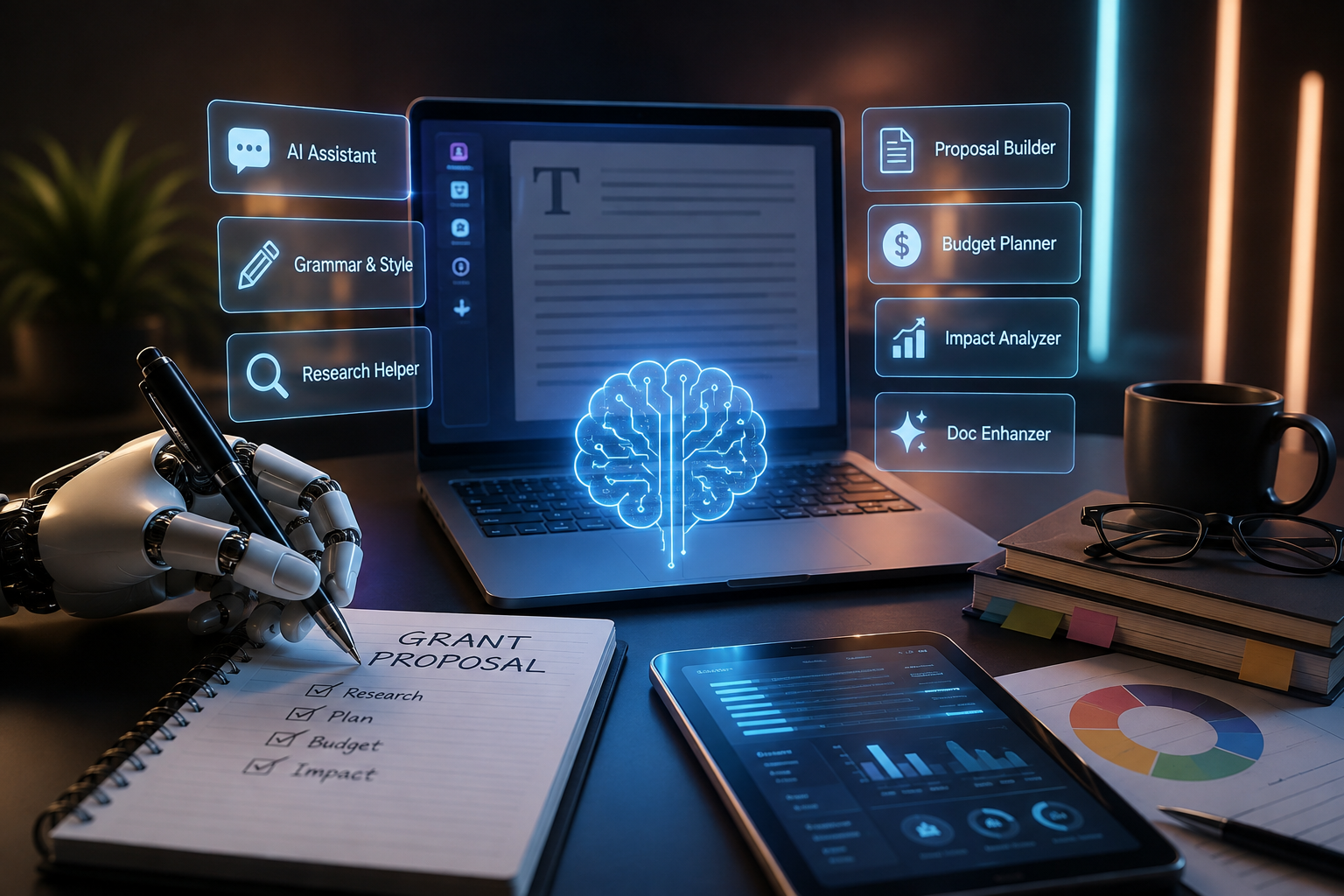
Every grant writer knows the feeling of staring at a blank proposal template at midnight. That’s exactly why so many nonprofits and small teams are turning to ai tools for grant writing to speed up research, tighten their language, and hit tight submission deadlines.
These platforms don’t replace the human judgment a strong application needs, but they do handle the repetitive parts — draft outlines, budget narratives, and funder research — so writers can focus on strategy. I’ve watched small teams cut drafting time in half using the right writing assistants. Here’s a closer look at what ai tools for grant writing genuinely handle well, and the parts of the process no software has cracked yet.
What Is AI Tools for Grant Writing?
At its core, this phrase describes software built to help nonprofits, researchers, and small organizations draft, edit, and manage grant proposals faster. Think of it as a research assistant crossed with an editor — one that never sleeps and never gets tired of formatting budget tables.
Most platforms in this category use large language models trained on writing patterns, funder guidelines, and proposal structures. Some focus narrowly on drafting text. Others handle deadline tracking, funder matching, or compliance checks against a specific grant’s requirements.
I’d describe the honest version of ai tools for grant writing as “helpful drafting software,” not magic. It won’t invent your organization’s mission or impact data. It just helps you say it clearly and quickly.
It also helps to understand what this category isn’t. It isn’t a shortcut around research, and it isn’t a way to skip knowing your own program inside and out. The best ai tools for grant writing work alongside someone who already understands the funder and the mission — they speed up execution, not judgment.
In practice, someone at the organization still has to sit with every draft and ask whether it sounds like their program, matches what really happened, and holds up under a skeptical reviewer’s eye.
Why It Matters
Grant writing eats time. A single federal application can take 40 to 80 hours to prepare properly, and most nonprofit staff already wear five other hats. That’s the real reason interest in this space keeps climbing.
A three-person nonprofit rarely has the luxury of a dedicated grants department, and that gap is exactly where bigger, better-staffed organizations tend to pull ahead.
There’s also a funding-side shift worth noting. Some foundations have started asking applicants directly whether AI assisted their submission — not to penalize it, but to understand how proposals are built. Transparency here matters more than people initially assumed.
And frankly, burnout is real in this field. Reducing the grind of formatting and reformatting the same narrative for five different funders keeps good writers from quitting the job entirely.
This is exactly the gap that ai tools for grant writing were built to close. When one person is responsible for research, drafting, budgeting, and compliance all at once, even a modest amount of automated support changes what’s realistically possible in a week.
Types and Features
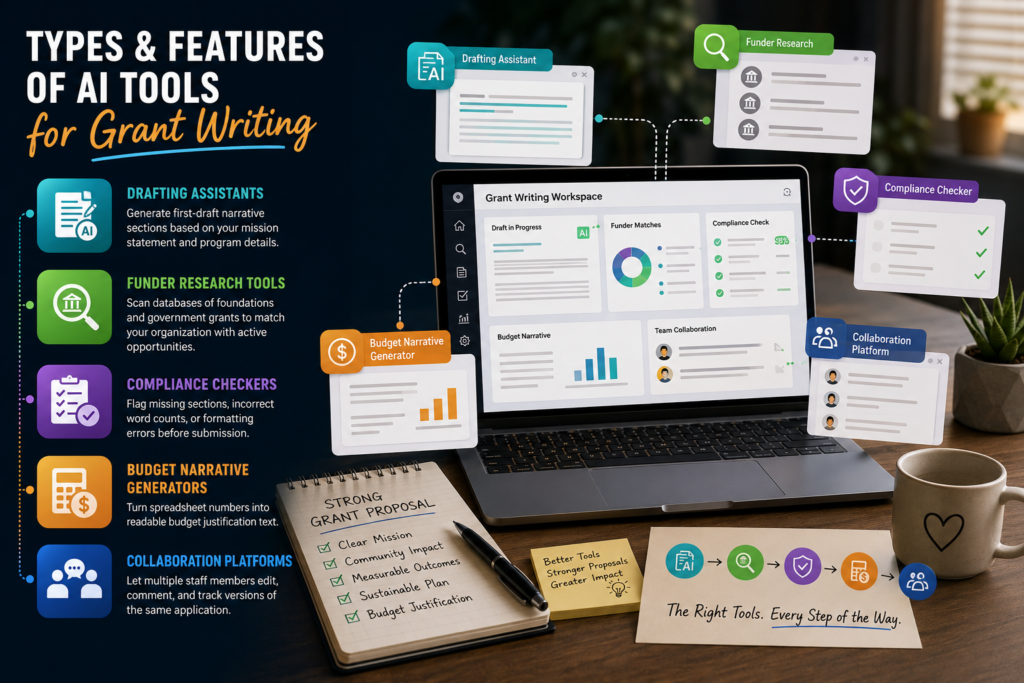
These tools split into a few distinct categories, and mixing them up is where a lot of first-time buyers waste money:
- Drafting assistants — generate first-draft narrative sections based on your mission statement and program details.
- Funder research tools — scan databases of foundations and government grants to match your organization with active opportunities.
- Compliance checkers — flag missing sections, incorrect word counts, or formatting errors before submission.
- Budget narrative generators — turn spreadsheet numbers into readable budget justification text.
- Collaboration platforms — let multiple staff members edit, comment, and track versions of the same application.
Some of the more capable options combine several of these features into one dashboard, while lighter tools focus on just one job and do it well. I generally prefer the narrower tools — they tend to produce cleaner output than the do-everything platforms.
When people search for ai tools for grant writing, they’re usually picturing the drafting assistants first. But the research and compliance categories often deliver more day-to-day value, especially for teams juggling several applications at once with limited staff.
It’s worth testing a few different ai tools for grant writing before settling on one. Pricing models vary a lot — some charge per document, others per seat — and what works for a solo consultant rarely fits a five-person development team.
Benefits
The clearest benefit of ai tools for grant writing is speed. What once took a week of drafting can often shrink to a day or two, especially for boilerplate sections like organizational background or staff bios.
Voice and tone stop drifting too. When five people write five sections of the same proposal, terminology tends to wander otherwise. A shared drafting tool keeps language aligned without a heavy editing pass at the end.
Smaller teams gain the most, honestly. A one-person development office suddenly has something resembling research support and a first-pass editor, without hiring anyone new.
There’s a research angle as well. Good funder-matching tools surface opportunities a busy program director would never have found by searching manually. That alone can open doors to new revenue streams for a small nonprofit.
Budgets rarely stretch as far as people assume. Hiring a full-time grant writer can run well past $60,000 a year in many regions, while a subscription to one of the better ai tools for grant writing often costs a fraction of that. It’s not a replacement for expertise, but it stretches a tight budget further.
Overall, the biggest win from ai tools for grant writing isn’t any single feature — it’s the compounding effect of saving small chunks of time across research, drafting, and formatting on every single application a team submits.
Real Examples
Picture a rural literacy nonprofit with a staff of three. Their only grant writer left in March, and a federal deadline sat six weeks out. Rather than scrambling, the executive director turned to one of the more affordable ai tools for grant writing to build a rough outline from last year’s approved proposal, then spent her limited hours rewriting the impact section by hand. The application went out on time — not perfect, but complete.
Or consider a university research lab applying for a multi-year science grant. The postdoc managing the application used a compliance checker to catch that the budget narrative was 400 words over the funder’s stated limit — a mistake that would have triggered an automatic rejection under that agency’s rules.
A mid-size arts organization I’ve heard about used a funder-matching tool to discover a regional foundation they’d never applied to before. It turned into a three-year funding relationship worth pursuing seriously.
These aren’t universal outcomes. But they show the realistic middle ground: faster drafts, fewer clerical mistakes, and occasionally, a new lead worth chasing.
One more scenario worth mentioning: a small environmental group applying for its very first federal grant used a compliance-focused tool purely to double-check formatting against the agency’s 80-page application guide. That single pass caught three formatting errors a first-time applicant would likely have missed, any one of which could have led to disqualification before a reviewer even read the narrative.
Tips for Getting Better Results
Feed the tool real detail, not vague prompts. The more specific your input — actual program outcomes, real numbers, direct quotes from participants — the less generic the output reads.
Always rewrite the opening paragraph yourself. A reviewer’s eyes land there first, and a stiff, templated opening can undercut an application that’s genuinely strong everywhere else.
Pull up the actual budget spreadsheet and check every figure the tool writes into the narrative line by line — rounding errors and misread columns slip through more often than you’d expect.
Keep a swipe file of your organization’s strongest language — mission statements, outcome data, testimonials — and paste that directly into your prompts. It grounds the output in something real instead of generic nonprofit language.
Don’t skip the compliance check step, even on a rushed deadline. That one pass catches formatting errors that reviewers use as an easy reason to disqualify an application.
Whichever ai tools for grant writing you choose, treat the first output as a rough draft, not a finished section. The strongest results I’ve seen always came from at least two rounds of human revision after the initial draft.
Common Mistakes to Avoid
Program officers read dozens of applications a season, and a flat, filler-heavy paragraph from ai tools for grant writing stands out to them almost instantly — not in a good way.
Formatting rules trip people up constantly. A tool trained on general writing patterns won’t automatically know that one foundation caps executive summaries at 250 words while another wants 500.
Ignoring your organization’s actual voice is a quieter mistake. Language that sounds fine in isolation can feel oddly detached from years of program history if you’re not careful to weave in real details.
Relying on one tool for everything also tends to backfire. Drafting software, research tools, and compliance checkers each do one job better than a single all-in-one platform usually manages.
Finally, treating every ai tool for grant writing as interchangeable is a mistake. A tool built for university research grants won’t necessarily handle a small arts nonprofit’s community program narrative well — the training data and templates behind each product differ more than most marketing pages admit.
FAQs
Can these tools write an entire grant proposal on their own?
No. AI tools for grant writing draft sections and catch errors, but funders can spot generic writing, so human editing stays essential.
Are AI-assisted proposals against the rules for most funders?
Rules vary widely. Some ask for disclosure; most don’t ban assistance outright. Always check the specific funder’s guidelines before using any ai tool for grant writing.
Do smaller nonprofits actually benefit more than large ones?
Generally yes, since smaller teams often lack dedicated grant staff and gain the most from research and drafting support that ai tools for grant writing provide.
How much time do these tools realistically save?
A drafting cut of 30-50% is a common figure people land on once ai tools for grant writing become part of the routine, though editing and strategy work still eat up real hours.
Final Thoughts
If there’s one honest takeaway here, it’s that ai tools for grant writing are assistants, not replacements. The strongest applications still come from people who understand their program, their community, and their funder’s priorities — software just clears away some of the repetitive work standing between that knowledge and a finished draft.
I’d recommend starting small. Pick one narrow tool — a drafting assistant or a compliance checker — and use it on a single proposal before building it into your whole workflow. That way you’ll learn its blind spots before a real deadline is riding on it.
The nonprofit sector runs on limited staff time, and that’s not changing anytime soon. Tools that give back even a few hours a week, without sacrificing the authentic voice a funder expects, are worth testing. Just don’t expect software to understand your mission the way your own team does — that part still takes a person.
For a nonprofit trying this for the first time, the safest bet is folding new software into whatever review process already exists rather than letting it replace that process entirely. Read the output critically, keep your own facts straight, and treat every draft as a starting point rather than a finished product. That mindset, more than any specific platform, is what actually makes proposals stronger over time.
According to the Chronicle of Philanthropy’s reporting on AI-assisted grants, one nonprofit leader compares these tools to an intern — useful for a first pass, but still needing a careful review before anything goes out the door. And Candid’s own analysis of AI use at nonprofits makes a similar point: the tools work well only when someone on staff who actually knows the programs checks the output before it’s submitted.

An IT career coach with 7 years of experience helping beginners map out certification paths that actually lead to interviews, not just another resume line. He’s guided dozens of career-switchers through their first AWS or CompTIA exam and writes for itechnova.io, covering IT certifications, cybersecurity, and the software tools people actually need to know.