

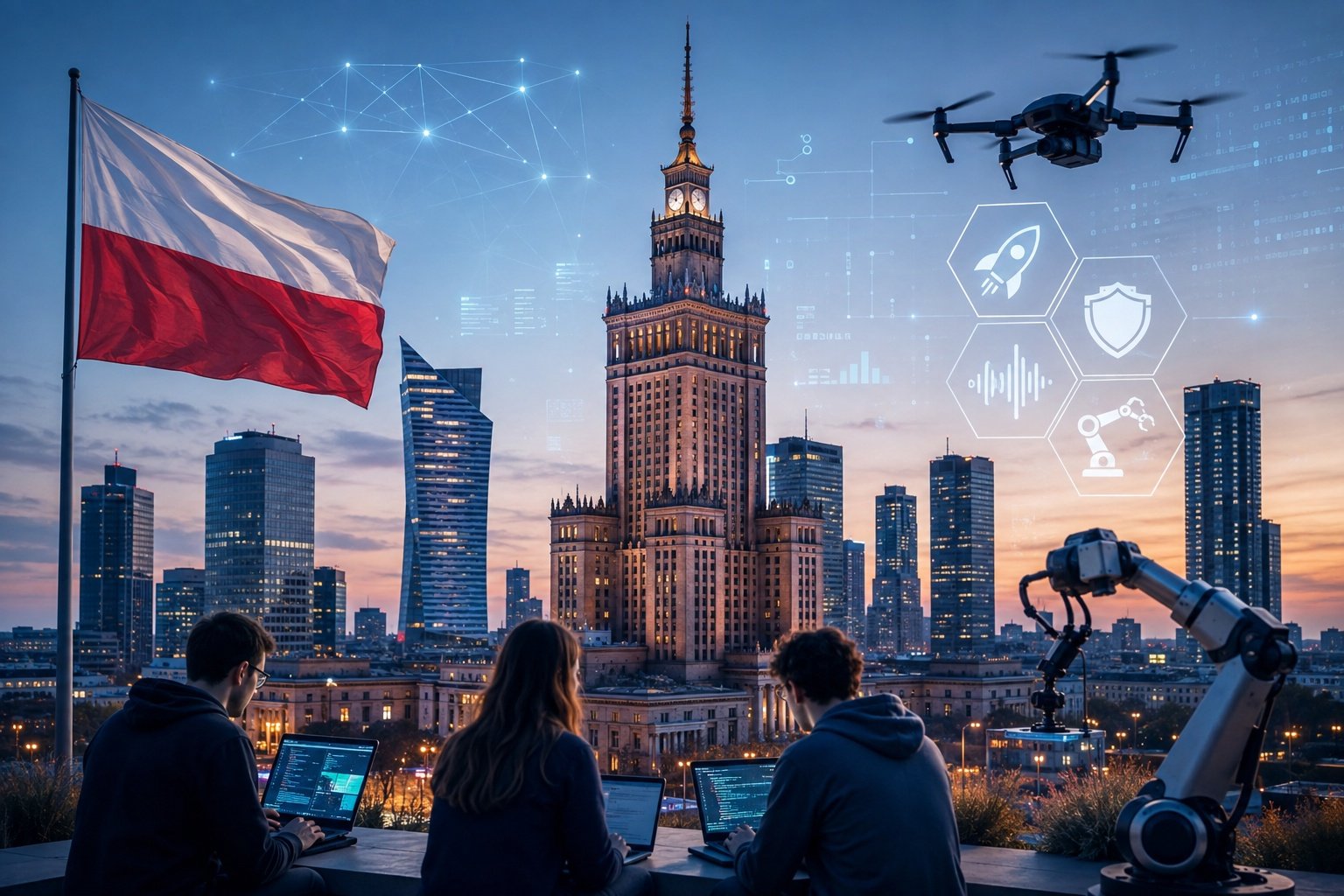
Poland tech news doesn’t usually crack international chatter, but 2026 flipped that script fast. Investors who used to skip this region entirely are suddenly writing checks into Warsaw, Kraków, and Wrocław, and the pace caught even local founders off guard.
For readers who want a global roundup coverage page alongside this story, it’s worth seeing how Poland’s momentum lines up against other markets making noise right now. If you’ve been half-watching Poland tech news from the sidelines, wondering whether any of it means something real, here’s the short version: it does. Companies working on spacetech, defense robotics, and voice AI are pulling in the biggest attention right now. This isn’t a hype cycle dressed up as Poland tech news — it’s a market quietly rewriting its own reputation, one round at a time.
Warsaw Didn’t Wait Around

Here’s the thing nobody tells you about Warsaw’s startup scene: it never asked for permission to grow up. While other capitals branded themselves as “the next Silicon Valley,” Polish founders just kept shipping.
DocPlanner did it. Booksy did it. ElevenLabs, built by Polish engineers, did it on a scale that made global headlines. None of them waited for a hype wave to arrive first — they built the wave themselves.
That same pattern is what’s fueling this current run of Poland tech news. Founders here treat cash discipline like a house rule, not a nice-to-have. It shows in how far a small round can stretch.
Poland Tech News Funding Jump
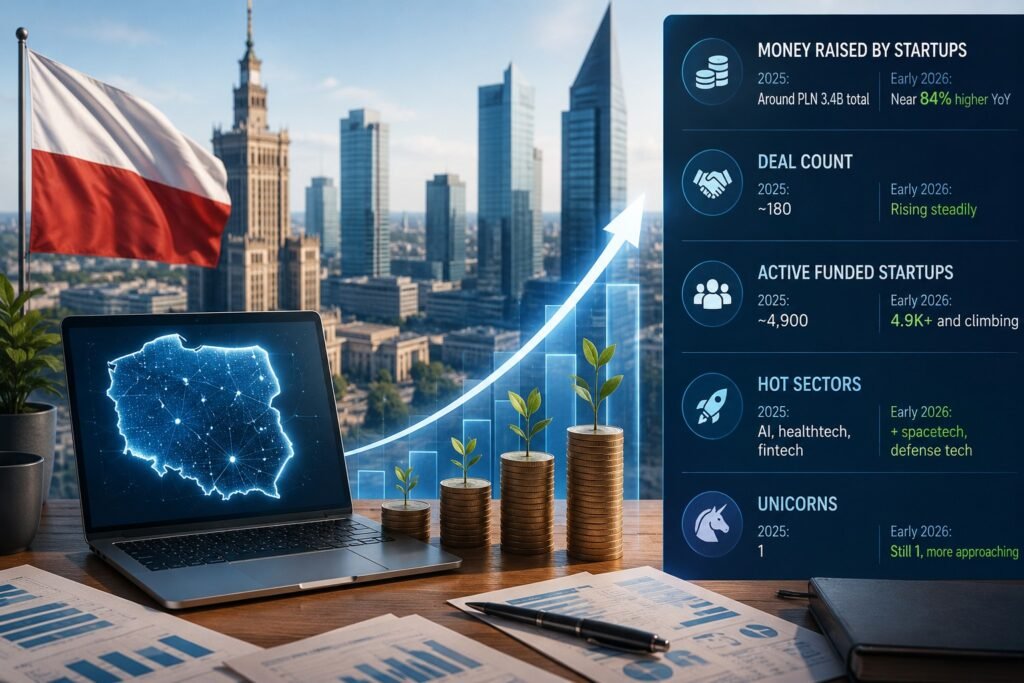
Numbers first, because they’re genuinely hard to ignore. Roughly 180 deals closed in Poland through 2025, adding up to something in the ballpark of PLN 3.4 billion. Analysts now expect domestic venture activity to climb further into 2026, helped along by foreign funds finally showing up with checkbooks.
The opening stretch of 2026 alone brought investment levels up nearly 84% compared to the same window a year earlier. Not a rounding error. Not a one-off headline either — a market that’s genuinely picking up speed while most outsiders were still asking “wait, Poland?”
| Metric | 2025 | Early 2026 |
| Money raised by startups | Around PLN 3.4B total | Sharp climb, near 84% higher YoY |
| Deal count | ~180 | Rising steadily |
| Active funded startups | ~4,900 | 4.9K+ and climbing |
| Hot sectors | AI, healthtech, fintech | + spacetech, defense tech |
| Unicorns | 1 | Still 1, more approaching |
Quick honesty check on this table: growth percentages look dramatic on paper, but they’re sitting on a small base compared to Berlin or London. Impressive, still — just don’t let the percentage alone do the talking.
Startups Actually Turning Heads
A handful of names keep coming up in every serious conversation about this market, and there’s a reason for that. One spacetech company here pulled in over €8 million to expand a network of optical sensors tracking objects in orbit — rare, ambitious deeptech for a region better known for outsourcing work.
Paymove closed a €2.12 million seed round to build payment rails for agentic AI, a category that barely existed twelve months ago. Infermedica, out of Wrocław, keeps growing its AI symptom-checking tools now used by insurers well beyond Poland’s borders.
A Warsaw-based voice tech startup founded in 2023 is building real-time speech-to-speech infrastructure for programmable voice — the kind of ambitious product that used to only show up in San Francisco pitch decks. For a broader look at who’s backing these founders, Sifted’s Polish founder coverage is worth the read.
Talent Spread Beyond Warsaw
Warsaw gets the headlines, sure, but it’s not carrying this alone. Kraków has quietly turned into a deeptech and gaming stronghold. Wrocław keeps pulling in defense and robotics talent at a rate that’s caught even seasoned investors off guard.
Gdańsk, Poznań, Łódź, and Bydgoszcz round out the picture with specialized skill pools that rarely get enough credit. There’s even a technology park reportedly going up near Wrocław, backed by Taiwanese investors — not a rumor, an actual project moving forward.
Honestly, this spread-out talent base might be the most underrated part of the whole story. Everyone fixates on Warsaw. The real depth sits across six or seven cities most outsiders couldn’t place on a map.
Why Investors Finally Noticed
Investors don’t move on vibes, not the sharp ones anyway. What actually pulled their attention toward Poland was a run of scale-ups and exits proving this wasn’t a one-year fluke. For the fuller founder-by-founder picture, EU-Startups’ Poland deep-dive lays out exactly which companies are driving that shift.
Google runs one of its few physical startup campuses anywhere in the world right here in Warsaw — that alone says something. AIP, the country’s largest academic incubator network, keeps feeding fresh founders into the pipeline year after year.
Government Money Enters Frame

Institutional backing used to be the missing piece, and that’s shifting too. A European fund and a state-backed Polish bank recently committed €30 million toward a new venture vehicle run by a local firm, aimed squarely at early-stage tech companies.
Roughly 40% of a larger state technology fund is set to be allocated by the close of 2026. That’s a real institutional bet, not a symbolic line in a press release.
A separate national development program is doing similar work, pushing liquidity into an ecosystem that used to run mostly on founder savings and family money.
What Founders Get Right
Spend a few days around Warsaw or Kraków founders and one thing becomes obvious fast — they’d rather have working software than a good pitch deck. There’s something almost stubborn about how little they care for hype before the product actually works.
There’s less startup theater here than in other European hubs. Fewer flashy launch parties, more actual customers paying actual invoices. That discipline is exactly what turns skeptical investors into repeat backers.
For readers who want a broader tech coverage lineup beyond just Poland, it’s worth seeing how this story stacks up against other regional booms making the rounds this year.
Risks Hiding Behind Headlines

Not everything here is smooth sailing, and pretending otherwise would be dishonest. One founder-advocacy group has publicly distanced itself from big tech funding to guard its independence — and now needs roughly PLN 1 million a year just to keep functioning fully.
That’s a small but telling crack. If ecosystem support groups struggle for funding during an actual boom, it says something about how fragile institutional memory still is here.
Foreign capital is fickle by nature too. A cooling global VC market could hit a growing-but-still-modest ecosystem like Poland’s harder than it would hit somewhere like London or Berlin.
Reading Poland Tech News Right
So how should you actually read all this Poland tech news noise without getting swept up in it? Treat the funding figures as directional, not gospel — growth percentages on a small base always look flashier than they really are.
Watch the government-backed funds closely over the coming year. If those institutions follow through on what they’ve promised, that’s the real signal — not another glossy “startups to watch” listicle.
For daily coverage that goes beyond just Poland, this worldwide tech story feed tracks similar momentum across other emerging markets.
And if you’re curious how today’s fast-moving startup infrastructure connects back to earlier internet-building breakthrough moments, that history explains a lot about why speed matters so much to founders working here now.
Common Questions, Quick Answers
Is Poland actually becoming a serious tech hub, or is this overstated?
Growth is genuine, though still smaller in scale than Western Europe’s biggest hubs. The trajectory matters more than the current size right now.
Which Polish cities matter most for tech right now?
Warsaw still leads the pack, but Kraków has become a deeptech magnet, Wrocław is pulling defense talent, and Gdańsk brings its own engineering strengths to the mix.
What sectors are pulling the most funding in 2026?
Investor money is concentrating around artificial intelligence, fintech, health platforms, spacetech, and defense-linked robotics more than anywhere else this year.
Is government funding actually helping Polish startups?
Yes — state-backed and EU-linked funds are injecting real early-stage capital, with more institutional commitments planned through the rest of 2026.
Are international investors genuinely interested in Poland?
Recent data shows funding growth here outpacing the wider European average by a wide margin, so yes, attention is climbing fast.
What’s the biggest risk facing this ecosystem?
Fragile institutional support and heavy dependence on global VC sentiment remain real concerns, even with strong momentum right now.
Does Poland have any unicorns yet?
Just one so far, though a few fast-scaling companies sit close enough to that valuation tier to watch closely.
Where can I follow ongoing Poland tech news updates?
Regional startup trackers, funding databases, and dedicated European tech outlets all publish regular, credible coverage of this market.
Final Thoughts
Poland tech news stopped being a niche interest sometime in the last year and a half, whether the wider world noticed or not. What started as scattered founder success stories has turned into something closer to a genuine pattern — funding, institutional backing, and international attention all pointing the same direction at once.
None of this came together by chance, either. It took years of founders quietly choosing steady growth over flashy launches, building technical teams across several cities instead of just one capital, long before any investor showed up asking questions. That patient groundwork is precisely why this run feels sturdier than the average regional hype spike that fades after a strong quarter.
That said, a little grounding helps here too. Poland is still a smaller player next to the major Western European tech capitals, and the government funding pledges — encouraging as they sound — need to actually land before anyone calls this ecosystem fully grown. Watching founder-support groups struggle for basic funding, even mid-boom, is a fair reminder that momentum and institutional stability don’t always arrive on the same timeline.
What does feel genuinely different this time is the mix of signals arriving together — sharp early-2026 funding growth, serious institutional money entering the picture, deeptech and defense startups pulling international checks, and talent spreading well beyond Warsaw into cities that rarely got credit before. That combination is harder to wave off as a fluke.
For anyone tracking European startup ecosystems, Poland tech news is worth watching closely through the rest of 2026. Not because the current pace is guaranteed to hold, but because the fundamentals underneath it look sturdier than most regional booms tend to be. Cash discipline, technical depth, and international ambition rarely line up all at once — and right now, Poland has all three working in its favor.

An IT career coach with 7 years of experience helping beginners map out certification paths that actually lead to interviews, not just another resume line. He’s guided dozens of career-switchers through their first AWS or CompTIA exam and writes for itechnova.io, covering IT certifications, cybersecurity, and the software tools people actually need to know.