


Somebody asked me last month if a comptia tech certification was “basically a cheat code” into IT. I laughed, mostly because I remember thinking the exact same thing back when I was staring at my first A+ study guide, coffee going cold next to me, wondering if I’d wasted $250 on a voucher I might fail. Spoiler: I almost did fail it. Passed by nine points.
So no, it’s not a cheat code. But it’s also not nothing. A comptia tech certification is one of the few credentials in this industry that actually opens doors without demanding four years and a mountain of student debt first. I’ve seen people go from stocking shelves to answering help desk tickets in five months flat. I’ve also seen people rack up three certs and still get ghosted by recruiters because their resume read like a list of acronyms with nothing behind it.
This guide is going to be blunt about both sides. What comptia tech certs actually cost right now, which one you should chase first, how the studying really goes (badly, at first, for most people), and where this whole path quietly falls apart if you’re not careful. No fluff, no “just believe in yourself” nonsense — just what I’ve watched work and what I’ve watched fail.
So What Even Is CompTIA?
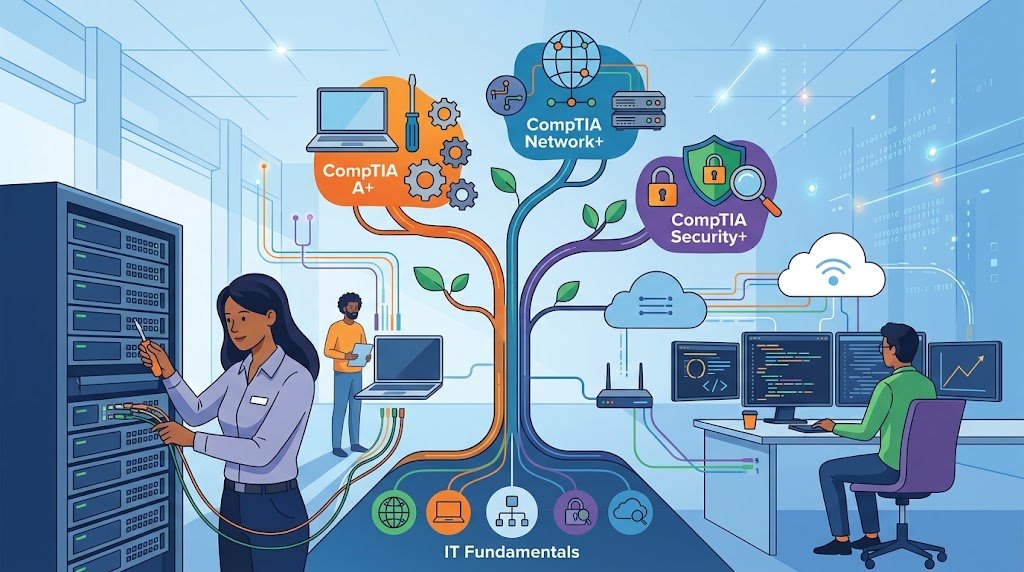
CompTIA — short for Computing Technology Industry Association — has been handing out vendor-neutral IT certs since the late 80s. Vendor-neutral is the part that matters here. You’re not learning “how to fix a Dell” or “how to configure a Cisco router specifically.” You’re learning the underlying concepts that show up no matter whose hardware you’re staring at on a Tuesday afternoon.
That neutrality is exactly why comptia tech certifications are such a common starting point. You don’t have to pick a lane before you even know what the lanes look like. A+ handles hardware and troubleshooting. Network+ handles, well, networks. Security+ gets you into cybersecurity basics. Most people climb this in that order, though plenty skip around depending on where they’re headed.
If the acronyms alone are making your head spin and you’re not even sure A+ is where you should start, there’s a gentler breakdown of options over at beginner certification paths that’s worth a skim before spending a dime.
Which Cert Actually Fits Where You’re At
Not every comptia tech certification is built for a beginner, and I think a lot of guides gloss over this. Some assume you’ve already got a year or two under your belt. Here’s roughly how they shake out:
| Certification | Who It’s For | Difficulty | Study Time (Realistic) |
| ITF+ | Complete beginners, career switchers | Easy | 2-4 weeks |
| A+ | First IT job, no experience | Moderate | 6-10 weeks |
| Network+ | Networking or sysadmin track | Moderate-Hard | 6-8 weeks |
| Security+ | Cybersecurity-bound folks | Hard | 8-12 weeks |
| CySA+ | Analysts with some field time already | Hard | 10-14 weeks |
| PenTest+ | Offensive security hopefuls | Hard | 10-14 weeks |
| Cloud+ | Cloud infrastructure roles | Hard | 8-10 weeks |
| Project+ | IT project management, not hands-on fixing | Moderate | 4-6 weeks |
A+ is still, in my opinion, the default starting point for anyone with zero background. It’s recognizable. Hiring managers see it and nod, even outside of pure-tech companies. If you’ve already been messing with hardware on your own — building a gaming PC, untangling your parents’ router problems, that sort of thing — you might genuinely skip to Network+ and save yourself some time.
And if security’s the goal from day one, Security+ tends to show up by name in job postings more than any other comptia tech credential I’ve seen. Partly because of DoD 8570 requirements that basically mandate it for certain government-adjacent positions.
The Money Side (Because Nobody Likes Guessing)

Let’s just get into numbers, since half the guides out there dance around this. At time of writing, a single exam voucher runs somewhere between $250 and $404, with Security+ sitting near the top of that range. And that’s before you buy a single study guide.
Rough breakdown if you’re doing the full A+ through Security+ ladder:
A+ (both parts) lands around 500-550. Network+ runs about $358. Security+ comes in near $404. Study materials swing wildly — anywhere from free YouTube content to $500+ if you go all-in on CertMaster bundles.
Add it up and you’re looking at somewhere between $900 and $2,000 total, assuming you’re not cutting corners on prep. Still dramatically cheaper than a degree, which is honestly the whole pitch of the comptia tech route for most people considering it.
One thing that trips people up: failed exams don’t come with free retakes in most cases. You pay again. I know a guy who bombed Security+ by twelve points, bought another exam voucher, waited two extra weeks, and passed comfortably the second time. Would’ve saved himself $400 if he’d just waited those two weeks the first time around. Patience is cheaper than pride, apparently.
What Jobs Actually Come From This
Here’s what people really want to know, so let’s not tiptoe around it. A comptia tech certification with zero prior experience realistically gets you interviews — not guaranteed jobs, interviews — for things like help desk technician, desktop support, field service tech, junior network admin if you’ve got Network+, or tier-1 SOC analyst work if Security+ is in your pocket.
None of these are glamorous. Starting pay for a fresh A+ holder in help desk work usually lands somewhere in the high $30Ks to high $40Ks depending on your city. But it’s a real foot in the door, and almost everyone currently working in IT walked through some version of that door at some point.
What surprised me, honestly, was how the cert’s usefulness shifts once you’re past the resume stage. Applicant tracking systems love seeing “CompTIA A+” or “Security+” — it’s a keyword match, plain and simple. But the second you’re actually sitting across from a hiring manager, they stop caring about the certificate itself and start asking things like “walk me through troubleshooting a printer that won’t join the network.” The cert gets you in the room. It doesn’t finish the conversation for you.
If cybersecurity specifically is the target rather than general support, there’s a decent rundown of realistic starting roles at entry-level security positions worth checking before you commit hard to the Security+ track.
Studying Without Wanting to Quit Halfway
Real talk about my own Network+ attempt. I tried cramming with a used study guide from 2019 (bad idea, exam objectives had shifted since then) plus a bunch of scattered forum threads. Failed. Not by a huge margin, but enough to sting and enough to cost me another $358 for the retake.
Second time around I actually bought current materials that matched the live exam objectives, worked through practice tests until I was consistently scoring in the mid-80s, and passed with room to spare three weeks later. The lesson wasn’t “study harder.” It was “study the right thing.” Outdated material gives you false confidence, which is honestly worse than no confidence at all.
CompTIA’s own CertMaster platform has actually improved a lot in recent years — it adapts based on what you’re weak in rather than just throwing generic questions at you. It’s not cheap standing alone, though bundling it with your exam voucher tends to shave off some cost. There’s a solid breakdown of whether it’s worth the price at CertMaster study resources if you’re on the fence like I was before my second Network+ attempt.
Beyond that, a few things separate people who pass on the first real try from people who don’t. Using a current, edition-matched study guide matters more than which specific book you pick. Practice exams until you’re consistently hitting 85%+ before you even book the real test. Building some kind of home lab — even a janky one on old hardware — teaches you things flashcards never will. And finding a study group or Discord server for your specific exam keeps you honest when motivation dips around week four.
Performance-based questions catch a lot of people off guard, by the way. These aren’t multiple choice — you’re actually configuring something in a simulation. If your prep was all flashcards and no hands-on practice, that section will humble you fast.
Comparing Comptia Tech Certs to Degrees and Bootcamps
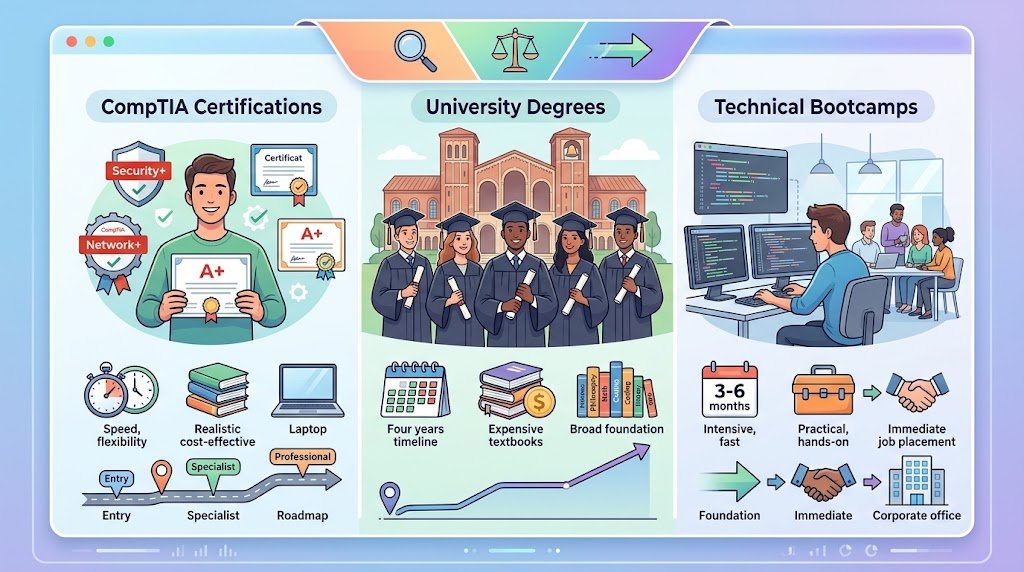
This comes up constantly, so let’s tackle it head-on rather than dodging it. A traditional CS or IT degree runs two to four years and anywhere from $10,000 to well past $100,000 depending on the school. What you get in return is deeper theoretical grounding and, for certain employers, a checkbox that no amount of certifications alone will satisfy.
Some programs actually bundle both. WGU’s cybersecurity degree folds several CompTIA certs directly into the coursework, which is a reasonable middle path if you want the degree and the credentials without paying for them twice.
Google’s Career Certificates have gained traction too, mostly riding on brand recognition. Generally cheaper and faster than a degree, comparable in cost to the comptia tech route, but not quite as universally recognized once you step outside tech-forward companies. Worth comparing directly at Google’s certificate program before picking a lane, since the two paths genuinely suit different people.
Bootcamps sit somewhere awkwardly in between. Faster than a degree, often pricier than the full comptia tech certification stack, and wildly inconsistent in quality — some have real job placement numbers behind them, others are glorified YouTube playlists with a Slack invite attached.
My honest opinion, for what it’s worth: if money’s tight and you need income soon, comptia tech certs are the most cost-effective on-ramp available right now. If you’ve got time and can afford it, pairing certs with a degree that specifically gatekeeps certain roles (government work especially) makes sense long-term.
What the Actual Exam Experience Is Like
These are proctored exams — either at a physical testing center or remotely through online proctoring software. Multiple choice mixed with performance-based simulations, timed, scored on a scale that varies by test (Security+, for instance, passes at 750 out of a possible 900).
Online proctoring is convenient in theory. In practice, I’ve heard from more than a few people whose sessions got flagged or paused because of background noise, a pet wandering into frame, or a desk that wasn’t “clean enough” by the software’s standards. If your household is chaotic (mine was, when I took mine — three roommates and a very vocal cat), book a testing center slot instead. Slightly less convenient, way less stressful.
The questions themselves lean practical rather than academic trivia. You’re not memorizing release dates. You’re being asked things like “what’s the most probable cause of this connectivity issue” or “which port does this protocol default to.” That practical framing is honestly one of the stronger points of the comptia tech certification model — it tests whether you can think like a technician under pressure, not whether you can recite a textbook chapter.
What You Can Realistically Expect to Earn
Numbers here vary a lot by region, but per the U.S. Bureau of Labor Statistics, computer support specialists pulled a median annual wage around $60,730 in their most recent published data, with growth projected faster than the average occupation over the coming decade. You can pull the current figures directly from the BLS occupational outlook rather than trusting secondhand numbers.
That figure’s a national median across every experience level, so someone brand new with a single comptia tech certification and no work history is typically starting well under that. Someone five years in with Security+ and CySA+ stacked is often comfortably above it. For a more detailed breakdown by role and cert combo, realistic pay ranges goes deeper than what the BLS averages show.
Stacking certs helps, but it’s not a straight line. Going from zero to A+ moves the needle more than going from three certs to four ever will. After your second or third year in the field, employers start weighing actual work history heavier than the cert count on your resume.
Where People Trip Themselves Up

A few mistakes keep repeating, enough that I think they deserve calling out directly instead of burying them in a list.
Rushing past the fundamentals straight to Security+ is probably the most common one. It sounds more exciting than “help desk technician,” sure, but without A+ and Network+ groundwork, the Security+ material doesn’t land the same way — and pass rates for people who skip ahead tend to reflect that.
Treating the certification like a finish line rather than a starting gate trips up almost everyone at least once. Passing Security+ doesn’t make you a security analyst overnight. It makes you eligible to be considered for the junior roles where the real learning actually happens. People who expect the cert to hand them a finished career get disillusioned fast, and honestly, a little bitter about it.
Letting a cert quietly expire is another one. Most comptia tech certifications are valid for three years before you need continuing education credits or a retake to keep them active. Easy to forget once you’re settled into a job and not thinking about certification status day to day.
And skipping practical projects entirely while studying — home labs, volunteer IT work for a local nonprofit, helping a small business untangle their network — any of that makes a resume far more compelling than a wall of acronyms alone. The certification gives you vocabulary and baseline knowledge. Projects give you proof you can actually use it.
FAQs
Is CompTIA A+ still worth getting in 2026?
Yes — it’s still the most widely recognized entry point into general IT support, even with newer alternatives competing for attention.
Do I need a college degree if I already have CompTIA certs?
Not necessarily. Plenty of help desk and junior IT roles accept certs instead, though some government and enterprise positions still hold firm on a degree requirement.
How long does the full comptia tech certification path take, realistically?
Going from zero to Security+ usually takes six to twelve months part-time, depending on your background and how consistently you’re able to study each week.
Are these certifications actually hard to pass?
A+ and Network+ are moderate for someone studying consistently; Security+ and beyond demand a deeper conceptual grasp and noticeably more prep time.
Can I land a job with just certs and zero work experience?
Often, yes — especially for entry-level help desk roles — though pairing the cert with even small hands-on projects noticeably improves your odds.
Final Thoughts
If you’re still on the fence about whether the comptia tech path is worth the time and money, here’s where I’ve landed after watching a lot of people go through it, myself included: it works, but only if you treat it as real work rather than a shortcut. Nobody buys a voucher, skims a guide over a weekend, and gets handed a job offer. It just doesn’t happen that way, no matter what some course-seller’s landing page promises.
The cost is genuinely reasonable next to a full degree, especially if you commit to solid study materials instead of gambling on outdated free content you found in some forgotten forum thread. Start with A+ if you’re coming in cold, or jump to Network+ if you’ve already got some hands-on comfort with computers. Work toward Security+ once you’ve got the fundamentals actually solid, not just memorized well enough to pass a practice test. Skipping the earlier steps because they feel less impressive tends to show up later, quietly, in how well you actually perform on the job.
Where I’d push back hardest is on the idea that certifications alone are enough to carry you. Pair whatever comptia tech certification you’re chasing with something tangible — a home lab you built yourself, volunteer support work, even a messy side project that taught you something the exam objectives never covered. Hiring managers have seen plenty of resumes stacked with certs and nothing real behind them. The candidates who actually stand out are the ones who can talk through a problem they genuinely solved, not just recite what a study guide told them to memorize.
If you’re ready to actually start rather than keep researching indefinitely, pick one certification, set yourself a realistic timeline, and commit to it fully. Don’t be the person who “starts studying” for eight months straight and never actually books the exam — I’ve seen that happen more times than I’d like to admit. The comptia tech world rewards people who finish what they start far more than it rewards people who just collect study guides and good intentions. Book the exam once your practice scores are consistently solid, not a day before, and don’t let perfectionism push that date back forever.

An IT career coach with 7 years of experience helping beginners map out certification paths that actually lead to interviews, not just another resume line. He’s guided dozens of career-switchers through their first AWS or CompTIA exam and writes for itechnova.io, covering IT certifications, cybersecurity, and the software tools people actually need to know.