

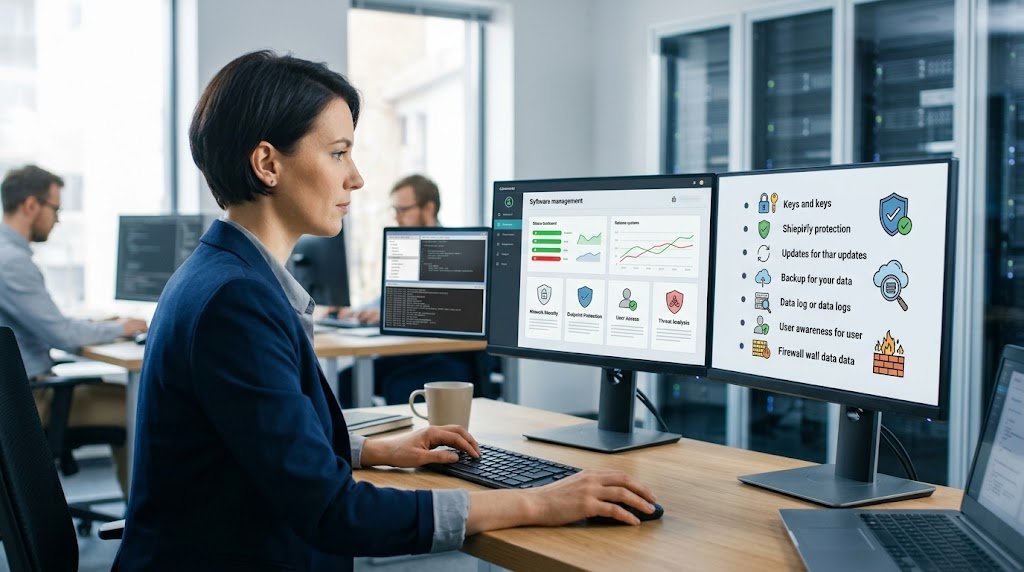
A number first, then I’ll leave it alone. IBM’s 2026 breach research puts the global average cost of a single breach at $4.99 million, a record and 12% up on the year before. Most small outfits will never get a bill like that. Still, it explains why everyone suddenly wants to talk about security tools, and why the talking gets muddled so quickly.
Somebody types “what are cybersecurity software wbsoftwarement” into a search box. Maybe they want a plain list and a price. Maybe an insurer, a client or a nervous boss told them to “get something in place” and nobody explained what that means. If that’s you, this wider software guide on the site makes a decent second tab.
Short version: cybersecurity software is anything that shields your devices, accounts, networks and data from attack, theft or damage. It comes in layers (device protection, firewalls, login tools, email filtering, monitoring, backup), and no single product covers all of them. The odd ending of that search phrase looks like “web” and “software management” smashed together, so I’ve spent time on running this stuff too, not only buying it. That’s the plain-English reply to “what are cybersecurity software wbsoftwarement,” and everything below unpacks it.
So, what are cybersecurity software wbsoftwarement tools, exactly?
Picture a flat in a busy building. There’s a lock on your door. There’s an intercom so you can see who’s buzzing before you let them in. A neighbour who’d notice a stranger hanging about on your landing. And a box of spare keys and photocopied documents at your mum’s place, for the day everything goes wrong.
Security software maps onto that almost one to one. Locks are firewalls and antivirus: they keep things out. The intercom is your login system, passwords and second checks included. The neighbour is monitoring, the software that notices something odd and says so. Mum’s box is your backup.
Vendors like to call their product “complete protection.” Ignore that. Ask which of those four jobs it does well, because it’s usually one, sometimes two, and the rest is brochure.
Also, plenty of security software isn’t “software” in the old sense of a disc you install. It might be a subscription running in the cloud, a browser add-on, or a feature tucked into something you already pay for, like your office suite or your operating system. People overlook that last one constantly and buy a second copy of what they already own.
So when “what are cybersecurity software wbsoftwarement” drags up a wall of brand names, sort them by job before you look at a single logo. Names can wait. So the next time someone asks “what are cybersecurity software wbsoftwarement” and wants one word, tell them: layers.
What are cybersecurity software wbsoftwarement types? The categories at a glance
Here’s the whole map in one table. The tools named are examples, not endorsements. Check each vendor’s own page before you buy anything, since features and prices move around.
| Category | Main job | Example tools | Who needs it most |
| Endpoint protection / EDR | Stops and investigates threats on laptops, phones, servers | Microsoft Defender, CrowdStrike Falcon, SentinelOne | Anyone with devices |
| Firewall / network security | Filters traffic in and out of a network | Palo Alto Networks, Fortinet | Offices, remote-access setups |
| Identity and access | Controls who can log in, and how | Okta, Microsoft Entra ID | Teams with staff or shared accounts |
| Password manager / MFA | Unique logins plus a second check | 1Password, Bitwarden | Everybody, frankly |
| Email security | Blocks phishing, spam, bad attachments | Proofpoint, Mimecast, Microsoft Defender for Office 365 | Every business that uses email |
| SIEM / monitoring | Collects logs, flags suspicious patterns | Splunk, Microsoft Sentinel | Mid-size teams and up |
| Vulnerability scanning | Finds unpatched weaknesses | Tenable Nessus, Qualys | Anyone running servers or apps |
| Backup and recovery | Restores data after loss or ransomware | Veeam, Backblaze | Everybody, again |
A freelancer might need three of those rows. A 200-person company might need all eight. Neither one is doing it wrong. The rest of this piece goes through them in order, though I’ll skip a few pleasantries. If you keep one table from your “what are cybersecurity software wbsoftwarement” research, keep this one.
Endpoint protection, or what lives on your laptop
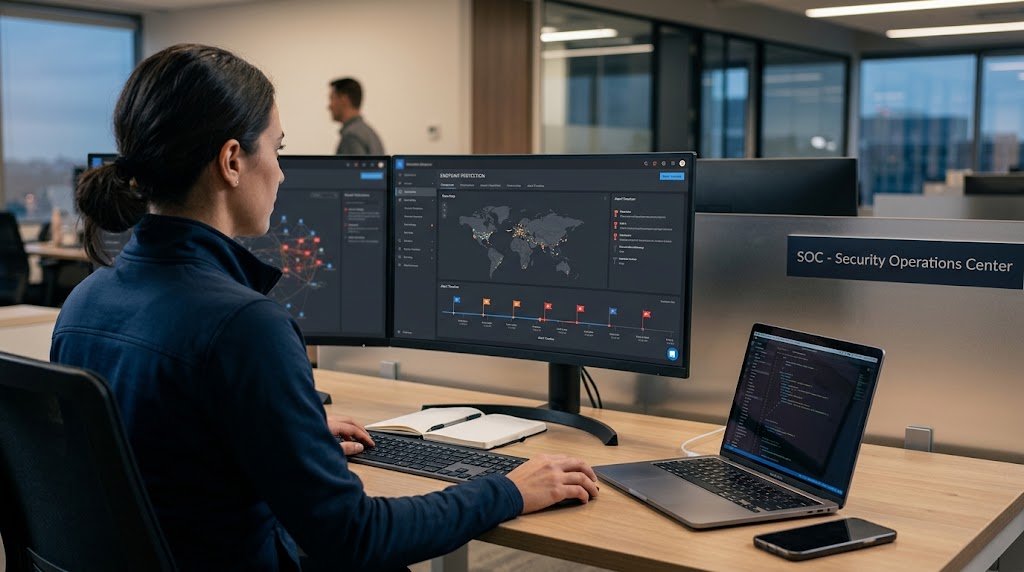
An endpoint is any device a human touches. Laptop, phone, tablet, desktop, server in a cupboard. Endpoint protection is the software installed on those devices, hunting for malicious files and strange behavior.
Old-school antivirus worked from a list of known bad files. If your file matched the list, it got blocked. Newer tools watch what a program does instead, so a document that suddenly starts scrambling hundreds of files gets caught even if nobody has ever seen that exact malware before.
You’ll run into EDR, endpoint detection and response. It keeps a record of what happened on a machine and lets an analyst cut that machine off from the network in one click. When something slips past prevention (and eventually something will), that record is gold.
Do you still need separate antivirus? On Windows, Microsoft Defender Antivirus comes with the system and does a decent job for one person. macOS has its own built-in protections, Gatekeeper and XProtect among them. A household or a solo freelancer can get a long way on those defaults plus sensible habits.
Businesses are a different animal. Once there are staff, remote laptops and shared files, you want central control: one screen showing which devices are covered, which are behind on updates, which just fired an alert. That’s what you’re paying for with the paid platforms.
My view, and I’ll stand by it: the best endpoint tool is whichever one is installed on every single device. A brilliant product on 80% of machines loses to a mediocre one on 100%. For “what are cybersecurity software wbsoftwarement” at the device level, endpoint protection comes first.
Firewalls and network filtering
A firewall decides what traffic gets through. Expected visitors walk in, strangers get turned away, and anything odd gets written down.
Your home router has a basic one. Businesses add stronger versions, as physical boxes or cloud services, that look inside traffic in more detail, block known bad destinations and control which apps can reach the internet.
What’s changed lately is where the “inside” is. Staff work from kitchens, cafes and airports, and most apps sit in the cloud, so the office network isn’t the centre of anything any more. Firewalls now often arrive as cloud services that protect the person rather than the building. You’ll bump into acronyms like SASE and zero-trust network access. Underneath, they all say roughly the same thing: check every connection, and don’t trust a place just because it happens to be “inside.”
For a small team, skip the big appliance that sounds serious. Start with what your router and cloud providers already include, switch on the default protections, and shut any ports you don’t use.
The firewall failure I see described most often isn’t technical at all. Someone opens a rule “just for a day” so a vendor can test something, then forgets. Two years on, that rule is still sitting there, wide open. Go through your rules twice a year and delete the stale ones. It’s free and it removes real risk. In the “what are cybersecurity software wbsoftwarement” picture, firewalls are the quiet layer most people already own without knowing it.
Passwords, MFA and identity
Most attackers don’t smash through anything. They log in, using a credential somebody else already leaked. That’s why identity tools deserve more attention than they usually get.
A password manager makes a long, unique password for every account and remembers it for you, so one leak can’t open ten doors. 1Password and Bitwarden (which has a free personal tier) are easy places to start.
Multi-factor authentication adds a second proof on top: a code from an app, a hardware key, a prompt on your phone. Government guidance treats it as a basic habit, and CISA’s guidance covers it next to other everyday practices for individuals and organisations alike.
For a business you’d also look at identity and access management, which means tools like Okta or Microsoft Entra ID. One sign-in opens many apps, MFA gets enforced for everyone, and when somebody leaves you cut off their access in a single step instead of twenty.
Where you can, pick app-based codes or hardware keys over text messages. SMS codes are easier to intercept. It’s a tiny upgrade with a real payoff.
This category answers a big slice of “what are cybersecurity software wbsoftwarement” for small teams. If you can afford two things this quarter, make them a password manager and MFA on every account that supports it. Nothing else gives you that much protection per dollar, and I’ve yet to hear a convincing argument against it. Identity tools are the cheapest answer to “what are cybersecurity software wbsoftwarement” on a tight budget.
Email is still the front door
Attackers love email because it lands in front of a person, and people are easier to fool than firewalls.
Email security software sits between the internet and your inbox. It scans for phishing links, dangerous attachments, spoofed senders and impersonation attempts. The better tools rewrite links so they get checked at the moment you click, not only when the message arrives.
Microsoft 365 and Google Workspace both include filtering, and both are fair baselines. Products like Proofpoint and Mimecast go deeper, which starts to matter as a company grows or handles sensitive data.
Filtering cuts volume but never to zero. Something gets through, and then the human reading it has to notice. That’s where staff training pays for itself, turning your whole team into a second filter, often for less than the software costs.
Setup order, if you’re starting cold: turn on the provider’s built-in protections first. Then set up SPF, DKIM and DMARC records on your domain so crooks can’t fake your address so easily. Last, give people one painless way to report a suspicious message. That final step matters more than it sounds. If reporting takes four clicks, nobody bothers. Any honest list for “what are cybersecurity software wbsoftwarement” has to include email filtering, because that’s where most people get caught.
Monitoring: SIEM, EDR and the alert problem

Monitoring tools gather signals from across your systems and try to tell you when something looks wrong. A SIEM (security information and event management, if you like the full name) collects logs from servers, apps, firewalls and cloud accounts in one place and applies rules to spot suspicious patterns.
Splunk and Microsoft Sentinel are the well-known examples. They’re powerful. They’re also where small teams most often buy far too much.
Alerts are the trap. A SIEM nobody watches is an expensive diary. Someone has to tune the rules, read what comes in and decide what matters, and tools that flood you with noise get ignored, and ignored tools protect nothing at all.
That’s the honest reason plenty of smaller organisations hand monitoring to a managed service. You’re paying for a team that watches alerts around the clock, which is hard to staff yourself.
A sensible path goes like this. Start with endpoint detection, since it already gives you plenty of visibility. Add cloud-account logging (most providers include basic logs). Only move to a full SIEM once you have a person or a provider who’ll actually operate it.
If an acronym pile-up is what “what are cybersecurity software wbsoftwarement” sent you into, here’s my sorting rule. Prevention tools stop things. Monitoring tools tell you what got through. You need both, but prevention usually comes first in the budget. Monitoring is the part of “what are cybersecurity software wbsoftwarement” that costs the most attention, not only money.
Backups
Unglamorous, and the hero of most ransomware stories that end well. When files get locked, a clean and recent backup is the gap between a bad week and a dead business.
The old guideline is 3-2-1: three copies, two kinds of storage, one copy offsite. Nowadays people add a fourth condition, that at least one copy can’t be changed or deleted by someone who has broken into your network. Look for “immutable” or “air-gapped” on the product page.
Veeam is popular with businesses, Backblaze with individuals and small teams. The software is the easy part, though. Testing is where people fall down. A backup you’ve never restored is a hope, not a plan.
Put a restore test in the calendar every quarter. Pick a random folder, bring it back to a different location, and check the files open. An hour of work, and the most honest audit of your setup you’ll ever do.
Keep the backup credentials separate from your everyday admin login too. If one stolen account controls both the network and the backups, the attacker gets both in one go. Backups round out “what are cybersecurity software wbsoftwarement” by covering the day prevention fails.
Does AI change what you should buy?
Yes, and in both directions. Attackers use AI to write convincing phishing and to speed up scouting. Defenders use it to sort alerts and spot odd behaviour faster.
The figures back that up. According to coverage of IBM’s 2026 report, AI-driven attacks rose 56% year over year, while organisations using security AI and automation extensively cut breach costs by about $1.93 million and found breaches roughly 65 days sooner, at time of writing. Numbers passed along by summaries deserve a second look, so read the original if you’re building a budget case.
For buying, it means you shouldn’t pay extra for the words “AI-powered.” Nearly every vendor uses them now. Ask what the AI does. Does it cut false alarms? Speed up investigations? Can you see why it flagged something, or is it a black box that says “trust me”?
There’s a quieter risk as well: staff pasting company data into AI chat tools nobody approved. People call this shadow AI, and it’s as much a policy problem as a software one. Some data loss prevention tools help. A clear written rule about what may and may not go into outside AI services helps about as much.
My take, for what it’s worth: AI features earn their place in endpoint and monitoring tools, where volume is the pain. In something simple like a password manager they’re mostly noise. AI is the newest twist in “what are cybersecurity software wbsoftwarement,” and it cuts both ways.
Free versus paid: where the line sits
Free tools have got much better. A solid baseline costs nothing: the operating system’s built-in antivirus, a free password manager tier, free authenticator apps, whatever filtering your email account already does, and automatic updates turned on.
For a household, or a freelancer with a couple of devices, that may be plenty. Add a cloud or external backup and you’re ahead of most people. People asking “what are cybersecurity software wbsoftwarement” for a household rarely need more than this.
The line falls roughly where you need three things free tools rarely give you: central management, reporting and a human to call. Once more than a handful of people share devices and data, you want one screen showing the whole picture.
Compliance shifts the line as well. If a client, insurer or regulator asks for evidence of certain controls (logs, access reviews, device reports), free tools usually can’t produce it in a form an auditor will take seriously.
Watch out for the free-tier switcheroo. Some products cost nothing for one user, then jump sharply when you add a second, or lock key features behind a paywall. Read the limits before you roll something out widely, because migrating later is miserable.
So, the rule of thumb. Stay free while your risk and headcount are small. Pay for central control once you have employees. Pay for detection and response once downtime or data loss would properly hurt. Prices differ a lot between vendors and change often, so I’m not quoting figures. Get current quotes from at least two. Free tools are a fair first answer to “what are cybersecurity software wbsoftwarement” when your setup is small.
How to choose when you’re asking what are cybersecurity software wbsoftwarement
Start with a written list of what you’re protecting: devices, accounts, customer data, payment systems. You can’t pick the right shield until you know what’s behind it. A simple risk assessment gives you that list, ranked by how badly each item would hurt if lost.
Next, match categories to that ranked list, not to whichever advert shouts loudest. If customer records are the crown jewels, put access control and backups first. If staff email is the weak spot, put email security and training first. Match each category to your ranked list before you Google “what are cybersecurity software wbsoftwarement” again.
Then run a short trial with real use. Two weeks usually does it. You’ll learn whether the tool is noisy, whether it slows machines down, and whether the console makes sense to whoever will use it daily. Test support too: ask a real question and note how fast and how clearly they answer.
When you talk to vendors, press on a few things. What does it stop, detect or recover, in plain words? How does it deploy, and what’s the effort to keep it current? Does it work with what you already run? Where does your data live? And what does the total cost look like after add-ons and extra users? Fuzzy answers to that last one are a red flag, because hidden add-on fees are common in this market.
Prefer fewer, well-fitting tools over a heap of separate ones. Every extra product means another login, another update cycle, another thing to misconfigure.
If “what are cybersecurity software wbsoftwarement” is really your way of asking where to begin, this is where I’d begin.
Managing the stack after you buy it
This is the part your search phrase hints at, and the part most buyers skip. Managing the tools is half of “what are cybersecurity software wbsoftwarement,” and it gets skipped the most. Software protects you only while it’s installed, current and switched on.
Keep an inventory. Devices, accounts, applications, all of it. You can’t protect what you don’t know exists. A spreadsheet is fine for a small team, and larger ones use asset-management tools.
Patch on a schedule. Plenty of successful attacks use flaws that already have fixes waiting. Turn on automatic updates where you can, and set a monthly rhythm for whatever can’t update itself.
Keep an eye on licences and renewals. An expired subscription quietly leaves a gap, so put renewal dates on a shared calendar with a reminder well ahead of time.
Give every tool a named owner. “The team” isn’t an owner. When something is everyone’s job it’s nobody’s, and I’ve seen that sentence explain more security failures than any clever exploit.
Review access regularly, removing accounts for people who’ve left and trimming permissions wider than anyone needs.
For something to hang all this on, the NIST framework sorts security work into functions such as identify, protect, detect, respond and recover, which line up neatly with the categories above. You don’t have to adopt it formally. Borrow the vocabulary to spot your gaps.
Write the basics down, too: where the backups live, who holds the admin credentials, who to ring during an incident. You’ll be glad it’s on paper when you’re stressed and it’s late. Keep this list beside your notes on “what are cybersecurity software wbsoftwarement” and update it every quarter.
What most people get wrong
Nearly every mistake here comes from treating “what are cybersecurity software wbsoftwarement” as a shopping question only. The common one isn’t buying the wrong product. It’s buying a good one and leaving it on default settings.
A typical story runs like this. A company installs endpoint protection, sees green ticks and assumes the job is done. Months later it emerges that a handful of laptops were never enrolled, a key feature sat in “monitor only” mode, and nobody read the alerts. The tool worked fine. The rollout didn’t.
Buying out of fear is another one. Frightening statistics sell software, and they sell a lot of it to people who’d have been fine with three free habits. Start from your own risks instead.
Stacking overlapping tools is a quiet money-burner, because two products doing the same job can clash and slow devices without adding safety. And people skip the boring basics for something fancy. Advanced detection is pointless if MFA is off and nobody has ever tested a restore.
Treating compliance as security trips up plenty of organisations. Passing an audit means you met a checklist, which isn’t the same as being safe. Forgotten accounts of departed staff are the last of my regulars, and they’re open doors.
If you’re comparing vendors, a vendor shortlist of established names can save some research time. Treat any list as a starting point and test the product against your own needs.
One mild opinion I’ll defend: for most small organisations, three things beat everything else in year one. MFA everywhere, tested backups, automatic updates. Get those right before you spend on anything exotic.
Is software enough on its own?

No. Software is one layer, and attackers love the gaps between layers.
People are the obvious gap. A convincing message asking someone to urgently pay an invoice or reset a password doesn’t need to beat your technology if it can beat a tired human on a Friday afternoon. Training and clear reporting habits turn up in every serious security plan for that reason.
Process is the second gap. Who approves a change to payment details? What happens if a laptop gets stolen? Who decides to shut a system down mid-incident? Write the answers down before you need them.
The third is your suppliers. The software and services you rely on have weaknesses of their own, and a breach at one of them can reach you. Ask key vendors how they handle security, and keep your own copies of critical data.
The healthiest mindset is to assume something will get through eventually and plan for containment and recovery, not only prevention. That’s why detection and backup sit in the same conversation as firewalls.
Good security is a habit, with tools behind it. It’s not a thing you buy once and forget. Even the best answer to “what are cybersecurity software wbsoftwarement” leaves human gaps.
7 best tips for putting this into practice
Here’s the whole article squeezed into seven moves you can start this week. They also answer “what are cybersecurity software wbsoftwarement” in practical terms.
- Turn on MFA everywhere it’s offered. Email and banking first.
- Use a password manager. One unique password per account.
- Put endpoint protection on every device. Coverage beats cleverness.
- Switch on automatic updates. Schedule a monthly check for anything that can’t update itself.
- Back up with a copy an attacker can’t change. Then test a restore every quarter.
- Filter email and train people to report odd messages. Make reporting a one-click habit.
- Name an owner for every tool. Write down who does what when something breaks.
If you only do three of these, pick the first, second and fifth.
FAQs
What are cybersecurity software wbsoftwarement tools, in one sentence?
Programs and services that protect devices, networks, accounts and data, plus the routine of keeping them installed and up to date. The main types are endpoint protection, firewalls, identity tools, email security, monitoring and backup.
Is antivirus enough to stay safe?
No. It handles malware on a device, but you also need strong logins with MFA, email filtering, updates and tested backups. Antivirus is one line in the “what are cybersecurity software wbsoftwarement” list, not the whole list.
What should a small business buy first?
A password manager with MFA, endpoint protection on every device, email filtering, and automated backups you’ve tested. For a small business, “what are cybersecurity software wbsoftwarement” starts with logins, devices, email and backups.
Do I need to pay for cybersecurity software?
Not always. Built-in operating system protections and free password tools cover a lot for individuals. Free tools answer “what are cybersecurity software wbsoftwarement” well for individuals; businesses usually need paid central control and support.
How often should I review my security tools?
Watch updates and alerts continuously, and do a proper review of accounts, licences and settings at least twice a year. Test backup restores every quarter.
Final Thoughts
Let me pull the threads together. Cybersecurity software isn’t one product but a set of layers with different jobs: prevent, detect, respond, recover. Endpoint protection covers devices. Firewalls filter traffic. Identity tools and MFA guard logins. Email security blocks the most popular attack route. Monitoring spots what slips through, and backups let you recover when everything else fails. That’s the whole shape of “what are cybersecurity software wbsoftwarement” in one breath.
The second takeaway is about order. Cheap, boring basics beat expensive, exciting tools. Turn on MFA, use a password manager, keep software updated, and test your backups. Those four habits do more for most organisations than any premium platform bought in a panic. Free tools can carry a household or a freelancer surprisingly far, and paid ones earn their place once you need central control, reporting and real support.
Third, buying is the beginning, not the end. A tool that’s misconfigured, unmonitored or missing from half your devices gives you comfort without protection. Keep an inventory, name owners, watch renewals, schedule reviews. That management layer turns a purchase into protection, and it’s the part “what are cybersecurity software wbsoftwarement” hints at. The phrase “what are cybersecurity software wbsoftwarement” sounds like a shopping query, but the answer is mostly habits.
My recommendation is simple. Don’t start by comparing products. Start by writing down what you can’t afford to lose, then match one tool to each top risk. Keep the stack small enough that somebody on your team genuinely understands it. Complexity is security’s enemy, and a plain setup that’s well run beats an impressive one nobody maintains.
And don’t let the big numbers frighten you into bad decisions. Breach costs are real, and IBM’s research shows them climbing, but the same research shows faster detection and better automation pulling costs down. Preparation pays.
So do one thing this week. Turn on MFA for your email and banking accounts, or restore one test file from your backup. Then sit down with whoever looks after your systems, and decide which layer is weakest. Fix that one first. Whatever you decide about “what are cybersecurity software wbsoftwarement,” start with one small fix this week.

An IT career coach with 7 years of experience helping beginners map out certification paths that actually lead to interviews, not just another resume line. He’s guided dozens of career-switchers through their first AWS or CompTIA exam and writes for itechnova.io, covering IT certifications, cybersecurity, and the software tools people actually need to know.