

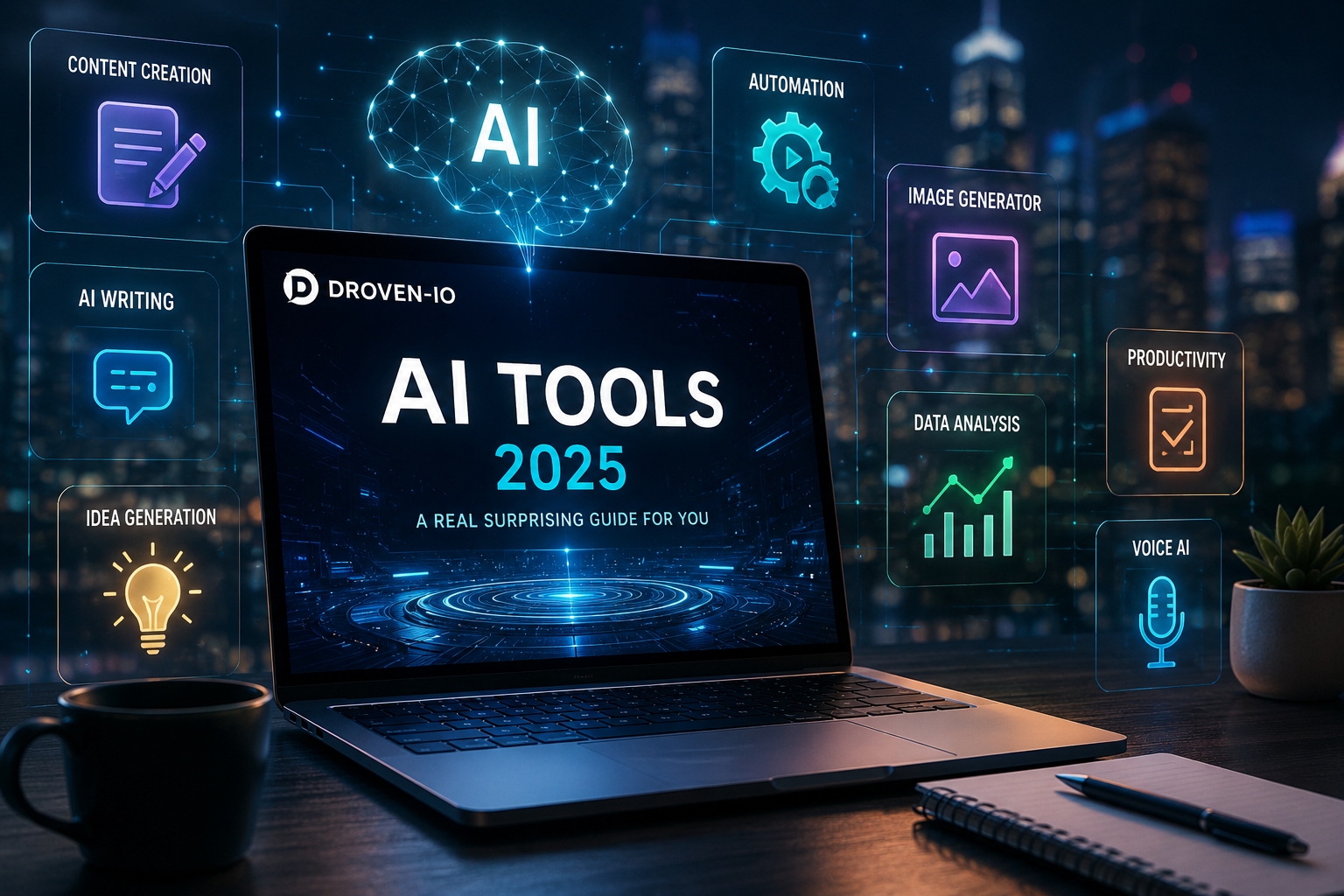
Somewhere between polished demo videos and the actual grind of running a business sits Droven io AI Tools 2025, a resource built for people tired of guessing which software deserves their time. I stumbled onto it while researching AI tool categories for a client project, and it wasn’t trying to sell me anything, which felt unusual.
Droven io AI Tools 2025 isn’t a piece of software itself — it’s closer to a well-read colleague who tracks changelogs obsessively. What makes Droven io AI Tools 2025 genuinely useful is the honesty baked into it: no lab benchmarks, no vendor kickbacks, just plain context about workflow automation, recruiting tools, and the smaller categories most roundup articles skip past entirely.
So What’s Actually Sitting Behind This Name
Picture a research layer wedged between flashy product demos and the day-to-day grind of running a business. That’s the whole pitch behind Droven io AI Tools 2025, and honestly, it’s a decent one.
It covers workflow platforms. It also covers the smaller, oddly specific categories that most comparison sites skip past entirely.
Here’s where people usually trip up, and it’s a fair mix-up. The name reads like something you’d install and license. It isn’t that at all.
It’s more of a reference point — one that stops you from re-Googling the same comparison every few months. A decent write-up, even a rough one, cuts that loop short.
Worth clarifying what Droven io AI Tools 2025 is not, too. Not a certification body. No lab benchmarks run anywhere. No paid affiliation with the tools it covers.
The Gap This Resource Is Quietly Filling

Adoption numbers tell an odd story right now. McKinsey’s state of AI survey found that nearly nine out of ten organizations regularly use AI somewhere internally — yet most haven’t moved past scattered pilots into anything resembling enterprise-wide results.
That’s the gap Droven io AI Tools 2025 sits inside. Not a shortage of tools. A shortage of context for choosing between them sensibly.
Pace of change makes this worse. A tool that felt genuinely ahead in January can look dated by June, because a rival shipped one feature that reshaped the whole category overnight.
Take chatbots as an example. The decent ones barely sound like chatbots anymore — first-line questions get handled cleanly, and messy edge cases escalate to a human before anyone gets frustrated.
Practical upside for teams: a shared reference point turns “is this legit” into “does this actually fit our workflow.” That shift alone can trim weeks off a procurement decision.
A Few Categories Worth Actually Trying
Abstract talk about categories only carries a conversation so far before it turns into filler. Let’s get specific instead.
Recruiting stands out first. Screening resumes, scheduling interviews, even flagging biased phrasing in job postings — AI recruiting tools have quietly stopped being novelties and become part of daily hiring workflow.
Study and research assistance is another lane worth a look. Anyone drowning in source material and short on time to synthesize it will find AI study tools genuinely useful, not just a gimmick bolted onto a note-taking app.
Grant writing tools round out the list. Narrower audience, sure, but AI grant writing tools save real hours for teams tired of rebuilding boilerplate proposal sections every single cycle.
Automation platforms deserve a mention too. Droven io covers this ground itself through AI automation tools, stitching together the repetitive tasks that eat up someone’s entire afternoon otherwise.
Filtering Signal From Noise Before You Commit

A few things I’d actually tell a friend over chai, if they asked where to start with Droven io AI Tools 2025 recommendations.
Skip the newest tool just because it’s trending. Ask what specific problem it solves that your current setup already handles reasonably well.
Read independent reviews, not the testimonials pinned to a landing page. G2’s 2025 year in review noted the platform crossed three million verified reviews this year alone, which says something about how much buyers now lean on peer feedback over vendor marketing copy.
Start small. Pick one workflow, automate that one thing, then check whether it actually saved time once setup and troubleshooting get factored in.
Find someone already using it, if you can. A five-minute chat with a real user usually reveals more than an hour spent reading a polished landing page.
The Cost Question Nobody Answers Upfront
Pricing across this space varies more than most buyers expect going in, and Droven io AI Tools 2025 tends to flag that variance rather than gloss over it.
Some tools charge per seat. Some charge per automation run or per query, quietly capping usage in ways that only show up once you’ve hit the ceiling.
Free tiers look generous until you notice what’s missing — usually the exact feature that made the tool worth trying in the first place.
Ask what happens at scale before committing budget. That question alone has saved more than one team from an ugly renewal conversation.
The Trap Most People Fall Into Anyway
Teams pick a tool once, then never look back. That’s the trap, and it’s a common one.
A tool that made sense in January might stop making sense the moment your team doubles in size or shifts focus entirely.
Build in a quarterly check instead. Doesn’t need to be formal — just a real look at whether the tool still fits, rather than assuming it always will.
Ignoring change management is the other recurring mistake. Even a genuinely good tool fails adoption if nobody explains why the old spreadsheet habit is going away.
Where Curation Like This Is Probably Headed

Resources like Droven io AI Tools 2025 will likely matter more, not less, as the number of available tools keeps climbing every quarter.
Buyers are already shifting away from raw search toward AI-assisted research themselves, asking chatbots to summarize options instead of reading ten separate landing pages.
That creates an odd loop — AI tools getting recommended through AI-summarized research. A neutral, human-reviewed layer breaks that loop for a minute, which is exactly the role Droven io AI Tools 2025 seems to be settling into.
Frequently Asked Questions
Do I actually need to install something, or is Droven io AI Tools 2025 just a website I read and move on from?
Just a website, nothing to install. Editorial content explaining AI tool categories in everyday language — it doesn’t run automations or execute any workflow on your behalf.
Walk me through the kind of categories this thing usually digs into when it publishes new content or updates.
Automation, chatbots, retrieval-based tools, plus smaller verticals — recruiting, study help, grant writing. Content and creative tools sneak in too, since that corner moves faster than most.
If I’m short on time, will it just tell me the one tool to buy so I can skip the comparison shopping entirely?
Not really its style. It sticks closer to explaining trade-offs across a category, which is honestly why it reads less like the sponsored comparison blogs flooding most search results.
Out of everyone browsing this kind of resource, who tends to get the most practical value out of reading it first?
Founders without a technical background, lean startup teams, anyone about to spend budget on software they haven’t fully stress-tested against how their team actually works day to day.
Once I’ve picked a tool through something like this, how long before I should bother checking if it’s still the right call?
Every few months works fine as a rhythm. Teams change shape fast enough that last year’s perfect tool can quietly stop fitting the job without anyone noticing right away.
Conclusion
Where does this actually land in a market this loud? Not fighting for the loudest microphone, and that’s kind of the point. Search for AI software advice and most of it reads suspiciously close to something the vendor wrote themselves, just dressed up in a reviewer’s voice. This one reads different — more like scribbled notes from someone who actually poked around inside these tools instead of rewording a press release before hitting publish.
That difference carries more weight than it seems at first glance. Finding AI tools was never the hard part — thousands exist already, and new ones drop weekly without slowing down. The hard part is cutting through that noise until something’s left you’d actually trust enough to act on. Content that lays out trade-offs honestly, doesn’t bury the weak points, and admits outright when a tool isn’t living up to its own hype — that’s rarer than it should be in this corner of the internet.
None of this guarantees every single recommendation fits every team perfectly, and no honest resource would claim otherwise. What it does offer is a starting point that isn’t quietly bankrolled by the same tools it’s covering — genuinely rare in a space this thick with affiliate links and paid placements dressed up as objective advice.
Shopping for new software this year? Treat a resource like this the way you’d treat advice from a sharp colleague — useful, worth hearing out, but not the final word. Cross-check it against real user reviews, track down someone already using the tool if you can, and run an actual pilot before signing anything long-term. That mix — a decent starting reference plus your own legwork — still beats buying something that looked flawless in a demo and fell apart the second your team touched it for real.

An IT career coach with 7 years of experience helping beginners map out certification paths that actually lead to interviews, not just another resume line. He’s guided dozens of career-switchers through their first AWS or CompTIA exam and writes for itechnova.io, covering IT certifications, cybersecurity, and the software tools people actually need to know.