


Auto shop management software reviews sound boring right up until you’re the one standing at the counter at 7 AM watching a scheduling app freeze for the third morning this week. That’s usually the moment someone finally sits down and reads real auto shop management software reviews instead of just copying whatever their buddy across town happens to use.
This piece breaks down what these tools actually do once the sales pitch wears off, where most of them quietly fall apart, and what separates a genuinely useful system from an expensive spreadsheet with a login screen bolted on. No filler, no vendor talking points — just what actually matters when you’ve got a bay full of cars and a phone that won’t stop buzzing.
Why Shop Owners Actually Switch Systems
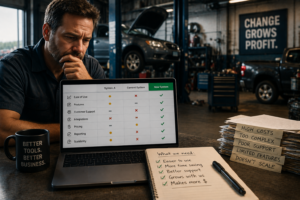
Nobody wakes up thrilled about migrating an entire customer database over to something new. It’s tedious, and honestly a little terrifying if your records are messy to begin with. Shops still do it anyway, because the old system eventually starts costing more in wasted hours than the new one costs in monthly fees.
These little frustrations don’t stay little for long — in a shop where fifteen wasted minutes actually shows up on the day’s revenue, they pile up into something that finally forces a decision. And that decision usually comes later than it should. A lot of owners hang onto a system that’s clearly outdated simply out of habit, telling themselves “this is just how we’ve always done it,” even while the shop down the street has already moved on — sending automatic texts instead of making customers wait on hold one by one.
What Auto Shop Management Software Reviews Actually Measure
Plenty of review sites just tally up feature lists and call it a day. That approach misses most of what matters. Real usefulness shows up when you watch how a tool holds together on a chaotic Monday, with three technicians fighting over the same lift and a customer tapping their fingers at the counter.
Response speed matters more than most owners expect going in. If the software lags every single time someone pulls up a work order, that’s not just a minor annoyance — it’s minutes bleeding away per vehicle, and that adds up fast across a full day of appointments.
Before narrowing anything down, it’s worth spending time on a site that actually collects browse verified user ratings from real shop owners — the day-to-day complaints and praise buried in those reviews usually reveal more than any glossy features page put together by a marketing team.
Core Features Worth Comparing Side By Side
Software shopping isn’t one-size-fits-all, no matter how the sales pages frame it. A shop running a single lift has completely different priorities than a five-location chain, even if both technically fall under the same “auto repair software” category — and most owners don’t realize how different those needs are until they’ve already signed a contract that doesn’t fit.
Here’s a rough sense of what tends to matter most, sorted loosely by shop size:
| Feature | Small Independent Shop | Multi-Location Operation |
| Digital vehicle inspections | Nice to have | Practically required |
| Multi-location reporting | Not needed | Essential |
| Parts ordering integration | Helpful | Critical for margins |
| Customer text reminders | High value | High value |
| Custom labor rate tiers | Rarely needed | Frequently needed |
If a fuller side-by-side of specific platforms would help rather than just broad categories, there’s a detailed software comparison chart worth working through before committing to anything long-term.
Pricing Models Nobody Explains Clearly
Pricing in this corner of the software world stays oddly murky. Some vendors quote one flat monthly number. Others charge per user, per bay, or per some other metric that only starts making sense three months into the contract, once you’re already locked in.
That $150-a-month price tag on the homepage rarely tells the whole story. By the time onboarding fees, data migration charges, and a mysterious “premium support” tier get added on, plenty of shops find themselves staring at a $2,000 bill they never budgeted for.
Get the full first-year number in writing — every fee, every add-on — before you sign anything at all. Vendors who dodge that question, even politely and even with a smile, are usually hiding something buried in the fine print somewhere.
Cloud Setups Versus Older On-Site Systems
Cloud-based platforms have mostly won this argument by now, and it’s not hard to see why. Pulling up a repair order from your phone in a parking lot, mid-errand, matters more in practice than it sounds like it should on paper.
Older, locally-installed systems still exist here and there, and some shops genuinely swear by them. They don’t depend on an internet connection, which is a real selling point if your shop’s wifi has ever died in the middle of a packed Saturday rush.
Even so, the direction of travel is obvious. Most current auto shop management software reviews you’ll come across these days lean almost entirely toward cloud platforms, simply because that’s where development money keeps flowing.
Customer Communication Tools That Matter
Texting has quietly taken over as the default way shops talk to their customers. Nobody wants to sit on hold anymore — and frankly, neither do you, answering the same “is my car ready yet” call for the fifth time in an hour gets old fast.
Automated status updates cut down on that back-and-forth noise considerably. A short text saying the vehicle’s ready for pickup saves both sides a phone call, and most customers genuinely seem to appreciate skipping the guessing game entirely.
Some platforms take it further with photo and video updates sent straight from the bay itself. A customer who can actually see the worn brake pad you’re describing questions the invoice far less than one working off your word alone.
Inventory And Parts Ordering Headaches
Parts management is where a lot of software either genuinely shines or falls apart completely. A technician standing around waiting on a part that should’ve shipped yesterday is money leaking straight out of your shop’s daily revenue.
Integrated ordering systems that connect directly to your suppliers save real, measurable time here. Instead of manually checking stock across three different supplier portals, decent software surfaces availability right inside the open work order.
That said, integration quality swings wildly between platforms. Some vendors advertise “supplier integration” and deliver a half-working connection that still forces manual double-checking anyway, which defeats the entire point.
Digital Inspections And Why Techs Like Them
Gone are the days of a paper checklist getting coffee-stained or misplaced between shifts. Now a tech walks the vehicle, snaps a few photos on a tablet, jots a quick note, and it’s all sitting in the customer’s file before the car’s even back on the ground.
People believe photographic proof in a way they never believe a verbal explanation — show someone their own worn-out brake pad and the conversation about approving the repair gets a lot shorter. Approval rates on recommended work tend to climb noticeably once shops start leaning on this feature seriously.
Techs tend to like it too, once the initial learning curve wears off. It’s faster than writing everything out longhand, and it protects them later if a dispute ever comes up about what was actually found during inspection.
Scheduling Tools That Save Real Time
A scheduling calendar sounds almost too simple to matter — until you’re juggling six technicians, four lifts, and a customer who insists their car absolutely has to be ready by 3 PM sharp.
Good scheduling software shows bay availability in real time, not just which technician happens to be free. That distinction trips people up more than expected — a tech can be sitting idle while every single lift stays occupied, and the reverse happens just as often.
Drag-and-drop rescheduling is one of those small, unglamorous features that feels unnecessary right up until a customer no-shows mid-shift, forcing you to rearrange the whole day’s lineup in under a minute.
Reporting Dashboards Owners Actually Use
Checking the dashboard daily isn’t really necessary for most owners, and that’s not a problem. The real question is whether the handful of times they do log in, the numbers actually mean something.
Average repair order value, technician efficiency, and parts markup are the three figures most experienced owners check first, above everything else. Software that buries these three behind five separate clicks has a design flaw worth complaining loudly about.
Some platforms overload the dashboard with charts nobody ever asked for in the first place. Simpler tends to win here — a clean weekly summary beats a cluttered screen full of graphs that don’t actually drive any real decision.
Integration With Accounting And Payment Systems
Manually re-entering invoices into QuickBooks every single night is the kind of task that quietly eats an hour a day without anyone really noticing, until it adds up across a full month of late evenings.
Direct accounting integration solves this cleanly, when it’s actually built well. Sales figures, taxes, and payments sync automatically, cutting down on both time spent and the small errors that creep in from manual double-entry work.
Built-in payment processing is one of those quiet time-savers that doesn’t get talked about enough. Send a customer a payment link by text and, more often than not, that invoice gets settled faster than if they’d had to call the front desk and read a card number out loud.
Onboarding And Support Quality Differences
Saying “we offer great support” is easy during a sales call — practically every vendor says it. Whether that promise survives past the first month, once you’re an actual paying customer instead of a warm lead, is a different story entirely.
Ask pointed questions about turnaround time on urgent tickets specifically, not the generic support hours pasted on their website. A system crashing on a packed Saturday afternoon needs a real answer faster than a vague “24-hour” promise.
Training quality during onboarding varies quite a bit too, shop to shop. Teams that get hands-on, live training — whether in person or over video — tend to adopt new software faster than ones handed a PDF manual and left to figure it out solo.
Common Mistakes When Choosing Software
Picking software purely on price is one of the more common missteps shop owners make, and it usually costs more down the road in wasted time and awkward workarounds nobody anticipated.
Skipping the trial period entirely is another frequent one. A platform can look flawless during a polished sales demo and still feel like a completely different product once your actual techs are using it under real, everyday pressure.
Industry veterans who’ve switched systems more than once tend to agree on this point specifically — an expert switching advice guide is worth reading closely before signing anything, since the common mistakes are predictable and mostly avoidable with a little upfront research.
Red Flags In Vendor Sales Pitches
Long-term contracts with no clear exit clause should raise an eyebrow immediately, no exceptions. Software companies confident in their own product rarely need to lock customers into three-year terms just to keep them around.
Vague, evasive answers about data ownership are another clear warning sign worth taking seriously. You should always be able to export your full customer history and repair records if you decide to leave — if a vendor hedges on that question at all, that’s your cue to walk.
Pushy upsells during the demo itself, before you’ve even signed for the base product, tend to predict exactly how the relationship goes long term. It rarely improves once you’re already locked into a contract.
Auto Shop Management Software Reviews: Final Decision Time
There’s no single objectively “best” system out there, honestly, no matter how confidently any one review claims otherwise. The right choice among the many auto shop management software reviews floating around online is whichever one actually fits your specific shop’s size, workflow, and realistic budget.
Nothing beats an honest conversation with another shop owner running a similar setup nearby — their unfiltered take, good or bad, usually carries more weight than any single write-up, including this one.
And don’t rush the trial period just to get the decision over with. Hand the software to your actual techs, let them run real jobs through it, and watch closely how they react. Their reaction, frustrated or relieved, says more than a feature list ever could.
Frequently Asked Questions
What does auto shop management software typically cost?
Most vendors charge somewhere between $100 and $500 monthly, with the final number shifting based on shop size, feature tier, and user count — and separate one-time fees for setup or migration aren’t unusual.
How long does a full system switch usually take?
Plan for roughly two to four weeks, covering data transfer, staff training, and a short overlap period where both old and new systems run side by side to catch anything that slipped through.
Can I run this software from my phone?
Nearly every current cloud platform includes a mobile app or a browser version built for phones, so checking schedules, pulling up inspections, or reviewing invoices from the shop floor isn’t a problem.
How secure is customer data on cloud-based platforms?
Established vendors encrypt stored data and back it up on a regular schedule — though it’s still smart to ask directly about their security track record, including whether they’ve had any past incidents.
Is this realistic for a small, independent shop budget-wise?
Definitely — a good number of vendors scale pricing down for single-bay shops, with entry plans sometimes starting under $150 a month, so advanced features aren’t locked behind an enterprise-only price tag.
What happens to my records if I decide to cancel?
A trustworthy vendor lets you pull a full export of your data before your account closes — get that guarantee in writing upfront, since not every contract makes this as simple as it should be.
Should reviews alone decide which software I pick?
They’re a solid starting point for narrowing things down, but pairing them with a hands-on trial and real conversations with other shop owners paints a far more accurate picture than reviews on their own ever will.
Conclusion
Choosing between the many different auto shop management software reviews out there can feel genuinely overwhelming, mostly because every vendor insists their platform is the perfect fit for every possible kind of shop. That’s rarely true in practice, and the sooner an owner accepts it, the easier the whole decision actually becomes.
What matters most really comes down to a short, unglamorous list — reliable scheduling, honest and transparent pricing, decent support when things break, and integrations that genuinely save time instead of just looking impressive during a sales demo. Everything else is secondary, no matter how flashy a vendor’s feature list looks on their homepage.
Trial periods exist for good reason, and skipping them to save a week of decision-making usually backfires later. Watching real technicians use the software under real daily pressure tells an owner more in three days than any single review article can tell them in three thousand words, this piece included.
Price obviously matters, but it shouldn’t be the only factor steering the decision. A cheaper system that quietly costs an extra hour of manual work every single day isn’t actually cheaper once that lost time gets multiplied across a full year of daily operations.
Talking to other shop owners nearby remains one of the more underrated research methods available to anyone in this position. Someone running a similarly sized operation close by has already made the mistakes worth avoiding, and most owners are genuinely happy to share what they learned the hard way.
At the end of the day, the goal isn’t chasing down the single objectively “best” software on the entire market. It’s finding whichever system actually fits how a specific shop operates day to day — the workflow, the team size, the customer base, and the budget realistically available right now. Get those pieces lined up properly, and the rest tends to fall into place on its own, without needing to chase every shiny new feature that hits the market next quarter.

An IT career coach with 7 years of experience helping beginners map out certification paths that actually lead to interviews, not just another resume line. He’s guided dozens of career-switchers through their first AWS or CompTIA exam and writes for itechnova.io, covering IT certifications, cybersecurity, and the software tools people actually need to know.