

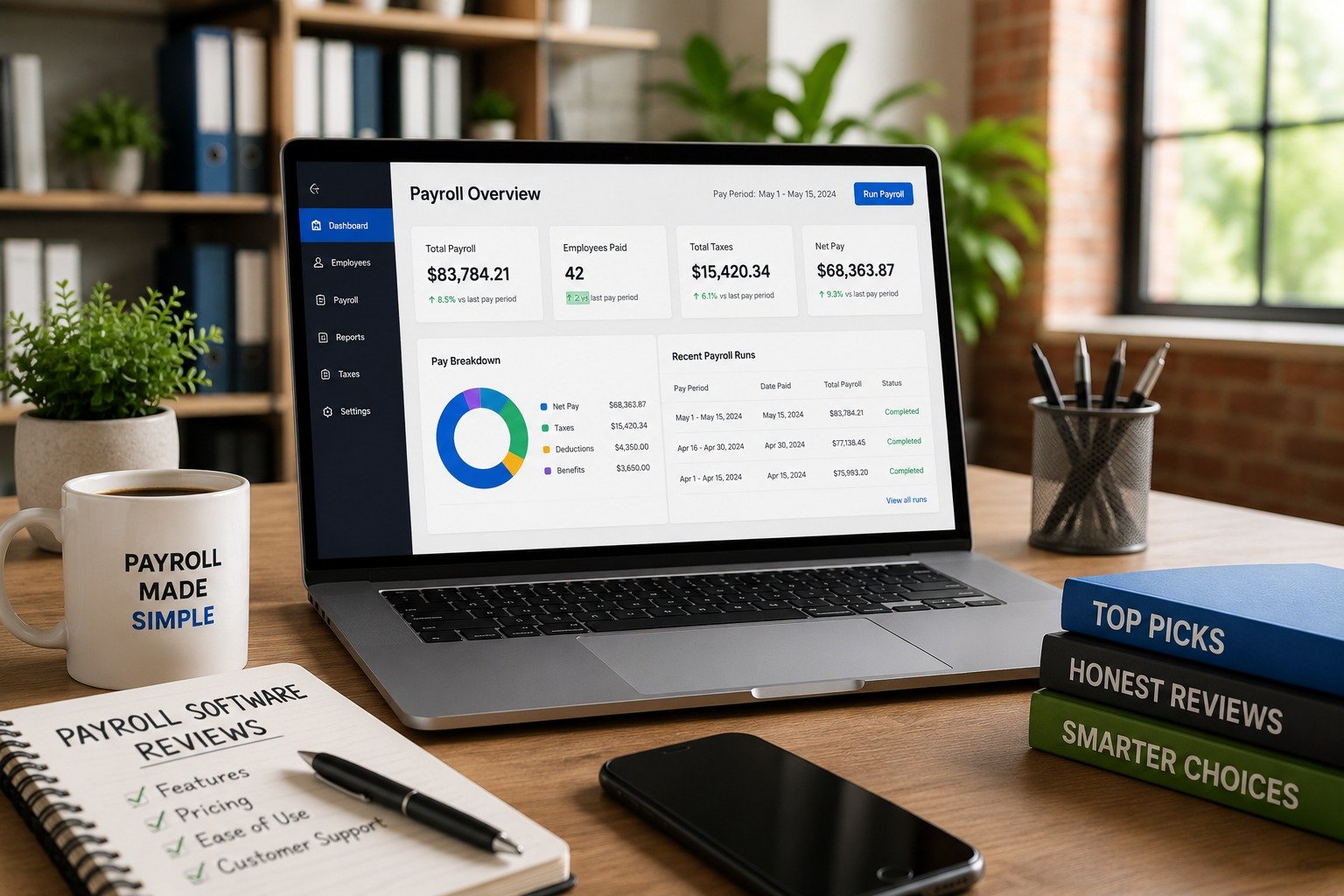
Payroll software reviews online are, honestly, kind of a mess. Half of them are written by people who’ve never run a payroll cycle in their life, and it shows. Payroll software isn’t just a spreadsheet with extra steps — it’s the thing standing between you and a very awkward conversation with an employee who didn’t get paid on time.
I’ve watched small business owners burn hours reading payroll software reviews that don’t matter while ignoring the stuff that actually breaks — tax filing accuracy, support response time, how painful onboarding is. This set of payroll software reviews skips the fluff and gets into what actually separates a good payroll tool from a headache waiting to happen. If you’ve been scanning payroll software reviews and coming away more confused than before, you’re not alone.
Why Payroll Software Reviews Keep Missing the Point
Most payroll software reviews rank tools by how many logos they can cram into a comparison table. Fifteen features listed, checkmarks everywhere, and somehow none of it tells you whether the thing will actually calculate your state unemployment tax correctly.
That’s the gap most payroll software reviews never close. A payroll platform can look gorgeous in a demo and still mess up a multi-state filing because the tax engine wasn’t built for your situation.
I’d rather know how a tool handles a messy edge case — a contractor who becomes an employee mid-quarter, say — than see another “unlimited pay runs” bullet point in yet another one of these payroll software reviews. That’s the lens worth using here.
What Payroll Software Actually Costs You
Pricing pages lie by omission, which is exactly what most payroll software reviews fail to mention. The base plan looks cheap, then you add per-employee fees, a filing fee, a year-end W-2 fee, maybe a “premium support” tier you didn’t know existed until you needed it.
Rough range for small teams in 2026: expect somewhere between $40 and $150 a month as a base fee, plus $6 to $12 per employee. Bigger platforms with HR bundled in climb past $200 fast — a detail plenty of payroll software reviews leave out entirely.
The sneaky part is add-ons. Time tracking, benefits administration, workers’ comp integration — each one’s usually a separate line item. Add them up before you commit, not after your first invoice arrives.
Best Payroll Software For Small Teams
For teams under 20 people, simplicity usually wins over feature depth. You want something that runs payroll in under ten minutes once it’s set up, not a system that needs a training session every time you touch it — this is where most payroll software reviews finally get useful.
If your business already leans on accounting software, checking a Xero accounting comparison first makes sense — a lot of payroll headaches disappear when the books and the paychecks are talking to each other automatically, a connection most payroll software reviews don’t bother explaining.
Teams juggling technicians or on-site workers have a slightly different puzzle, since scheduling and payroll need to sync. Worth glancing at how field service tools handle payroll integrations before picking a standalone system that’ll fight with your dispatch software later.
Is Payroll Software Worth The Switch
If you’re still doing payroll by hand or through a generic spreadsheet template, yes — almost always, and most honest payroll software reviews will tell you the same thing. The math on manual errors alone justifies it. One missed tax deadline can cost more in penalties than a year of software fees.
But if you’re already happy with a bookkeeper who handles payroll as part of a bigger service, the calculus changes. You’re not just buying software, you’re potentially replacing a relationship, and that’s a bigger decision than any pile of payroll software reviews can settle.
According to federal payroll rules, employers are responsible for depositing withheld taxes on a strict schedule — miss that and the penalties stack up fast, regardless of whether a human or a piece of software dropped the ball.
Common Payroll Software Mistakes People Make
The biggest one, and it’s rarely mentioned in payroll software reviews: skipping the setup verification step. People rush through onboarding, get one tax ID wrong, and don’t catch it until the first filing bounces back.
Second mistake — not updating employee classifications when roles change. A part-timer who goes full-time needs their benefits eligibility flagged manually in most systems; the software won’t catch it for you.
Home care agencies run into this constantly, actually, since caregiver hours shift week to week. Anyone in that space should look at home care software built specifically for variable scheduling rather than forcing a generic payroll tool to guess.
Third one, smaller but annoying: not double-checking direct deposit timing around bank holidays. Miss that window once and you’ll never forget again — no payroll software reviews will save you from that particular lesson.
Payroll Software vs Outsourcing Payroll
Software gives you control. You see every number, you can adjust on the fly, and you’re not waiting on someone else’s business hours to fix a mistake — a point most payroll software reviews underplay.
Outsourcing gives you distance from the liability. A payroll service usually eats the cost of tax filing errors made on their end — read the contract carefully, because that guarantee isn’t universal, and it’s rarely spelled out clearly in payroll software reviews either.
For a business with straightforward payroll — same employees, same schedule, month after month — software alone tends to be cheaper and just as reliable. Complexity is really what pushes people toward outsourcing, not size.
Free And Budget Payroll Options
Free payroll tools exist, but they’re almost always free for a reason — usually because tax filing isn’t included, or it’s capped at a handful of employees. Budget-focused payroll software reviews rarely spell out that trade-off up front.
Patriot Software breakdown is worth a read if budget is the priority; it sits in that affordable-but-still-functional middle ground that a lot of true “free” tools don’t manage.
Budget tiers generally strip out things like same-day direct deposit or dedicated support, which is fine until the one week you actually need either of those.
Setting Up Payroll Software Step-By-Step
Getting a new system running usually takes three to five business days if your data’s clean, something most payroll software reviews gloss over completely. Messier data — old spreadsheets, inconsistent employee records — can stretch that to two weeks.
Start with your EIN and state tax account numbers ready. Nothing stalls onboarding faster than chasing down a number you thought you had saved somewhere.
Import employee data next, then run a parallel test payroll alongside your old system for one cycle before fully switching over. It catches mismatches before they become real paycheck problems — a step most payroll software reviews never mention at all.
FAQs
Is payroll software hard to learn for a first-time user?
Not really — most platforms are built for non-accountants, with guided setup and templates for common pay schedules.
Can payroll software handle contractors and employees together?
Yes, most modern platforms separate 1099 and W-2 workers automatically, though tax handling differs for each.
How often do payroll software prices increase?
Annually, typically, often tied to per-employee rate hikes rather than the base subscription fee itself.
Does payroll software file taxes automatically?
Most mid-tier and higher plans do, but always confirm which states are covered before assuming full coverage.
What happens if payroll software makes a filing error?
Policies vary widely — some vendors cover penalties, others leave the liability entirely with the business owner.
Is switching payroll providers mid-year a bad idea?
It’s doable, but plan the transition around a quarter-end to avoid messy year-to-date wage reporting.
Why do payroll software reviews rarely agree on a top pick?
Because business needs vary so much — team size, states, and contractor mix all change which platform actually fits best.
Conclusion
Picking payroll software isn’t really about finding the flashiest dashboard or the longest feature list — it’s about finding the system that won’t embarrass you in front of your own employees. That sounds dramatic, maybe, but anyone who’s dealt with a botched pay run knows it’s not far off, and it’s exactly why sorting through payroll software reviews carefully actually matters.
The honest advice is this: figure out your actual complexity first. A five-person shop with steady hours doesn’t need the same tool as a business juggling contractors, multiple states, and shifting schedules. Buying more software than you need just adds cost without solving problems you don’t have — something too many payroll software reviews conveniently skip.
Price it out fully before signing anything — base fee, per-employee cost, filing fees, and whatever “premium” tier hides the features you’ll probably end up needing anyway. Run a parallel payroll cycle before fully committing, because catching an error during a test run costs nothing; catching it after a real paycheck goes out costs a lot more, in both money and trust.
There’s no universal “best” pick here, despite what a lot of payroll software reviews claim. There’s just the option that matches how your business actually pays people — and that’s worth more time to figure out than most payroll software reviews give it credit for. If this rundown of payroll software reviews did one thing, hopefully it steered you toward asking the right questions instead of chasing another feature checklist.

An IT career coach with 7 years of experience helping beginners map out certification paths that actually lead to interviews, not just another resume line. He’s guided dozens of career-switchers through their first AWS or CompTIA exam and writes for itechnova.io, covering IT certifications, cybersecurity, and the software tools people actually need to know.
1 thought on “Payroll Software Reviews: Proven, Shocking Picks”