

Every morning, before email, before Slack, I open up whatever hardware startup news came in overnight. Started as a work habit for content planning across itechnova. Turned into something closer to an obsession, honestly, because the category keeps doing things that don’t match what I was taught about venture capital ten years back.
The old rule was simple. Investors chased software because it scaled cheap and hardware didn’t. A robot arm or a chip fab needed real money, real time, real risk of the whole thing just not working after eighteen months of R&D. That rule hasn’t been repealed exactly. It’s just being ignored by a specific, well-funded slice of the market right now, and figuring out which slice matters more than reading any single headline in isolation.
Three separate currents are running through this year’s coverage. Physical AI, machines doing real tasks instead of generating text. The chips underneath all of it, which nobody outside the industry pays attention to until a shortage hits. And governments, quietly deciding that some hardware categories are too strategically important to leave to venture timelines alone. Pull on any thread in hardware startup news this year and you’ll find at least one of these three running underneath it.
What’s Happening Right Now
Here’s a pattern I noticed after a few months of tracking this daily: the money isn’t spread thin. It’s stacked.
A small number of categories are absorbing most of the capital, while everything else in the hardware startup news world fights over scraps by comparison. Chip companies have collected close to $10.7 billion between seed rounds and pre-IPO deals this year, per Crunchbase’s tracking, and that’s already ahead of where the same period landed in 2025. Widen the lens to robotics and hardware overall, and the count sits at 83 disclosed rounds in 2026, worth $2.84 billion combined, according to FundedStartupsDaily. Most of that, seventy-one percent by their count, never gets past seed stage. So picture a long, thin tail of small bets, with a handful of enormous rounds sitting off to one side, pulling the average upward without representing what a typical deal actually looks like.
Saronic sits at the far end of that tail. Four years old. Building autonomous vessels for defense customers out of Austin. In March, the company closed a $1.75 billion Series D, a number that on its own lifted total lifetime funding to roughly $2.6 billion. I keep coming back to that timeline. Four years from founding to a round that size is not a normal trajectory, and nobody in the coverage I’ve read seems bothered by it. Nobody’s calling it a bubble the way they might have during an earlier hardware funding cycle. That silence tells its own story about how far this category’s reputation has traveled.
Why Robotics Is Winning Big
For a long time, robotics got respect without getting checks. Engineers loved it. Investors mostly stayed away, because a robot that works in a demo video and a robot that works reliably on a warehouse floor for six months are two very different, very expensive problems.
What changed the calculus was embodied AI, machines whose decision-making runs on a foundation model rather than a mountain of custom, hand-tuned logic. Suddenly a robot could be evaluated the way software gets evaluated: benchmarked, measured, improved on a cadence investors could actually track quarter over quarter. Apptronik is the case I keep pointing people toward when they ask what changed. In February, the humanoid robotics company added a $520 million extension on top of an earlier $415 million Series A, pushing the combined raise past $935 million. Look at who signed those checks, though, not just the total. Google. Mercedes-Benz. B Capital. Peak6. That’s not speculative money chasing a trend. Corporations write strategic checks when a technology looks close enough to actually show up on their own factory floor, not when it’s still five years from anything real. A Crunchbase sector breakdown of robotics investing lays out the same conclusion from a wider data set: capital keeps clustering around embodied AI specifically, not robotics as a broad, undifferentiated category.
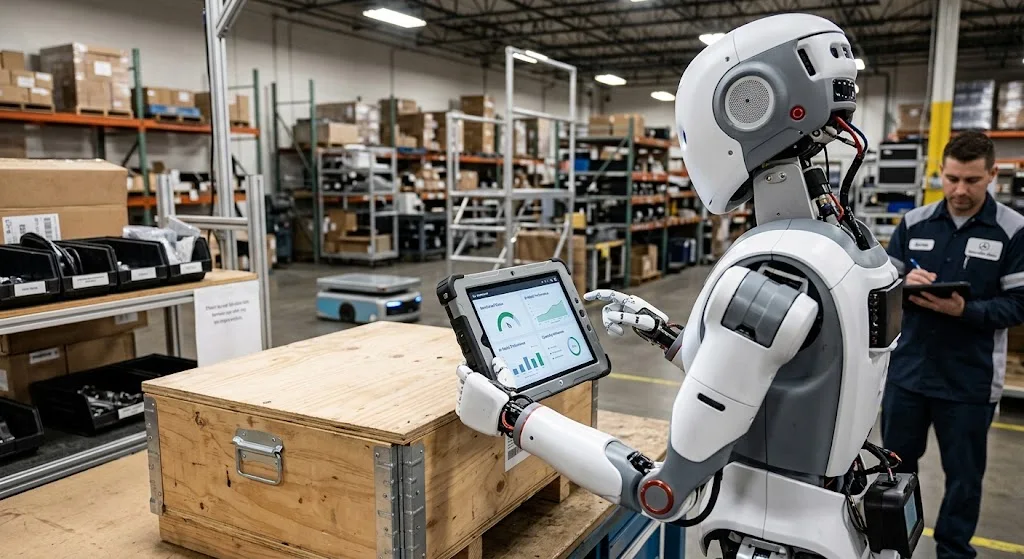
NEURA Robotics topped even Apptronik’s combined total with a single $1.4 billion Series C, more money in one event than most companies ever see across their entire lifespan. Then there’s Generalist AI, founded by Pete Florence, who spent years at Google DeepMind helping build the PaLM-E and RT-2 robotics models before striking out on his own. His company’s $400 million Series A currently sits atop the largest robotics or hardware round of the year. Three companies. Three completely different products. The same underlying wager, though: a robot with a genuinely capable AI brain deserves a valuation multiple that looks like software, even while every dollar of its cost structure looks like hardware startup news.
None of this means the smaller deals stopped happening, and I’d actually argue the smaller ones tell you more about the health of the category than the mega-rounds do. Haystack Robotics, working out of Portland on autonomous disinfection systems, closed a modest $3.95 million Series A this month, aimed at expanding into healthcare and hospitality accounts it already serves. No nine-figure valuation story. Just a small check against real, paying customers. That’s the kind of round that doesn’t make headlines but tells you the funding environment still has room for founders who aren’t selling a moonshot.
There’s a quieter robotics story sitting underneath all the humanoid coverage, too: warehouse and logistics automation. Individually, these companies rarely land the kind of round that gets written up with a splashy headline. Collectively, though, they make up a real chunk of that 83-deal count FundedStartupsDaily is tracking, and their pitch tends to be refreshingly unglamorous. Fewer promises about the future of labor. More straightforward math about what a warehouse operator saves per shift. Boring, in the best possible sense, and boring is exactly what a certain kind of risk-averse investor wants right now.
If you’re watching funding patterns across sectors rather than just hardware, it’s worth cross-referencing this against HR tech funding, where a similar preference is showing up: investors rewarding a tightly scoped problem over an ambitious, sprawling platform vision.
The Chip Side Nobody Talks About
Ask a random person what a hardware startup news builds, and you’ll get robots or gadgets almost every time. The heavier money, though, sits one layer below all of that, inside the silicon itself, and it rarely gets the same media attention.
Crunchbase News puts total AI chip funding for 2026 at around $4.16 billion so far, concentrated into a genuinely small number of disclosed rounds rather than spread across dozens of hopeful startups. That concentration isn’t random. Fabricating a chip requires years of committed capital before the first unit ever ships, which makes this corner of the hardware world behave nothing like consumer software funding, where a hundred companies can each grab a small check and see what sticks. Crunchbase’s own breakdown of 2026 chip funding runs through the ten biggest recipients if you want the full list.
Etched is the name that keeps coming up whenever this topic gets discussed. The company landed $300 million at a $10.3 billion valuation, aimed at continuing work on Sohu, a chip built to do exactly one thing extremely well: run transformer-based AI models faster than a general-purpose GPU ever could. Rather than keeping that architecture flexible and programmable, Etched committed it permanently to the silicon itself, a bet that trades away versatility for raw efficiency. TSMC’s Emerging Businesses Group is manufacturing the chip, which matters more than it sounds. A manufacturing partnership with TSMC isn’t something you get for a roadmap slide. It’s something you get for actual working silicon.
MatX chose a related bet but got there through a different sequence. Three rounds, $605 million total, one of the faster funding climbs anywhere in this year’s semiconductor coverage, with a $500 million Series B in February doing most of the lifting. Cerebras Systems already finished the journey entirely, going public after closing a $1 billion pre-IPO round in February. That’s the first real proof point this cycle has produced showing what an exit from all this hardware money might eventually look like, rather than just another number added to the pile.
There’s a section of this market that almost never makes it into general coverage: interconnect and packaging. As chip counts multiply inside AI data centers, the real bottleneck stops being the chip itself and starts being how fast data can move between chips. Photonics, optical I/O, advanced packaging, these have quietly become their own sub-category inside hardware startup news, pulling real capital away from headline-grabbing chip-design plays even though most of the company names involved never show up outside trade publications most people never read.
Here’s how this quarter’s biggest names line up next to each other:
| Company | Round | Amount | Valuation/Total | Focus |
| Etched | Series (2026) | $300M | $10.3B valuation | Transformer-specific AI inference chip |
| MatX | Series B | $500M | $605M total raised | AI training chip performance |
| Saronic | Series D | $1.75B | $2.6B total raised | Autonomous defense vessels |
| Apptronik | Series A extension | $520M | $935M+ total raised | Humanoid robotics |
| NEURA Robotics | Series C | $1.4B | Not disclosed | General-purpose humanoid robots |
| Generalist AI | Series A | $400M | Not disclosed | Robotics foundation models |
| Haystack Robotics | Series A | $3.95M | Not disclosed | Autonomous disinfection systems |
Line up the smallest number against the largest and it’s almost comical, $3.95 million sitting next to $1.75 billion, both technically the same asset class, both raised in the same twelve-month window.
Where the Money Is Actually Coming From
Coverage of this beat leans heavily American, and the numbers back that up, though not by the margin most people assume. North America accounts for roughly 78% of disclosed semiconductor capital over the trailing year, with a median deal landing around $78.5 million. Europe isn’t nearly as far behind on activity as the headlines suggest either. It’s tied with Asia-Pacific on raw deal count, a dozen apiece, but Europe’s median round size, $28.6 million, dwarfs Asia-Pacific’s $11.2 million. Read that the right way and it says something specific: European hardware startup news bets happen less often but go deeper per company, especially once a government co-investor gets involved.
That government layer deserves more attention than it usually gets in casual coverage of this space. Germany put close to $275 million behind Black Semiconductor for next-generation chip work, with public funds covering most of that figure. Samsung, working with strategic rather than purely public capital, led at least $300 million into Toronto-based Tenstorrent, blending corporate money with the kind of national-champion instinct that’s spreading across the semiconductor world generally. None of this is generosity for its own sake. Governments watched entire industries seize up during earlier chip shortages and decided domestic fabrication capacity mattered too much to leave purely to venture-fund patience.
The Middle East is a smaller piece of the puzzle, still early, but growing. Roughly $187 million in disclosed deals over the past year, mostly Israeli chip companies plus at least one fabless AI semiconductor startup out of the UAE. Not a huge percentage of the global total yet. Worth watching over the next year or two regardless, since a region starting from almost nothing tends to grow in ways that look sudden from the outside even when the underlying buildup took years.
Why the Checks Got Bigger
Standard venture advice for a long time said to run from anything with a bill of materials attached. Physical inventory locks up cash long before revenue shows up to offset it. Software never had that constraint. Scaling meant renting more server capacity, not building an actual factory.
Reading enough of this year’s coverage back to back, four things keep explaining why that old rule stopped applying so cleanly.
- AI turned hardware into something measurable. A robot powered by a real foundation model can show progress on video, on standardized tasks, on live pilots running inside actual enterprise operations, none of which existed as a real diligence tool a decade ago.
- Public money took some of the risk off the table for private investors. Subsidy programs aimed at rebuilding domestic chip fabrication, a direct reaction to pandemic-era supply shocks, gave venture funds enough cover to follow with their own capital rather than sit it out.
- Reputation replaced raw enthusiasm. Saronic’s founders came out of defense and shipbuilding. Etched’s engineers built careers around transformer research specifically. Generalist AI’s founder helped architect PaLM-E and RT-2 at DeepMind before going independent. Investors stopped funding good stories and started funding people who’d already solved adjacent problems.
- An actual exit gave the whole thesis proof. Cerebras going public after its pre-IPO round hands later-stage hardware startup news investors a real data point instead of a hopeful projection, and that changes underwriting decisions in ways a hundred press releases never could.
None of that makes every hardware bet safe, and I’d push back hard on anyone reading this as “hardware startup news is easy now.” It isn’t. It just means the deals clearing committee today have to prove considerably more than a good slide deck, and that higher bar is the actual reason this year’s coverage reads so differently from the skeptical hardware headlines of five years back.
Mistakes People Make Reading This
A few habits I keep noticing among people newer to this beat, worth naming directly rather than dancing around.
The biggest one: treating every nine-figure round as equally significant. A $1.75 billion defense raise and a $400 million robotics Series A are not the same signal about the market, even though both get covered with similar enthusiasm. One reflects a mature company with government-adjacent revenue already flowing. The other reflects a bet on a founder’s pedigree and a technical thesis that hasn’t fully proven out commercially yet. Collapsing both into “big hardware round, must mean the sector is hot” flattens information that actually matters if you’re trying to make a decision based on any of this.
Second mistake: ignoring how much of this capital comes with strings attached that a pure software round wouldn’t have. Government-backed money, like what Black Semiconductor received, often comes with domestic manufacturing requirements, reporting obligations, or geopolitical conditions that never show up in a typical VC term sheet. Treating a subsidized round exactly like a Sequoia check misreads what actually happened.
Third, and this one’s more personal: I see people assume hardware funding news moves at the same pace as software news. It doesn’t. A robotics company raising a Series A this month might not ship a meaningfully different product for another eighteen months. If you’re checking hardware startup news expecting weekly product launches the way you would with a SaaS company, you’ll misread silence as stagnation when it’s often just the normal, grinding pace of physical engineering.
What Could Slow This Down
Nobody covering this beat right now seems eager to ask what breaks the momentum, so I’ll take a stab at it myself, since it’s the one section of this piece that isn’t chasing a source, just a hunch built from watching the pattern for months.
Interest rates are the obvious one. Hardware bets require patient capital precisely because timelines run long, and patient capital gets a lot less patient when the cost of holding it climbs. A meaningful rate move could compress the multiples investors are willing to pay for a robotics company that’s still eighteen months from real revenue, even if the underlying technology hasn’t changed at all.
Geopolitics is the second, and it’s already partly baked into why governments are co-funding chip fabrication in the first place. Export controls, tariff changes, or a supply disruption tied to any single region could reshape which companies get funded almost overnight, regardless of how strong their technology looks on paper.
And there’s a simpler risk that gets almost no attention: execution. hardware startup news doesn’t forgive mistakes the way software does. A design flaw discovered six months into tooling can mean eating the cost and starting over, often with a supplier overseas and a shipping delay measured in weeks. A handful of high-profile stumbles from well-funded humanoid robotics companies, the kind that make it into mainstream coverage rather than trade press, could cool investor appetite for the entire category faster than any macro shift would.
What Founders Should Take From This
Reading this coverage as a founder is a different exercise entirely from reading it as an outside observer. A handful of practical lessons kept surfacing as I went through this year’s deals one by one.
- Seed rounds in hardware run larger than software seeds as a default, frequently $10 to $50 million for robotics specifically, since manufacturing and testing costs show up long before any revenue does.
- A narrow, defensible technical wedge beats a sprawling platform pitch nearly every time. Etched didn’t sell “better AI chips” as a broad category. It sold one specific bottleneck, transformer inference, and built silicon around exactly that.
- Strategic and corporate backers carry weight a pure financial VC simply can’t replicate. A manufacturing partnership or an enterprise investor signals validation that no amount of investor enthusiasm alone can substitute for.
- Smaller hardware companies with real, paying customers still close rounds without needing a billion-dollar narrative. Haystack Robotics is the clearest example this month.
- Timelines run longer than most founders plan for going in. Eighteen to twenty-four months from concept to a working prototype is fairly normal, against six to nine months for a typical software MVP.
- Non-dilutive capital is worth chasing early and aggressively. Grants, R&D tax credits, and government innovation programs, the kind that helped fund Black Semiconductor, can carry a team through technical validation without giving away equity before the product even exists.
Founders building anything hardware-adjacent should also keep an eye on climate tech funding, since battery storage and grid infrastructure draw from a lot of the same capital pools right now, occasionally the exact same funds writing checks into both categories in the same quarter.
Hardware vs Software Funding
People outside the VC world ask me some version of this question constantly. Why does a $400 million robotics round barely register compared to the buzz around a $40 million software raise?
It comes down to what counts as impressive at each stage of the two categories. A million dollars in recurring revenue looks genuinely strong for a software Series A. That same number attached to a hardware Series A would raise eyebrows instead, because getting there required roughly ten times the capital along the way. Investors judge hardware startup news progress against how much physical infrastructure, testing, and certification stood between an idea and its first real sale, not against a bare revenue figure sitting on its own.
Patience gets built into the category differently, too, in a way that isn’t always obvious from the outside. Software founders plan around weekly iteration cycles. Hardware founders plan around a year and a half passing before a single working unit even exists. That gap quietly filters out a whole category of investor who might otherwise chase the space for the headlines alone, and it explains a lot of why hardware startup news tends to spotlight fewer, larger, more concentrated deals compared to software, where a dozen different AI-agent startups can each clear $50 million inside the same single quarter.
There’s a talent dimension worth naming too, one that rarely gets its own paragraph in coverage like this. A software team can pivot an entire product inside a single sprint. A hardware startup news team that discovers a design flaw six months into tooling usually has to eat that cost and rebuild from scratch, often with a supplier on the other side of the planet and a shipping delay measured in weeks rather than hours. That’s a real part of why the founders raising the biggest hardware checks right now tend to have done something like this before, either at a previous startup or inside a large lab like DeepMind, Boston Dynamics, or a major chipmaker. Investors are pricing in fewer rookie mistakes, whether or not they say so out loud during the pitch.
Anyone tracking AI developer tools news alongside hardware headlines will notice the same investor instinct showing up in both places, honestly. Proof beats projections. Contracts beat roadmaps. Specificity beats breadth almost every single time a term sheet actually gets signed.
FAQs
What’s the biggest hardware startup news funding round of 2026 so far?
Saronic’s $1.75 billion Series D in March leads the year, pushing the autonomous defense vessel company’s lifetime total to around $2.6 billion.
Are chip startups considered hardware startups?
Yes, semiconductor companies sit squarely inside hardware startup news, and they’ve collectively raised around $10.7 billion in 2026, tracked separately from robotics funding.
Why is robotics attracting so much more funding than a few years ago?
Foundation models turned robot capability into something measurable and demonstrable, shifting the category from a slow engineering bet into something investors can benchmark like software.
Do small hardware startups still get funded, or is it all mega-rounds?
Both happen simultaneously. Haystack Robotics closed under $4 million this month, proving early-stage hardware startup news funding hasn’t vanished even with billion-dollar rounds dominating headlines.
How long does it typically take a hardware startup to reach a working prototype?
Eighteen to twenty-four months is common from concept to prototype, noticeably longer than the six-to-nine-month window typical of a software MVP.
Final Thoughts
Hardware startup news in 2026 barely resembles what the category looked like even three years back, and the change runs a lot deeper than a handful of big numbers. Investors stopped treating physical products as dead weight and started treating them as the actual moat, the part a competitor can’t clone over a single weekend of coding. Robots running genuinely capable AI behind the scenes. Chips engineered around one narrow bottleneck instead of chasing general-purpose ambition. Defense hardware startup news backed by people who’ve actually built ships before. Governments quietly co-signing the riskiest chip bets right alongside private investors, treating fabrication capacity as a strategic asset rather than a pure market outcome. None of that describes the funding climate hardware companies were pitching into not long ago.
If you’re a founder trying to read the tea leaves here, every deal in this roundup points toward the same handful of things. Specificity wins over broad ambition. A real track record helps more than a compelling story. Non-dilutive capital is worth chasing early, before you need it desperately. And patience with slower capital timelines simply isn’t negotiable, no matter how impatient the rest of the tech industry has become. If you’re just here to stay current on the beat, check back soon, because this category is moving fast enough that today’s numbers will feel dated within a month.

An IT career coach with 7 years of experience helping beginners map out certification paths that actually lead to interviews, not just another resume line. He’s guided dozens of career-switchers through their first AWS or CompTIA exam and writes for itechnova.io, covering IT certifications, cybersecurity, and the software tools people actually need to know.