

Every few weeks a headline claims some company has “deployed 50,000 humanoid robots.” Scroll past the press release and check the actual filings, and the number quietly shrinks to a few hundred.
I went digging through the current state of general robotics — not the marketing version, the version backed by earnings calls, plant tours, and disclosed operating hours. The gap between hype and reality is bigger than most coverage admits.
Start with Tesla, because it’s the loudest voice in general robotics right now. Musk has floated production targets in the millions of units per year.
Plenty of outlets have run with cumulative figures north of 50,000 Optimus robots. The actual picture, as of mid-2026, is closer to 1,000–1,200 units operating inside Fremont and Giga Texas.
Tesla itself hasn’t published a single uptime figure. On the Q4 2025 earnings call, Musk described the current fleet as existing “primarily for learning and data collection rather than performing productive tasks.” That’s a meaningfully different story than “robots are replacing factory workers.”
Tesla didn’t even start converting its Fremont line for Optimus assembly until it ended Model S/X production there in May 2026 — a four-month retooling job that pushed real production starts to late July or August.
Compare that to Figure AI, which gets a fraction of the press coverage but has the stronger receipts in the general robotics space. Its Figure 02 units have been running ten-hour shifts on BMW’s Spartanburg line, loading sheet-metal parts into welding fixtures.
They’ve logged over 90,000 parts placed at better than 99% accuracy. That’s not a demo reel — that’s a paying industrial customer with a documented production record.
If you’re trying to figure out which humanoid program to take seriously, that distinction — verified operating hours versus announced targets — is the single best filter I’ve found in general robotics coverage.
Then there’s the company that quietly ships more humanoid robots than anyone in the West: Unitree. It moved roughly 5,500 units in 2025 at around a tenth of the price point competitors are chasing.
It’s the current global leader by raw volume. Here’s the part that surprises people — Unitree’s Q1 2026 net profit still fell 52% year-on-year, even while its stock and IPO valuation surged.
Volume and profitability are not the same curve. Any general robotics pitch deck that conflates “units shipped” with “business working” is skipping the part that actually matters to a buyer.
Why humanoids are the wrong place to start if you’re evaluating general robotics for a real business
Humanoid robots dominate the headlines because they’re visually dramatic. But most of the commercial value in general robotics right now isn’t walking on two legs.
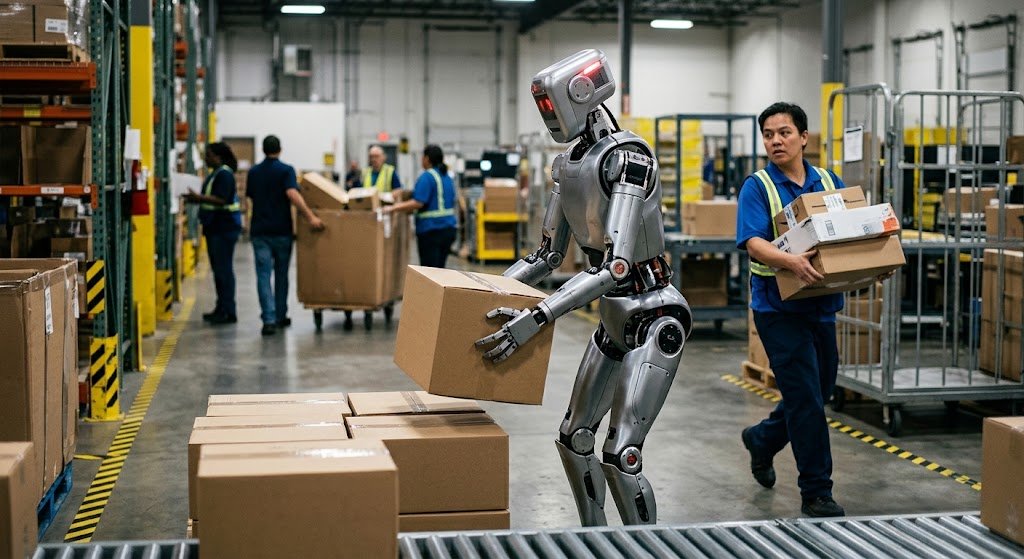
It’s fixed-base arms, mobile warehouse platforms, and narrow-task machines that never make the news. A Universal Robots cobot bolted to a workbench doesn’t need computer-vision breakthroughs to be profitable — it needs a repeatable motion and a payload under 10kg. That’s a solved problem, and has been for years, which is exactly why it doesn’t trend.
The mistake I see companies make constantly is benchmarking a purchase decision against the splashiest humanoid demo instead of asking what a boring, purpose-built machine can already do reliably today.
Boston Dynamics made the same bet internally. It retired the hydraulic version of Atlas in 2024 and rebuilt it fully electric, explicitly designed for sustained commercial operation rather than research showreels.
That shift — from “look what it can do once” to “here’s what it can do eight hours a day, five days a week” — is the real inflection point in general robotics. And it’s happening quietly in industrial contracts, not on stage.
General robotics is also spreading well past factories and warehouses. Construction sites are running autonomous survey and layout robots that cut rework costs on large jobs — a trend worth tracking if you follow AEC tech news closely.
Public agencies are piloting robots for hazardous inspection and perimeter monitoring, which shows up regularly in public safety tech news.
The capital behind general robotics increasingly overlaps with sustainability mandates, too. Battery sorting, materials recovery, and grid-site inspection robots are getting funded alongside broader climate tech funding news, because a robot that reduces waste or emissions is an easier grant application than one that just cuts headcount.
The AI layer is the actual bottleneck, not the hardware
Ask any robotics engineer privately and they’ll tell you the mechanical side of general robotics has been mostly solved for a decade. Actuators, sensors, and materials are mature.
What’s still genuinely hard is getting a robot to generalize — to pick up an object it’s never seen, in lighting it’s never trained on, and not panic. That’s why Figure AI partnered with OpenAI for instruction-following rather than building everything in-house.
It’s also why Tesla’s real competitive asset isn’t Optimus’s hardware — it’s the video data Tesla records of human workers performing tasks at Fremont, which then trains the robot through imitation learning. Whoever solves generalized manipulation cheaply, not whoever builds the prettiest chassis, wins the next five years of general robotics.
If you want a sense of where that underlying model work is heading, it’s worth keeping an eye on AI developer tools news. The frameworks being built for coding agents right now are the same architectures getting repurposed for robot control loops.
One more thing worth knowing before you take any general robotics deployment number at face value: manufacturing a robot with roughly 10,000 components at real scale has zero historical precedent to compare against.
Even Tesla’s own Model 3 ramp, a far simpler product, took eighteen months of what the company itself called “production hell” before hitting stable volume. Missing an aggressive robotics target isn’t proof a program is failing — it’s the default outcome for anything this mechanically complex.
The honest read on general robotics right now, per a detailed Technology.org analysis, is that no humanoid robot from any manufacturer has cleared the low hundreds of units in sustained commercial use.
The widely shared “tens of thousands deployed” claims simply don’t survive contact with actual company filings — a gap also documented in IIoT World’s manufacturing coverage.
If you’re evaluating general robotics for your own operation, ignore the unit-count headlines entirely. Ask three questions instead: does this vendor have a named customer with disclosed operating hours, what’s the actual task-success rate on that deployment, and what happens when the robot encounters something outside its training data.
Everything else — the production targets, the valuation numbers, the “millions of units by 2027” projections — is marketing until general robotics proves otherwise.

An IT career coach with 7 years of experience helping beginners map out certification paths that actually lead to interviews, not just another resume line. He’s guided dozens of career-switchers through their first AWS or CompTIA exam and writes for itechnova.io, covering IT certifications, cybersecurity, and the software tools people actually need to know.