


Searching for the Abraham Quiros Villalba AI tool? Here’s an honest, in-depth look at the claims, what’s missing, and how to check any AI investing tool before trusting it.
If you searched for the Abraham Quiros Villalba AI tool, you’ve probably already landed on a handful of articles telling the same story: a Costa Rican engineer, a career that moved from oil and gas into renewable energy, an early Bitcoin bet, and now — supposedly — a sophisticated AI platform that helps everyday investors read stock and crypto markets. It’s a compelling narrative. It’s also worth slowing down on, because a compelling narrative isn’t the same thing as a verified product, and when the subject is where you put your money, that difference matters.
We spent time digging into what’s actually out there — not just repeating the story, but checking whether it holds up. Here’s the full picture: what’s being claimed, what we couldn’t confirm, why this specific pattern deserves extra scrutiny, and a practical way to evaluate any AI investing tool you come across, this one included.
What the Articles Claim About the Abraham Quiros Villalba AI Tool
Across a cluster of similar-sounding sites, the description of the tool stays fairly consistent. It’s positioned as a machine-learning platform that combines three things: historical pattern recognition across price data, real-time sentiment analysis pulled from news and social chatter, and alert-based signals meant to flag opportunities in stocks, cryptocurrency, and sometimes pre-IPO startups. A few versions add an “ethical prediction model” framing, suggesting the tool weighs long-term sustainability rather than just short-term price swings.
Taken at face value, it reads like a fairly standard pitch in the AI-fintech space — not wildly different from the marketing language used by dozens of other platforms promising to “democratize” institutional-grade analysis for retail traders.
What We Couldn’t Confirm

This is the part worth sitting with. Going through the available coverage of the Abraham Quiros Villalba AI tool, we were unable to locate any of the following:
- A working product website, app, or sign-up flow for the tool itself
- A registered company name, business address, or regulatory filing tied to the platform
- An independent biography of Abraham Quiros Villalba sourced from anywhere other than these near-identical articles
- Published or audited performance data, or any way to actually test the tool with real or paper money
- A pricing page, feature demo, or customer support channel of any kind
That’s a meaningful list of gaps. A functioning fintech product — even an early-stage one — almost always has at minimum a landing page and a way to sign up. The absence of both, combined with the fact that the entire narrative exists only inside articles describing it rather than a product demonstrating it, is the single biggest reason for caution here.
Why the Same Story Keeps Repeating
One detail stood out while researching this: several of the articles covering the Abraham Quiros Villalba AI tool use strikingly similar phrasing, structure, and biographical beats, down to specific career details repeated almost word for word. That’s a recognizable pattern in content marketing — a single narrative gets seeded across many lower-authority websites so that anyone who searches the name sees what looks like multiple independent confirmations, when in reality there’s likely one source behind all of it.
This tactic isn’t automatically proof of fraud. Legitimate startups sometimes run early press pushes that look similar. But it is a tactic frequently used ahead of a product launch, a paid course, an affiliate scheme, or in some cases an outright scam — precisely because manufactured consensus is persuasive. Seeing the “same” information in five places feels like verification even when it isn’t.
What Regulators Actually Say About This Exact Pattern

This is worth pulling out of the abstract and into the specific, because the pattern described above is exactly what financial regulators have been warning about. A joint investor alert from U.S. securities regulators flags that bad actors are increasingly using AI branding to lure people into fraudulent schemes, and specifically calls out lack of registration as an early red flag worth checking before anyone puts money toward a platform.
Coverage of this broader trend has also pointed to a consistent theme across enforcement actions: it’s rarely AI itself that regulators are pushing back on. It’s how AI gets marketed — vague technical language stacked on top of an unverifiable personal story, with no way for an outside party to test whether the underlying claims are true. That description lines up closely with what’s circulating about this particular tool right now.
None of this means the Abraham Quiros Villalba AI tool is definitely fraudulent. It means the situation matches a pattern regulators have explicitly asked investors to slow down and scrutinize before engaging with financially.
How This Compares to AI Tools With an Actual Track Record
It’s useful to compare this situation against platforms in the AI-investing space that do have something concrete behind them. Tools like Danelfin, for example, publish their scoring methodology, offer a free tier anyone can test without paying, and disclose historical backtested results that can be checked against public market data. Whether or not you’d choose to use a tool like that, the point is that it’s checkable — you can visit it, test it, and compare its claims against reality.
That contrast is really the whole story here. A tool with a real track record invites scrutiny because it can survive scrutiny. A story with no product behind it can only ever be taken on faith, and faith isn’t a sound basis for deciding where your money goes.
This same “does the underlying claim survive an outside check” question comes up constantly outside investing too. It’s the same logic behind evaluating post-sales leader competencies for AI-driven developer tools — a title or a pitch means very little without a demonstrable, testable track record sitting behind it.
A Practical Checklist for Vetting Any AI Investing Tool
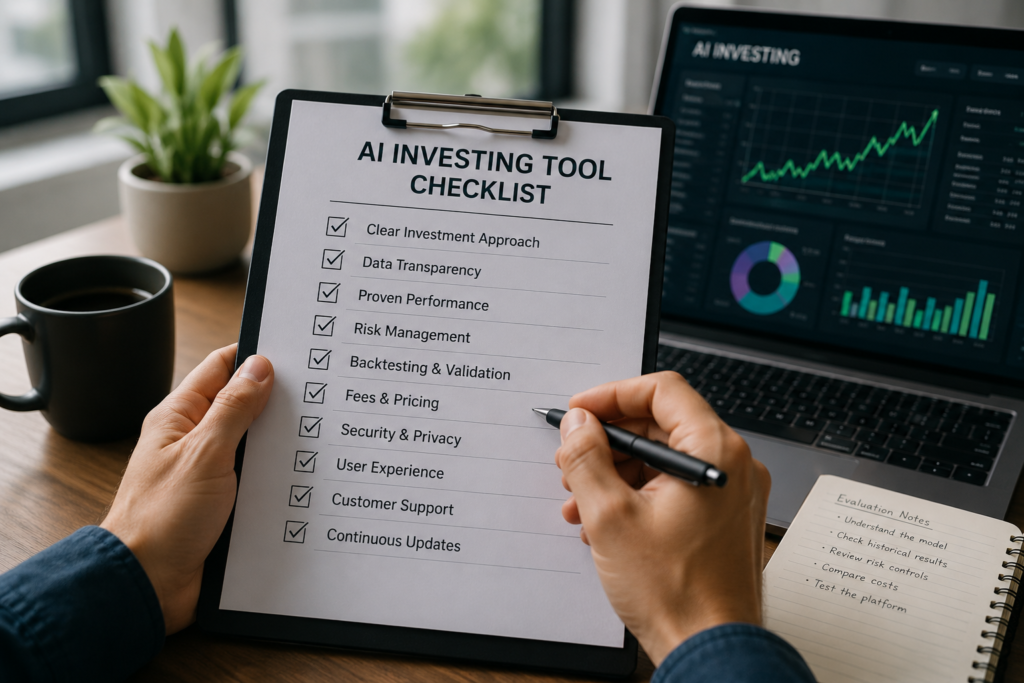
Whether or not this specific tool eventually turns out to be real, the checklist below is worth applying to anything in this category, including tools that look far more polished than this one.
Look for a working product, not just articles about one. A legitimate platform has a visitable website, a sign-up flow, and real screenshots of a real interface — not just third-party blog posts describing it in the abstract, however detailed those posts sound.
Check who’s actually behind it. A real fintech product usually discloses a company name, a jurisdiction, and in many cases a regulatory status, particularly if it touches investment advice or trade execution. If none of that is findable, treat that absence as the headline fact, not a minor detail.
Be skeptical of a single narrative repeated everywhere. If multiple articles share the same phrasing, the same biographical specifics, and no original sourcing of their own, that’s a sign of coordinated content rather than independent verification — the digital equivalent of ten people repeating a rumor they all heard from the same place.
Cross-check independently before trusting anything. Search the product name alongside “scam” or “review” on forums the marketing itself doesn’t control — Reddit threads, Trustpilot, and active trading communities tend to surface real user experiences far faster than SEO-optimized content does.
Never fund an account based on a story alone. An interesting biography doesn’t substitute for a visible track record, transparent pricing, and a product you can test with a small, expendable amount of money before committing anything more.
Treat guaranteed-sounding language as a hard stop. Phrases implying certainty — “can’t lose,” “guaranteed winners,” anything promising consistent high returns — are consistently flagged by regulators as classic markers of investment fraud, regardless of how much AI terminology surrounds them.
This same discipline — verify before trusting, and don’t let a polished pitch substitute for a track record — is exactly the filter worth applying anywhere AI tools are being used to make consequential decisions on someone’s behalf, whether that’s AI recruiting tools ranking job candidates or a platform claiming to rank your next trade.
Frequently Asked Questions
Is the Abraham Quiros Villalba AI tool real?
There’s no verifiable product, company, or independent source confirming it beyond a cluster of similarly worded articles. That doesn’t prove it’s fake, but it does mean there’s currently nothing to test or confirm.
Who is Abraham Quiros Villalba?
Articles describe him as a Costa Rican engineer with a background spanning oil and gas, renewable energy, and early Bitcoin adoption. None of that biography is independently sourced outside of the articles repeating it.
Should I sign up or invest based on what I’ve read?
No. Without a working product, a disclosed company, or any independent confirmation, there’s nothing concrete to sign up for or invest in yet. Treat any request for money or personal information tied to this name as a serious red flag.
How can I tell if a different AI investing tool is legitimate?
Look for a testable product, transparent pricing, disclosed ownership, and a track record that exists somewhere other than marketing copy. If a platform can’t survive basic outside scrutiny, that’s the answer.
Final Thoughts
There’s nothing wrong with being curious about the Abraham Quiros Villalba AI tool — a lot of people are searching for it right now, and the coverage is written persuasively enough that curiosity is a reasonable reaction. But as of today, what’s circulating is a story, not a demonstrable product. Until there’s a real website, a disclosed company, and independent user feedback to check against, the responsible move is to treat every claim as unconfirmed and hold onto your money until that changes.
If you’re evaluating AI tools for investing more broadly, the safer starting point stays the same no matter which platform you’re looking at: pick tools with a transparent, checkable track record and a company you can actually look up — not just a compelling name attached to a compelling story.

An IT career coach with 7 years of experience helping beginners map out certification paths that actually lead to interviews, not just another resume line. He’s guided dozens of career-switchers through their first AWS or CompTIA exam and writes for itechnova.io, covering IT certifications, cybersecurity, and the software tools people actually need to know.