


My Slack got hit with the same question three times last month, worded three different ways: is the CompTIA project certification actually worth chasing. Funny thing is, my answer shifted a little each time depending on who asked. That tells you something about this cert on its own — it’s not a bad credential, it’s just poorly explained by nearly everyone who writes about it. Half the internet treats it like a junior PMP. The other half dismisses it because “everyone already knows agile” now, apparently. Neither camp has actually looked closely, and I say that having personally sat the PK0-005 exam last year while accidentally running a software rollout with zero formal training to my name.
This piece is going to walk through what the CompTIA project certification actually tests, the real dollar cost once every hidden fee gets counted, how I fit studying around a job that didn’t slow down for me, and whether the payoff is real or just marketing. I’ll also touch on where it loses to the PMP outright, and where it genuinely holds its own.
If you searched “CompTIA project” and landed here, you’ve probably already scrolled through a handful of pages that repeat the same three generic sentences and call it a guide. This one goes deeper — actual numbers, my own exam-day mess-ups, and details most write-ups skip entirely.
What The CompTIA Project Certification Actually Covers
Its full name is CompTIA Project+, tied to exam code PK0-005. “CompTIA project” is just the search-bar version most people type, minus the plus sign — my own coworkers drop it too when talking out loud. Peel back the branding, though, and the CompTIA project certification boils down to one question: can you steer a project from a loose concept to a finished result without the schedule, the budget, or the people involved falling apart along the way. Scope creep, silent stakeholders, budget drift — that’s the terrain this exam probes.
CompTIA lays out the certification’s scope with less hype than most competitors would, honestly. The CompTIA project certification targets smaller, lower-stakes projects rather than sprawling enterprise programs, and I’d take a modest pitch over an inflated one any day in this industry.
Structurally, four themes carry the CompTIA project certification: general project management thinking, the arc a project follows from launch to wrap-up, the documentation and tools you’d realistically use on the job, and a slice covering basic IT governance. It doesn’t pin you to a single methodology anywhere. Agile shows up, waterfall shows up, hybrid setups show up — all in the same test, which lines up with how teams actually mix approaches in 2026 rather than picking one and sticking to it forever.
What caught me off guard flipping through the objectives PDF the first time: this isn’t purely technical, and it isn’t purely soft-skills either. It occupies an odd, genuinely useful middle zone. You need enough infrastructure literacy to discuss change control and staging environments intelligently, but you also need to run a stakeholder meeting without it devolving into chaos. That dual nature is exactly why people who bounce between technical work and coordination duties gravitate toward the CompTIA project certification.
Who The CompTIA Project Certification Is Actually For
I’ll disagree slightly with how this gets pitched elsewhere. The CompTIA project certification wasn’t designed for someone who already holds a “Project Manager” title chasing a promotion. It’s built around the person who backed into project ownership without asking for it — the sysadmin dropped into a migration, the help desk lead now juggling three vendor rollouts at once, the marketing hire who somehow inherited a website relaunch nobody else wanted.
For that person, the CompTIA project certification puts vocabulary and structure around instincts they’ve already been using. CompTIA itself points to roughly six to twelve months of relevant hands-on work as a sensible floor — not zero background, but far short of a decade.
I’ve personally guided a few people through this exact shift, from “the person who quietly handles it” to “certified, formally, on paper.” Every single time, the confidence boost showed up first in meetings, well before anything changed on a paycheck.
Who Should Skip This Cert
Most write-ups skip this angle entirely, but it’s worth saying plainly. Someone already three-plus years deep into a real, title-holding PM role gains little from the CompTIA project certification — you’d be studying material you already live in, and this credential simply carries less weight at that stage than a CAPM or PMP would.
Same logic applies if a target job posting hard-requires PMP specifically. Studying for the CompTIA project certification doesn’t satisfy that requirement no matter how well you know the material — an applicant tracking system won’t care. Go straight for PMP eligibility instead in that scenario.
And if you’re brand-new to IT with genuinely zero project exposure, not even informally, I’d push back on jumping straight into this exam. Grab six months of real coordination work first, even unofficial, because the scenario-based questions rely heavily on pattern recognition from lived situations — something memorization alone struggles to fake.
Inside The PK0-005 Exam

Enough vague summaries — here’s the actual shape of what you’re sitting for. The exam currently runs version 5, released toward the tail end of 2022, and it remains the active version heading through 2026.
What the test day itself involves:
- A ceiling of 90 questions, split between standard multiple-choice and hands-on performance-based tasks
- 90 minutes on the clock, delivered in fixed linear order rather than adapting to your answers
- 710 out of 900 required to clear the bar
- Available in English, Japanese, or Thai depending on your testing region
- Zero prerequisite paperwork — no application review, no experience audit before you’re allowed to register
That final point gets undersold constantly. Plenty of certifications force you through an approval process before you can even book a slot. This exam skips it entirely, which partly explains why it’s such a common first credential for people testing the project management waters without much bureaucracy.
Content weighting breaks down roughly like this: project management concepts and life cycle phases each claim close to a third of the questions apiece, tools and documentation take up around a fifth, and governance fills the remainder. Pressed for time? Prioritize life cycle phases specifically — kickoff, planning, execution, closeout keep resurfacing across scenario questions throughout.
Tools And Terms You’ll See On The Test
A meaningful slice of the exam checks whether you recognize named artifacts rather than testing abstract theory alone. Expect these to show up:
- Gantt charts alongside burndown and burnup charts for tracking schedule progress
- PERT charts for estimating task duration when uncertainty’s involved
- Risk registers, issue logs, and change logs as core documentation
- RACI matrices for mapping out who’s responsible for what
- Fishbone diagrams and Pareto charts tied to root-cause and quality analysis
None of this feels exotic if you’ve spent time near a PMO already. If formal project documentation is unfamiliar territory, though, budget real hours here. I underestimated this exact section going in and had to backtrack midway through my own prep once I realized how many question stems named specific chart types outright.
Real Cost Of Getting Certified
Actual figures, not vague ballpark ranges. Plan on the standalone voucher landing somewhere in the high $300s — roughly $390 to $399 at list price — with a fair shot at knocking $30 to $40 off by buying through an authorized reseller instead of straight from CompTIA.
Beyond just the voucher itself, the fuller money picture looks like this:
- Voucher: approximately $390–$399
- Retake protection, genuinely worth grabbing on a first attempt: usually bundled in at a discount rather than priced separately
- Study materials: free if you rely on CompTIA’s own objectives document, or $150–$400 for a structured course with lab access
- Standalone practice exams: $30–$80, or folded into a CertMaster tier instead
Eyeing a security-focused credential down the road too? The voucher-hunting logic barely changes across CompTIA’s entire lineup — we broke it down separately in our CompTIA Security+ exam voucher guide, and nearly all of it transfers over here without modification.
Stack that against the PMP, where PMI’s own fee schedule now runs $445 for members and $675 for everyone else since the August 2026 increase, before training hours or annual dues even enter the picture. Dollar for dollar, this remains the cheaper on-ramp into project management credentialing by a wide margin.
Factor in the invisible costs too — time away from work to actually study, a testing center trip or a quiet corner for online proctoring, and the mental energy of prepping alongside a job that doesn’t pause for you. None of that appears on a receipt, but it’s real when you’re mapping out an attempt.
How I Actually Studied For This
I won’t pretend I had 200 spare hours lying around, because I didn’t. Between a full-time job and a migration project that felt perpetually one crisis from catching fire, six hours a week was the realistic ceiling for my own prep.
What actually moved the needle was treating CompTIA’s free objectives document like a punch list instead of a textbook to read start to finish. Anything I couldn’t define off the top of my head — RACI charts, burndown versus burnup, the distinction between a risk register and an issue log — got flagged and turned into a flashcard on the spot. Anything I already knew cold from the job itself, I skipped without guilt.
The final two weeks, I leaned almost entirely on CertMaster Practice, mainly because a countdown timer exposes shaky knowledge faster than anything else. If you’re trying to figure out which CertMaster tier is actually worth paying for, we laid that comparison out in our CompTIA CertMaster guide — worth a read before dropping money on the wrong one, since it genuinely shaped how I paced my last stretch.
Being upfront about the trade-off: I skipped the full video course entirely, and it probably cost me a few points on the governance section. If ESG and compliance terminology feels unfamiliar to you, don’t take that same shortcut.
What Exam Day Actually Feels Like
Nobody covers this part, so I will. I sat mine at a physical testing center on a Tuesday morning, mostly because weekend slots in my area were booked out two weeks ahead — which says something about how much demand exists locally.
Check-in ran about fifteen minutes: ID verification, empty pockets, phone in a locker, the standard drill. Once seated, 90 minutes moves faster than expected, largely because performance-based questions quietly eat time without you noticing. One drag-and-drop task on sequencing project phases alone cost me a solid four minutes, which felt brutal with a visible clock running down.
My biggest takeaway: flag anything uncertain and move forward immediately rather than getting stuck fighting it. I burned nearly ten minutes on one early governance question, then had to rush the final fifteen because of it. Passed regardless, but it was closer than comfortable, and it taught me more about pacing than any practice exam managed to.
Results appear the second you submit — instant relief or instant gut-punch, depending on how the morning went. Mine showed “pass” before I’d even fully registered what I was reading.
A Study Timeline That Works
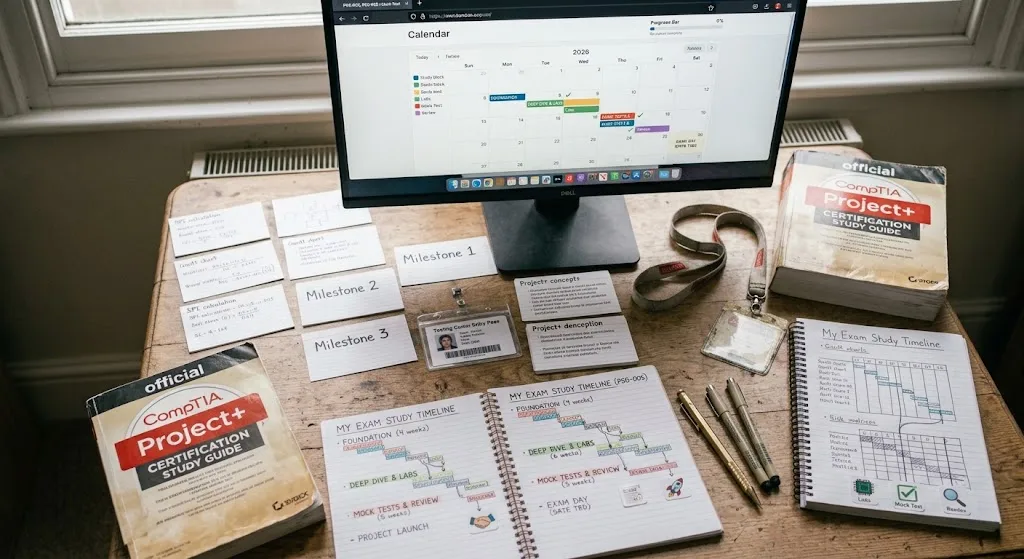
Starting from zero project background, here’s a pace built on realism instead of ambition:
- Week 1–2: Read the full objectives once purely for orientation — hold off on memorizing anything yet
- Week 3–4: Turn every shaky term or framework into a flashcard as you go
- Week 5–6: Daily practice questions, about thirty minutes, tracking which domain keeps beating you
- Week 7: One complete timed mock exam, then break down every wrong answer for the underlying reasoning, not just the correct letter
- Week 8: Pure review, nothing new — revisit weak spots only, then lock in your test date
Spread across eight lighter weeks, this beats cramming into two exhausting weekends every time I’ve watched someone try both routes. Already juggling informal project work day to day? Four or five weeks likely covers it.
One warning worth repeating: don’t book your exam date before you’ve actually started studying. I’ve watched people lock in a date too early, panic two weeks out, then either eat a rescheduling fee or walk in underprepared. Study first. Book once your practice scores hold steady.
Project+ Versus PMP Versus CAPM
Here’s the side-by-side comparison people are actually searching for, stripped of sales language:
| Factor | CompTIA Project+ | CAPM (PMI) | PMP (PMI) |
| Experience required | None formally required | 23 hours of PM education | 3–5 years PM experience |
| Exam price | Around $390–$399 | Roughly $300 | $445 members / $675 non-members |
| Length | 90 items, 90 minutes | 150 items, 3 hours | 180 items, 230 minutes |
| Keeps you certified | 3-year cycle, CEUs or retest | 3-year cycle, PDUs | 3-year cycle, 60 PDUs |
| Fits best | Accidental PMs, IT coordinators | Early-career, aspiring PMs | Seasoned project leads |
CAPM occupies the middle ground — cheaper than PMP but still anchored to PMI’s specific terminology, whereas this certification stays framework-neutral throughout. Eyeing PMP eventually? PMI spells out eligibility paths directly, and it’s worth knowing upfront that the CompTIA project certification isn’t a formal prerequisite for PMP at all. Consider it practice rather than a required rung on that ladder.
A common mistake in this comparison is assuming all three certs fight for identical job postings. They largely don’t. This one competes for coordinator and analyst-level roles, CAPM competes inside entry-level PM tracks at larger PMOs, and PMP competes for positions where “Project Manager” already sits in your current title.
Certifications People Confuse This With
Beyond PMP and CAPM, a handful of other credentials get mixed up with the CompTIA project certification often enough to untangle here. PRINCE2 leans heavily UK-and-Commonwealth in adoption, far more documentation-heavy as a methodology, and rarely the right comparison point for a US-based job search. Scrum Master credentials, from either Scrum.org or Scrum Alliance, cover agile exclusively and skip waterfall or hybrid entirely — a poor substitute if your actual job blends methodologies the way most do.
ITIL gets lumped in occasionally too, mostly because it’s another CompTIA-adjacent, process-heavy credential — but ITIL addresses IT service management, not project delivery, and the overlap is thinner than the naming similarity implies. If someone suggests ITIL when you asked about this certification specifically, they’ve likely confused two unrelated things.
These distinctions matter in practice because job listings sometimes accept “equivalent” certifications for a named requirement, and knowing when a vendor-neutral credential like this genuinely counts as that equivalent — and when it doesn’t — saves wasted application effort.
Self-Study Versus Bootcamp Versus Bundle
Three realistic paths exist toward earning this certification, and picking wrong wastes either time or money. Pure self-study, using free objectives plus one solid practice bank, costs the least and works fine if you already carry some project exposure. It demands self-discipline, though — nothing external keeps you on track.
A guided bootcamp or live course runs pricier, typically $300 to $800, but adds structure and a peer cohort for accountability. I’d point someone with genuinely zero background and motivation concerns toward this route specifically.
CertMaster bundles land somewhere in between — self-paced yet structured, with built-in labs and progress tracking. For most people targeting this exact certification, though, I’d steer toward self-study plus one strong practice bank over a full bundle purchase, mainly because the underlying content isn’t dense enough to justify a full platform’s premium. Save bundle spending for something meatier, like Security+ or a cloud-focused track.
Is The CompTIA Project Certification Even Worth It
Here’s the part people resist hearing: three-plus years into dedicated PM work already, and your time’s better spent chasing CAPM or PMP directly rather than circling back to this credential.
But for the IT technician, the analyst, or the ops person already handling project work informally without a matching title — this one earns its cost. It’s cheaper than the alternatives, doesn’t lock you into one vendor’s framework, and gives a hiring manager a fast, credible signal that you handle scope, scheduling, and stakeholder communication without them digging through a resume for proof.
Still unsure project management is even your direction? Our IT certifications for beginners breakdown maps this certification against A+, Network+, and the cloud-track options — a useful gut check before committing money and hours anywhere specific.
I’ll say this directly too: the real value here leans toward confidence and shared vocabulary more than a direct salary lever. Chasing a specific dollar figure works better through negotiation or a role change than through this credential alone.
How This Looks On A Resume Or LinkedIn
List it exactly the way CompTIA writes it officially — “CompTIA Project+” — placed right after your name in a credentials line, or under a dedicated certifications section with the date earned. Recruiters skimming quickly tend to catch that top section first, so don’t bury it three pages deep inside a generic skills list nobody actually reads.
On LinkedIn, drop it into the Licenses & Certifications section specifically, rather than just mentioning it somewhere in your headline. It renders as a verified-style badge there, and two separate recruiters have told me they filtered candidates using that exact field during an active search. Whether that’s universal practice, I can’t confirm — but filling it in correctly costs nothing.
One small snag that tripped me up early on: don’t rename it as “CompTIA Project Management” or any reworded variant. Use the official title exactly, since some applicant tracking systems match keywords literally against job requirements, and a slightly altered name can quietly keep your application from ever surfacing in a filtered search.
Regional Differences And Global Recognition
Since the exam itself runs in English, Japanese, and Thai, recognition genuinely varies by region and it’s worth addressing directly. Across the US and Canada, this certification is reasonably well known within IT circles but rarely appears as a hard requirement the way Security+ does — more of a nice-to-have signal boost than a gatekeeping credential.
In parts of Asia, particularly markets where CompTIA has invested more heavily in local partner training, I’ve noticed it carrying slightly more standalone weight, partly because formal project management credentialing culture there is younger compared to how deeply entrenched PMP already is in North American hiring.
Job hunting across borders? Don’t assume uniform recognition anywhere. It functions as a genuinely useful vendor-neutral signal everywhere, but how actively a hiring manager actually looks for it swings more than CompTIA’s own marketing tends to acknowledge.
Jobs This Actually Opens
Nobody lands a Senior PM title off this certification alone. What it does is strengthen applications for roles like IT project coordinator, junior project manager, business systems analyst, or technical program assistant — particularly at companies that skip a hard PMP requirement but still want evidence you understand basic project vocabulary.
From what I’ve seen, it functions more as a tiebreaker than a golden ticket. Between two similarly qualified candidates, recruiters I’ve spoken with admit the certified one earns slightly more benefit of the doubt on whether they can actually run a meeting or keep a budget on track without hand-holding.
Government labor data backs up genuine long-term demand in the broader field: Bureau of Labor Statistics figures put total employment for project management specialists at roughly 1.1 million people as of 2025, with hiring projected to climb 7% over the following decade — comfortably ahead of the average across all occupations, with thousands of fresh openings appearing annually. That sustained pull is a big reason an entry-level credential in this space still holds relevance.
Geographically and industry-wise within the US, I’ve noticed this certification gaining more traction at mid-size companies specifically — somewhere in the 200-to-2,000-employee range — where project work never stops but headcount doesn’t justify a fully staffed, PMP-heavy PMO.
Real Salary Numbers
Skipping the generic “boosts your earning potential” phrasing for actual figures instead: nationally, project management specialists sat at a median salary just above $102,000 as of May 2025. That figure covers the entire occupation broadly, not people holding this specific certification, so don’t mistake it for a guaranteed personal outcome from one exam.
Industry shifts that number considerably. Finance and insurance topped the list, clearing $120,000, with professional and technical services trailing closely in the high $100,000s. Construction and administrative-support roles sat lower, closer to the upper $90,000s. Where you actually land a role matters just as much as whether the certification appears on your resume at all.
This particular credential tends to align more with entry and mid-level coordinator work rather than the higher specialist figures above, so treat this section as useful context, not a paycheck guarantee tied to a single 90-minute test. In my own case, no immediate raise followed — what I got instead was a stronger position the next time compensation came up in conversation, because I had something concrete to point to instead of just “I’ve been doing this informally for a while now.”
How This Compares To Just Learning On The Job
A fair question people ask often: why bother with the CompTIA project certification at all instead of learning purely through experience? You genuinely can skip it. Plenty of solid project coordinators never touch a formal credential.
What this certification adds is speed and external validation. Learning purely on the job means absorbing terminology unevenly, project by project, sometimes with gaps you don’t notice until a bigger role exposes them unexpectedly. Studying for this exam forces the full vocabulary and framework set into weeks instead of years, and it hands you an outside party — CompTIA — willing to vouch for what you know, rather than relying solely on a manager’s word.
That said, I wouldn’t treat this certification as a substitute for actual hands-on project experience. The strongest outcome I’ve personally seen pairs both together — real coordination work plus the credential formalizing it — rather than leaning entirely on either one by itself.
Mistakes People Make Chasing This Cert
A handful of recurring patterns are worth naming directly:
- Treating this certification as PMP-lite and expecting senior-level offers to follow automatically
- Skimming past governance and IT concepts because it feels less exciting — it’s still nearly a fifth of the exam
- Buying a full CertMaster bundle when free objectives plus one practice bank would’ve handled it fine
- Delaying the actual exam booking after finishing prep, then losing sharpness before test day arrives
- Treating this as a single career-defining move rather than one piece of a broader plan
Mapping this against a longer IT career trajectory instead of a standalone exam? Our IT certification roadmap guide breaks down sequencing — what to knock out first, what’s safe to skip entirely, and how to avoid stacking up certifications nobody in an interview will ever ask about.
Before You Register: A Quick Checklist
Before actually paying for a voucher, run through this list honestly:
- Have you read the full exam objectives at least once, start to finish?
- Can you explain agile versus waterfall out loud, unscripted, without notes?
- Do you know what separates a project charter from a business case?
- Have you scored consistently above 80% on at least one complete practice exam?
- Is there an actual exam date booked, not just a loose “sometime soon” plan?
Can’t check most of these yet? That’s fine — it means you’re not quite ready to book, not that the certification itself is a poor choice.
Renewal And Keeping It Active
This runs on the same three-year cycle as most CompTIA credentials. Staying current means either banking continuing education units through their program or retaking the newest exam version before your window closes. No experience audit gets required at renewal time — purely CEUs or a retest, whichever fits better.
Don’t assume the CEU path is automatically free, though — it isn’t. Most people I’ve talked with still prefer earning CEUs over retesting, mainly because it spreads the work gradually across three years instead of cramming for another high-stakes exam day.
Frequently Asked Questions
Is CompTIA Project+ hard to pass?
Not particularly, assuming some hands-on project exposure already exists. Hitting 710 out of 900 is achievable with focused prep, though scenario-heavy questions do trip up anyone who only memorized bare definitions.
Do I need experience before taking the exam?
Nothing’s formally required, though CompTIA suggests roughly six to twelve months of related hands-on work as a reasonable floor before attempting it.
Is the CompTIA project certification recognized outside the US?
Yes — it stays vendor-neutral globally, sat in English, Japanese, or Thai, though how actively employers actually look for it varies noticeably by region.
Can this certification replace a PMP eventually?
Not really. They serve entirely different career stages. This one works well as an entry point; PMP demands years of documented experience and carries more weight for senior positions.
How long does the certification stay valid?
Three years from your pass date, renewable through CEUs or by retaking the current exam version.
Will it guarantee a raise?
No single credential guarantees pay changes. It strengthens your case and resume, but the actual raise typically comes from negotiation or a role change, not the exam itself.
Better to start with this certification or CAPM?
Inside IT specifically, and wanting something cheaper and framework-neutral, start here. Already committed to a long-term PMI career path? CAPM aligns better with that direction.
Final Thoughts
Already handling project work with nothing on paper to show for it? The CompTIA project certification offers a low-cost, practical way to close that gap. It won’t catapult anyone into a senior role overnight, and I won’t pretend my own paycheck jumped the week I passed. What it genuinely delivered was vocabulary and structure for things I was already doing on instinct — and that showed up in smoother meetings long before it ever showed up on a pay stub.
Eyeing a move from general IT work into project coordination specifically? This is a sensible, low-risk starting point. Just walk in with realistic expectations about exactly what one exam can and can’t change about your title.

An IT career coach with 7 years of experience helping beginners map out certification paths that actually lead to interviews, not just another resume line. He’s guided dozens of career-switchers through their first AWS or CompTIA exam and writes for itechnova.io, covering IT certifications, cybersecurity, and the software tools people actually need to know.