
Discover proven skincare tips AI technology secrets that actually work, backed by real dermatology experience and honest, no-fluff advice for smarter skin.
I spent almost a decade behind the counter at a dermatology clinic, and if there’s one thing that changed how I talk to clients, it’s watching apps and scanners try to replace what a trained eye used to do alone. Skincare tips AI technology isn’t some far-off gimmick anymore — it’s sitting in people’s bathrooms, built into their phone cameras, and quietly rewriting how routines get built. That shift didn’t happen overnight, and it hasn’t been smooth either.
Here’s the thing nobody tells you upfront: most of these tools are only as good as the data feeding them. I’ve tested a dozen apps that promise to scan your face and hand back a “personalized” routine, and maybe three actually held up under real scrutiny. So this isn’t a puff piece cheering on every new gadget. It’s a straight look at where skincare tips AI technology genuinely helps, where it falls short, and how to use it without wasting money on nonsense.
Most people reaching for these tools fall into a few buckets. There’s the busy professional who doesn’t have time for a dermatologist appointment every time a breakout shows up. There’s the teenager dealing with acne for the first time and no idea where to start. And there’s the person past forty who suddenly notices sun damage they never paid attention to in their twenties. All three end up typing the same kind of search — something like “best skincare routine for my skin type” — and land on an app promising to answer it in thirty seconds. Sometimes that promise holds up. Sometimes it doesn’t.
What Is Skincare Tips AI Technology, Exactly?
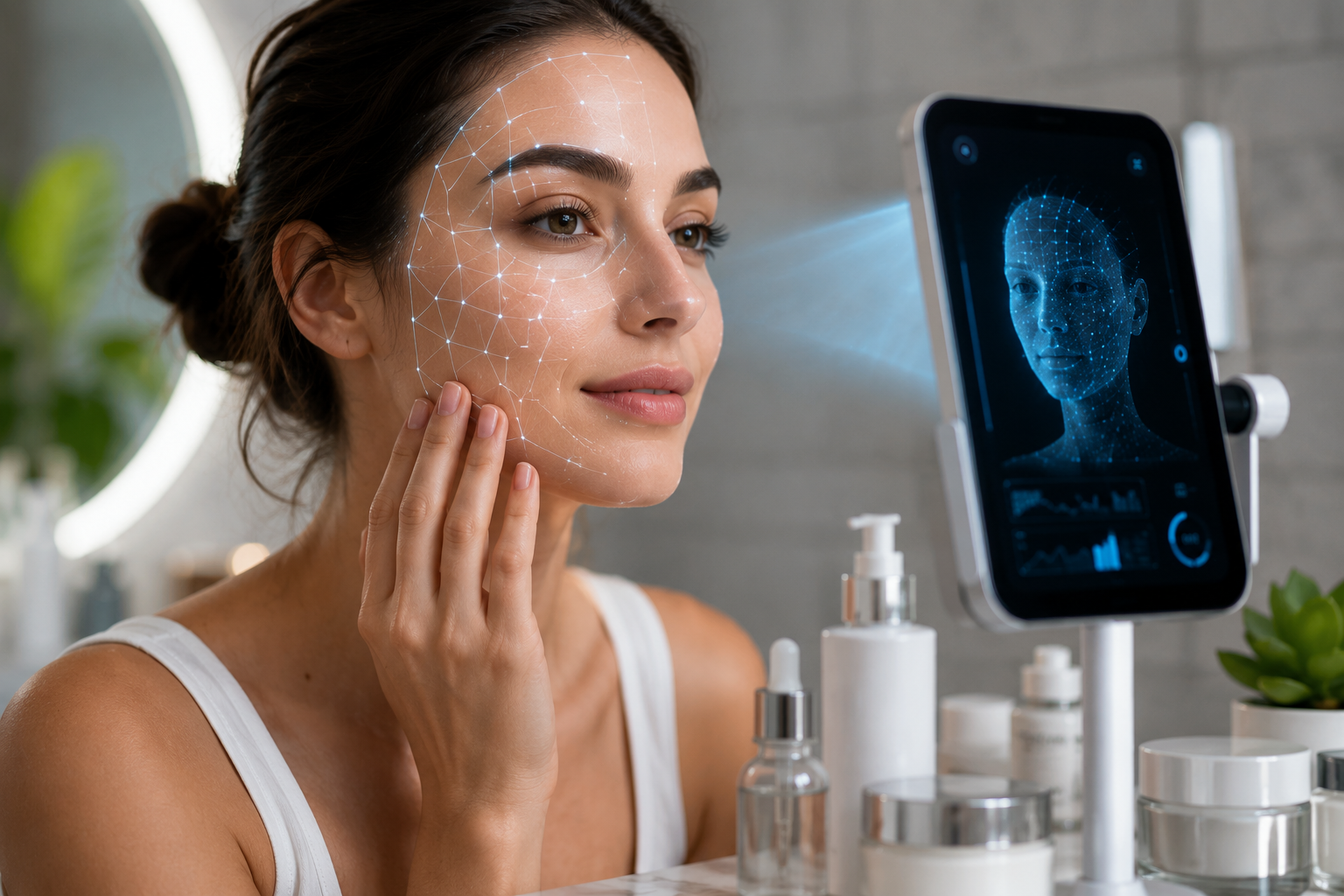
At its core, skincare tips AI technology refers to software — usually paired with a camera or sensor — that analyzes skin conditions and generates advice based on patterns in massive datasets. Wrinkle detection. Pore mapping. Pigmentation scoring. Sometimes even a hydration estimate pulled from nothing more than a single selfie. A few tools go further and track your skin over weeks, catching changes a person would probably miss on their own.
It’s not magic. Underneath the friendly interface, you’re looking at computer vision models trained on thousands (sometimes millions) of labeled skin images. The better platforms, like the ones covered in this AI skincare routine breakdown, pull from dermatologist-reviewed datasets rather than crowdsourced photos, which matters more than most people realize. A model trained on poor data will confidently give you bad advice — it just won’t sound uncertain about it.
There are really two broad categories worth knowing about. The first is consumer-grade apps, the kind you download for free and scan with your phone’s front camera. These are convenient but limited by whatever lighting and lens quality your phone happens to have. The second is clinical-grade imaging, the sort you’d find at a dermatology office or a higher-end spa, using dedicated hardware with controlled lighting and multiple wavelength sensors. Clinical tools cost more and aren’t something you’ll use daily, but they catch details a phone camera physically can’t. Knowing which category you’re dealing with changes how much weight you should put on the results.
Why Skincare Tips AI Technology Actually Matters Right Now
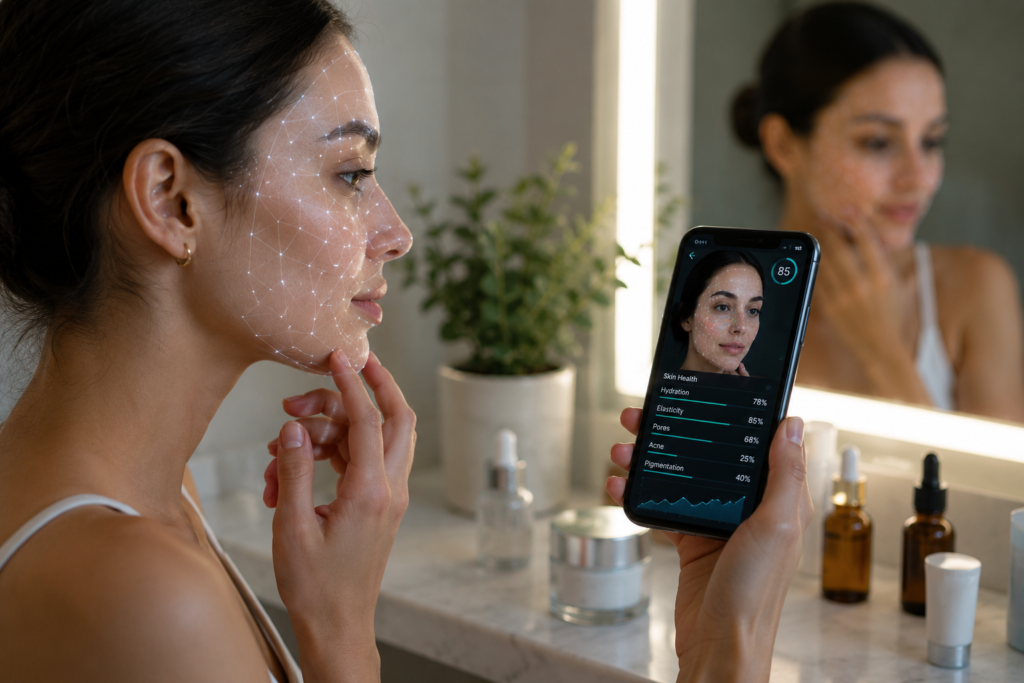
Skin care used to be guesswork dressed up as expertise. You’d walk into a store, someone would glance at your face for ten seconds, and hand you a serum that matched whatever was on sale. That’s changing. And honestly, it needed to.
The reason skincare tips AI technology matters isn’t the novelty — it’s consistency. A scanner doesn’t get tired at hour eight of a shift. It doesn’t upsell you because commission is on the line. It measures the same metrics the same way every single time, which means you can actually track whether a product is working instead of relying on vibes and a mirror.
People stick with a routine longer when they can actually see the data behind it — that part I didn’t expect at first. I’ve watched clients follow a regimen for the first time in years, not because I convinced them, but because an app handed them a progress chart instead of another stranger’s opinion.
Think about how skincare advice used to spread. A friend swears by a product. You try it. Maybe it works — maybe your skin breaks out badly and you spend three weeks trying to figure out why, blaming the wrong thing the whole time. Skincare tips AI technology cuts through a chunk of that guesswork. It grounds advice in measurable patterns instead of word-of-mouth luck. Doesn’t get everything right, but it beats picking a serum because someone held it up on camera for four seconds and called it life-changing.
Core Features Behind Modern Skin Analysis Tools
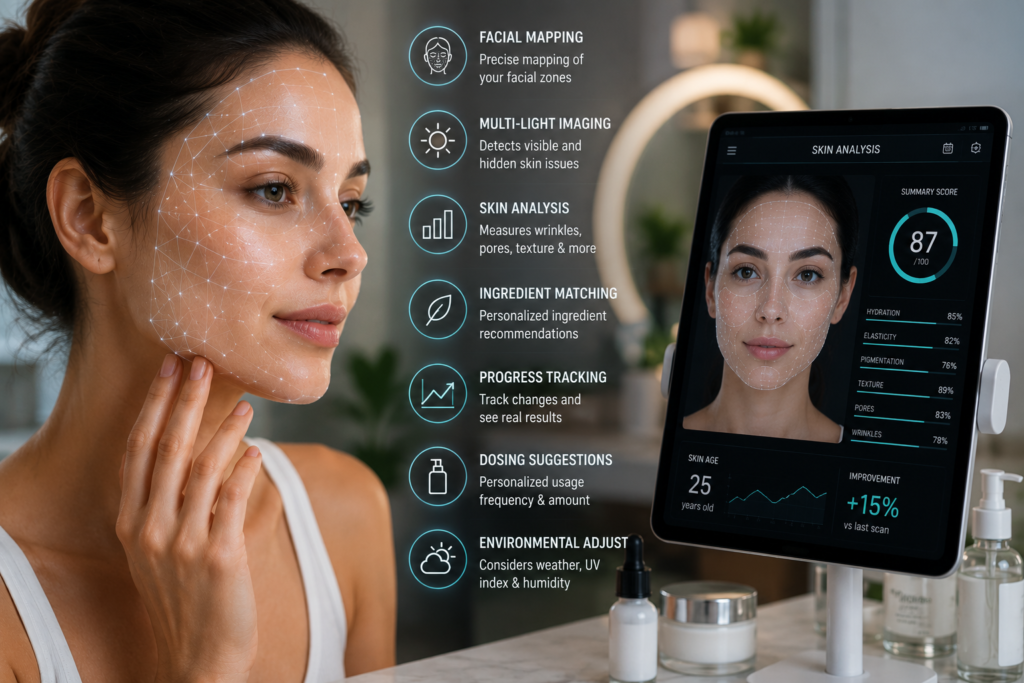
Most platforms built around skincare tips AI technology share a handful of core components. Branding looks different from one app to the next, sure, but strip away the marketing and you’ll find the same handful of building blocks underneath almost every single time.
- Facial mapping — the face gets split into zones (T-zone, cheeks, under-eye), so you’re not getting the same generic advice for every part of your skin
- Spectral or multi-light imaging — higher-end tools use UV or polarized light here, catching sun damage that’s completely invisible under normal lighting
- Ingredient matching engines — cross-referencing your scan results against a database of active ingredients and known interactions
- Progress tracking — weekly or monthly comparison photos with quantified change, not just “looks better”
- Personalized dosing suggestions — how often to apply a retinoid or acid based on sensitivity readings, not a generic label instruction
- Environmental adjustment — some tools factor in local humidity and UV index data, tweaking recommendations for winter dryness or summer sun exposure
- Barrier health scoring — newer platforms measure signs of a compromised moisture barrier, something that used to require an in-office consultation to catch
The ingredient matching piece is where I’ve seen the biggest leap. A few years back, this was static advice — “use retinol at night.” Now the better systems check what you’re already using and warn you before you layer something that’ll irritate your skin.
Sensitivity readings deserve a quick explanation too, since it’s the feature most people misunderstand. The system isn’t measuring pain tolerance — it’s estimating how reactive your skin barrier is likely to be based on redness patterns, visible dryness, and texture irregularities picked up in the scan. A high sensitivity reading doesn’t mean you’ll definitely react badly to a new product — it just means the odds are stacked a little higher, so patch testing matters more for you than it would for someone flagged as low sensitivity.
How Skincare Tips AI Technology Works Behind the Scenes
Here’s the part most articles skip. Your photo gets processed through a convolutional neural network — a type of model built specifically to recognize visual patterns like edges, texture, and color gradients. The network was trained beforehand on labeled examples: this is acne, this is rosacea, this is normal pore size for this age bracket.
Once it identifies patterns, the system cross-references a rules engine — basically a giant decision tree built by dermatologists — to translate “moderate hyperpigmentation, upper cheek” into an actual product suggestion. Some apps stop there. The more advanced ones layer in a recommendation model that adjusts based on your feedback loop: did you follow the last suggestion, did your skin improve, did you report irritation.
This is also where skincare tips AI technology runs into real limits. Lighting, camera quality, even the angle of your phone can throw off a scan. I’ve seen the same face analyzed twice in one day return different pigmentation scores just because the second scan happened near a window instead of under a lamp.
Worth mentioning here — the training data itself usually comes from clinical partnerships, university dermatology departments, or licensed image banks. Reputable companies will actually say so, if you dig into their about page. Won’t tell you where the training images came from? That’s a decent signal to be cautious. Small detail. Most users never check it. But it says a lot about whether a platform actually cares about accuracy or is just chasing app store downloads.
Real Benefits Worth Paying Attention To
I’ll be direct about what actually works.
Consistency is the biggest win. A scanner tracking your skin weekly catches slow changes — the kind that build up over two months and would otherwise go unnoticed until they’re a bigger problem. That early flagging matters for things like sun damage or early rosacea patterns.
Cost savings show up too, though not in the way marketing suggests. It’s not that the tools are cheap. It’s that they stop you from buying five products that don’t match your actual skin type. I’ve had clients cut their monthly skincare spend nearly in half just by trusting a scan over a salesperson’s pitch.
Accessibility matters more than people give it credit for. Not everyone lives near a dermatologist, and appointment wait times in a lot of regions stretch past two months. A decent scanning tool won’t replace a doctor, but it gives people in underserved areas a starting point that’s better than nothing.
There’s a data-quality benefit too, one that compounds the longer someone uses these tools. A single scan is a snapshot. Twenty scans over six months is a trend line, and trend lines are what actually let you separate a product that’s working slowly from one that’s doing nothing at all. Skin improvement is often too gradual to notice day to day — a two percent reduction in redness or a slight increase in measured hydration won’t register in a mirror, but it shows up clearly once the numbers are lined up side by side.
One benefit that doesn’t get talked about enough is early habit correction. A lot of people layer products in the wrong order for years — applying sunscreen before moisturizer, or using an acid and a retinol on the same night without realizing it cancels out half the benefit. A well-built scanning tool flags this kind of routine conflict directly, sometimes catching mistakes a person has been making for a decade without ever knowing.
And there’s the accountability angle — seeing your own data laid out tends to keep people honest about whether they’re actually following through on a routine.
Where the Technology Still Falls Short
Skin tone bias is the biggest one, and it’s not a small issue. A lot of early training datasets skewed heavily toward lighter skin, which means darker skin tones sometimes get flagged inaccurately for conditions that are actually normal pigmentation variation. This has improved, but it hasn’t disappeared, and anyone using these tools should know that going in.
Medical conditions get missed too. An app can’t tell the difference between eczema and a fungal infection reliably — not yet, anyway. If something looks off and doesn’t improve with basic care, a real dermatologist visit still beats trusting a phone scan.
I’ve seen this trip people up more than once. A rash gets scanned, the app calls it irritation or dryness, and the person spends weeks treating the wrong thing. Then they finally see an actual doctor, who spots contact dermatitis — or a mild fungal issue — in about ninety seconds flat. That’s exactly where pattern-matching software struggles most. Two completely different problems can look almost identical in a flat, two-dimensional photo.
Privacy’s worth a mention too. Facial scan data is sensitive stuff, and not every app is upfront about where it goes or how long it sits on some server. Read the fine print before you hand your face over to a company you know nothing about.
Cost is a real barrier too, on the higher end. The free apps tend to be the least accurate, while the platforms with genuine dermatologist backing often run a subscription fee — somewhere in the range of a streaming service, sometimes more. That price gap creates an uncomfortable pattern where the more reliable version of skincare tips AI technology ends up out of reach for people who might actually need it most.
Getting Started: A Step-by-Step Approach
If you’re trying skincare tips AI technology for the first time, don’t just grab whatever app pops up first in the store. Here’s how I’d actually walk a client through it.
First, pick a tool with published accuracy data or dermatologist partnerships — not just app store ratings, which get gamed constantly. Second, scan under consistent lighting every time; natural daylight near a window works better than a bathroom overhead light, which distorts tone. Third, run the scan weekly rather than daily. Daily scans just add noise since skin doesn’t change meaningfully in 24 hours. Fourth, cross-check any serious flag (something like a suspicious mole or unusual texture change) with an actual doctor rather than trusting the app’s diagnosis outright. Fifth, keep a simple log of what you changed in your routine alongside each scan so you can actually connect cause and effect later.
Sixth, give the tool at least four to six weeks before deciding whether it’s actually useful. One scan tells you almost nothing on its own — the value shows up in the pattern across multiple sessions, not a single snapshot.
That last step sounds tedious, but it’s the difference between guessing and knowing.
Practical Examples From Real Routines
A client of mine — mid-thirties, kept breaking out along her jawline no matter what cleanser she tried. The scan flagged hormonal-pattern acne based on the location and texture of it, which pushed her to look at her diet and stress levels instead of swapping products for the fifth time that year.
Another case — a guy in his fifties who’d never worn sunscreen consistently — got a UV imaging scan that showed sun damage he couldn’t see with the naked eye, spread across his forehead and the tops of his ears. That visual did more to change his habits than any lecture from me ever could’ve. Some people just need to see it before they’ll believe it.
There’s also a case I think about a lot — a college student who kept getting told her skin was “just oily” by every clerk at the beauty counter. A scan actually broke down that she had dehydrated skin producing excess oil to compensate, which is a completely different problem with a completely different fix. She switched from stripping cleansers to a gentler routine with actual hydration, and the oiliness calmed down within a few weeks. That’s the kind of nuance a rushed in-store consultation almost never catches.
I’ve also seen skincare tips AI technology used well for tracking product performance directly. Someone trying a new vitamin C serum ran weekly scans for six weeks and could actually see the brightening trend in the data instead of squinting in a mirror wondering if anything changed at all. For more on setting up a tracking routine like that, this guide on building smart skincare habits breaks down the process step by step.
Expert Tips for Getting More Out of These Tools
Don’t chase every recommendation an app throws at you. If a scan suggests six new products, that’s a red flag, not good advice — real dermatological guidance rarely means overhauling everything at once. Introduce one product at a time and give it a full month before judging results, since most active ingredients need that long to show visible change.
Pay attention to how a tool explains its reasoning. If it just says “buy this,” walk away. If it explains why — hydration levels are low in this zone, or pigmentation increased 4% since last scan — that’s a sign the underlying model is doing something more sophisticated than a sales funnel dressed up as science.
Something else worth testing early on: run the same scan twice within a few minutes, same lighting, same angle. If the two results come back wildly different, that tells you the model has a stability problem — noise in its output that has nothing to do with your actual skin. A reliable tool should give you close to the same numbers both times, give or take a small margin. This is a five-minute test that saves people from trusting a shaky platform for months before figuring out the readings were never consistent to begin with.
Patch notes matter more than people realize too. Companies serious about their scanning accuracy tend to publish updates about retraining their models or adding new skin tone categories to their datasets. If a company hasn’t touched its model in two or three years, that’s not necessarily disqualifying, but it’s worth a second look — skin science and imaging hardware both move fast enough that stagnant tools tend to fall behind quietly.
And don’t skip sunscreen just because an app didn’t flag sun damage yet. By the time a scan catches it, you’re already behind. Prevention beats detection every time in skincare, technology or not.
One more thing worth flagging — check whether the platform lets you export your own scan history. A lot of newer users don’t think about this until they want to switch apps or bring their data to an actual dermatologist appointment, and by then some platforms make it painfully hard to pull your own history out. Pick a tool that treats your scan data as yours, not just something locked inside their ecosystem.
Common Mistakes People Make With These Tools
Trusting a single scan too much is probably the most common mistake. One bad lighting angle and suddenly someone thinks they have a skin condition they don’t actually have. Patience matters here — run a few scans before drawing conclusions.
Ignoring the basics is another one. I’ve seen people obsess over app recommendations while skipping sunscreen entirely, which undoes most of the benefit regardless of how good the analysis is.
Buying too fast is a mistake too. A lot of these platforms partner with brands, and recommendations sometimes lean toward products the app profits from. Cross-check suggestions against independent reviews before buying, especially for anything expensive.
Mixing too many new products at once ranks up there too. Someone gets a scan, sees four flagged issues, and buys a solution for each one the same week. A week later their skin is irritated and there’s no way to tell which product caused it, because everything changed at once. Slower is genuinely better here — one variable at a time, always.
Skipping the follow-up scan is a quieter mistake, but a common one. People run an initial scan, buy the recommended products, then never check back in to see if anything actually changed. Without that second data point, you’re back to guessing whether the routine is working, which defeats most of the point of using a measurement tool in the first place.
Last one — expecting overnight results. Skin takes weeks to show change, and no scanning tool speeds up biology. Patience is still part of the process, no matter how advanced the tech gets.
I’d also add: don’t assume every app using the phrase “AI-powered” is actually running a sophisticated model. Some are just dressed-up decision trees with a few if-then rules behind a slick interface, marketed as something more advanced than what’s actually happening under the hood. It’s worth a quick search for how a company describes its own technology before trusting it with your skin — and your money.
Who Actually Benefits Most From These Tools
Not everyone needs skincare tips AI technology in their routine, and that’s fine to admit. Someone with clear, stable skin who’s already found products that work has less to gain from constant scanning — there’s just less to track.
The people who benefit most are dealing with change or uncertainty. That’s someone managing hormonal acne that flares unpredictably, someone new to a country with different climate and sun exposure than what their skin is used to, or someone navigating perimenopause when skin behavior shifts in ways that are hard to predict from experience alone. In all three cases, having objective measurements over time beats relying on memory or gut feeling about whether things are getting better or worse.
Older adults are an interesting group here too. A lot of dermatological damage from decades of sun exposure only becomes visible under UV imaging, long before it shows up to the naked eye. Catching that early — even if the honest answer is “the damage is already done, focus on prevention now” — still has value. It’s better than finding out during a biopsy years later.
Pregnant and postpartum people are worth a mention here too, since hormonal shifts during this period can trigger melasma, acne, or unpredictable dryness that doesn’t match anything they’ve experienced before. A lot of standard skincare advice gets thrown out during pregnancy anyway, since certain actives aren’t recommended, so having objective tracking to guide safer substitutions can genuinely help fill the gap left by fewer product options.
Athletes and outdoor workers fall into this group as well, though people rarely think to include them. Someone spending eight hours a day outside — construction, landscaping, coaching — accumulates sun exposure at a rate most skincare advice doesn’t account for. A scan built around typical indoor lifestyles will under-recommend sun protection for this group badly, so it’s worth telling the app or adjusting recommendations manually if your lifestyle skews heavily outdoors. This is one spot where the underlying models still need a human filling in the context a general algorithm can’t guess on its own.
People managing chronic skin conditions like rosacea or psoriasis fall into this category too, though for a slightly different reason. These conditions flare and calm down in cycles that can span weeks, and it’s genuinely hard to remember whether last month was better or worse than this month without something tracking it. A simple photo log, even without fancy analysis attached, gives a much clearer picture than memory alone. Add in automated flare detection and you’ve got an early warning system that can prompt someone to adjust their routine or call their doctor before a flare gets out of hand.
Frequently Asked Questions
Is skincare tips AI technology accurate for all skin tones?
Accuracy has improved but isn’t perfect across all tones yet. Darker skin tones can still get less reliable readings depending on the app’s training data, so cross-checking with a dermatologist is smart.
Can these apps replace a dermatologist visit?
No, not for medical conditions or anything unusual looking. They’re useful for routine tracking and general guidance, but anything concerning still needs a real doctor’s opinion.
How often should I scan my skin?
Weekly is usually enough. Daily scans mostly just add noise since skin doesn’t change meaningfully within 24 hours, and it can make you overreact to normal fluctuation.
Do these tools work for acne-prone skin specifically?
Yes, many are actually built with acne tracking as a core feature, since it’s one of the easier conditions to visually measure and monitor over time.
Where This Technology Is Heading Next

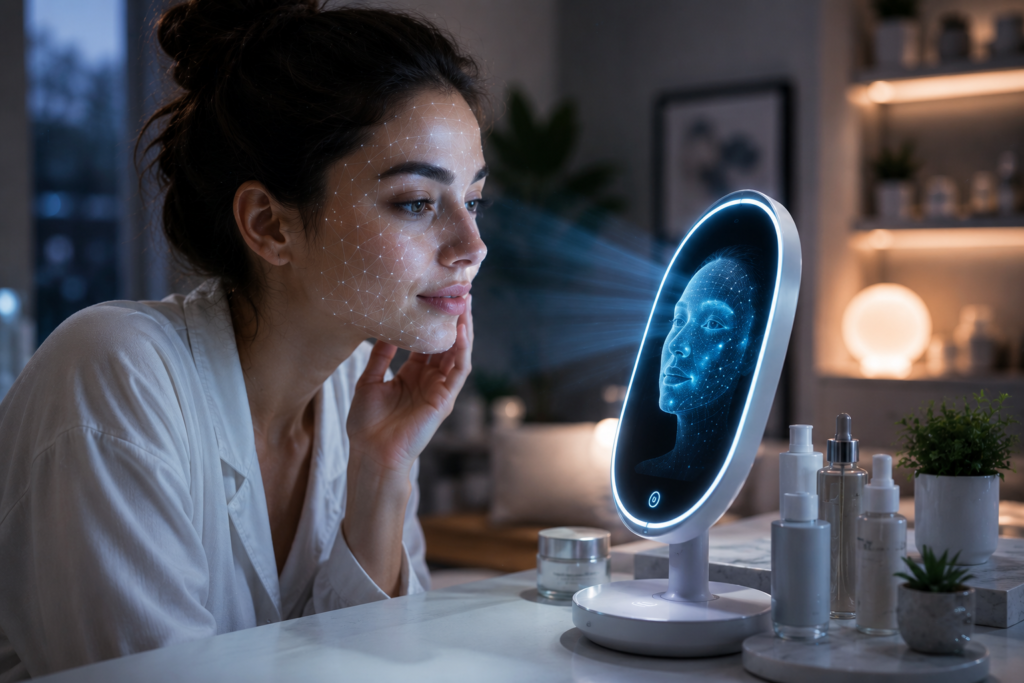
A few years back, most of these tools could barely tell the difference between a blemish and a shadow. That’s changed fast. The next wave seems to be moving toward continuous monitoring rather than one-off scans — smart mirrors, for instance, that quietly track your skin every morning while you brush your teeth, no separate app open needed.
Wearables are starting to enter the picture too, though this part is still early. A few prototypes on the market measure skin hydration and sebum levels passively through sensors, feeding that data back into the same kind of recommendation engines used in scanning apps. It’s not mainstream yet, and the accuracy claims from smaller manufacturers should be taken with a decent amount of skepticism until independent testing catches up.
There’s also a push toward combining genetic data with visual scans — services that ask for a cheek swab alongside a photo, building recommendations around both your skin’s current state and its underlying predisposition to things like collagen breakdown or sensitivity. That combination sounds promising on paper. Whether it holds up under real scrutiny the way basic scanning has is something that’ll take another couple of years to prove out.
Regulation is a piece of this story that gets ignored too often. Right now, most of these apps market themselves as “wellness” products rather than medical devices, which keeps them out of the stricter approval processes actual diagnostic tools go through. That’s fine for a routine tracker, but it gets murkier the more these platforms start making claims that edge toward diagnosis rather than general skin monitoring. A few regulatory bodies have started paying closer attention to this gray area, and it wouldn’t be surprising to see clearer rules within the next few years, especially as more of these tools start handling health-adjacent claims rather than pure cosmetics.
None of this changes the fundamentals, though. The best use of skincare tips AI technology right now is still the boring version: consistent scans, patient tracking, and a healthy dose of skepticism toward anything promising instant results.
Conclusion
Skincare tips AI technology isn’t a replacement for expertise — it’s a tool that, used right, makes expertise more accessible and routines more consistent. The biggest mistake I see people make is treating these apps like an oracle instead of what they actually are: a measurement tool built on pattern recognition, with real strengths and real blind spots.
The strengths are genuinely useful — consistency, early detection of slow changes, and cutting down on wasted money from mismatched products. Anyone who’s tried five different serums chasing a routine that never worked knows how much that matters.
But the limits matter just as much. Skin tone bias hasn’t fully disappeared from these systems, medical conditions still need a trained eye rather than a camera, and privacy concerns around facial scan data are worth taking seriously before uploading your face to any random app.
If there’s one takeaway, it’s this: use skincare tips AI technology as a starting point, not a final answer. Let it guide your routine, track your progress, and flag things worth a second look. But keep a real dermatologist in the loop for anything that looks off, and don’t let an app talk you into buying more than your skin actually needs.
The technology keeps getting better every year, and five years from now it’ll probably catch things today’s tools miss entirely. I think back to that client with hormonal acne along her jawline, and the guy who never wore sunscreen until a scan showed him what decades of sun exposure actually looked like. Neither needed a miracle app. They needed a clearer picture of what was already happening on their own skin, and something to hold them accountable long enough to see real results.
So if you’re deciding whether to try one of these tools, start small. Pick something with a transparent track record, run it consistently for a month or two, and treat the output as a conversation starter rather than a verdict. Pair it with an actual dermatologist when something looks unusual, and don’t let a subscription fee convince you that more expensive automatically means more accurate.

An IT career coach with 7 years of experience helping beginners map out certification paths that actually lead to interviews, not just another resume line. He’s guided dozens of career-switchers through their first AWS or CompTIA exam and writes for itechnova.io, covering IT certifications, cybersecurity, and the software tools people actually need to know.