

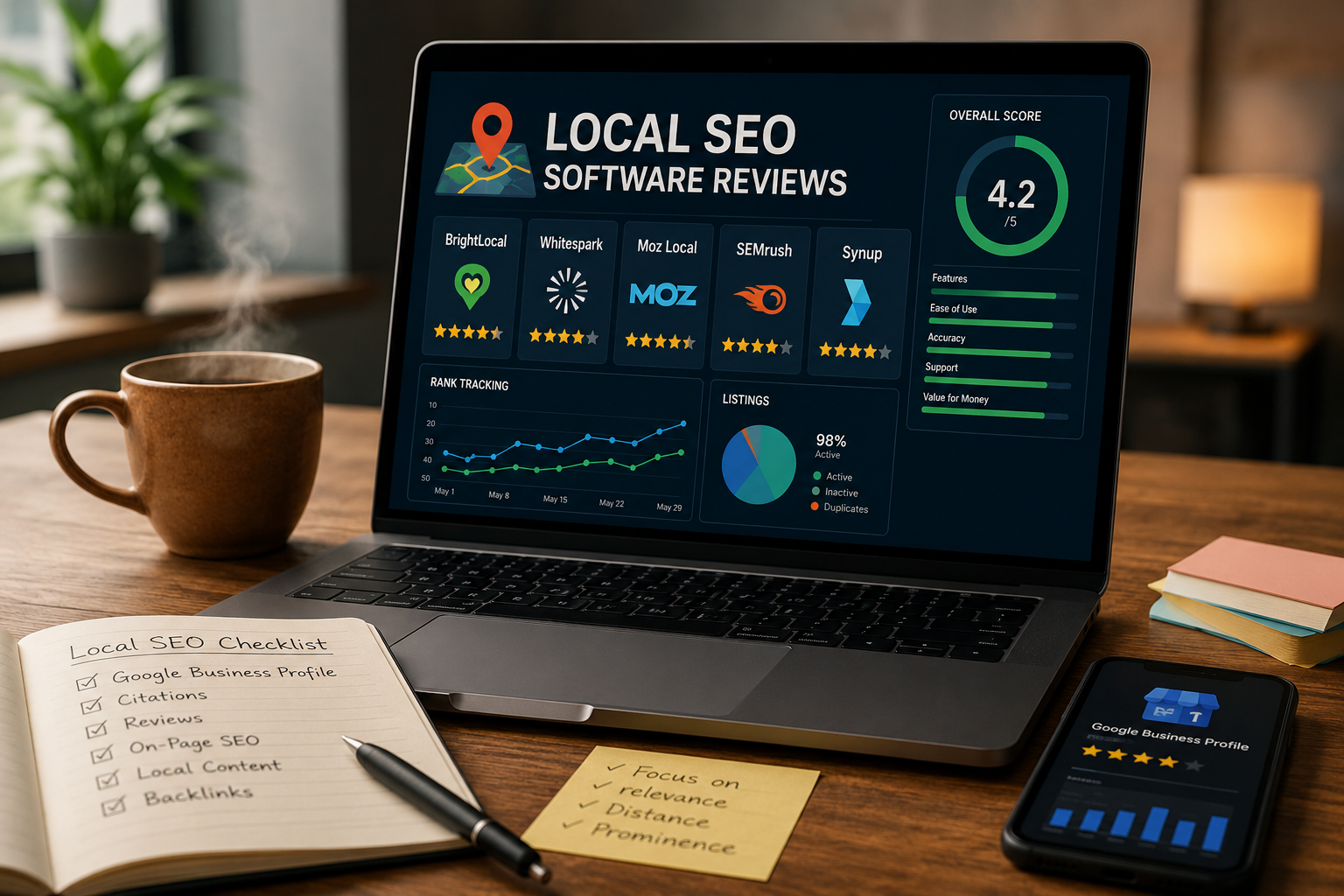
Grab a cup of chai, because this one’s going to take a minute. I’ve spent the better part of six years knee-deep in client dashboards, and if there’s one question I get asked at least twice a week, it’s some version of “which tool should I actually pay for.” So here’s my crack at local SEO software reviews that don’t read like a press release.
Most roundups just copy-paste feature lists off a vendor’s website and call it a day. I’m not doing that. I’ve used a chunk of these platforms myself, broken a few, cursed at one or two, and I’ll tell you exactly where the money goes and where it doesn’t.
Why I Even Bother Writing Local SEO Software Reviews
Because most business owners get sold on features they’ll never touch. A dental office in a small town does not need enterprise multi-location reporting built for a 400-store chain. It needs three things done well: listings that stay accurate, reviews that get answered, and rankings that get tracked without a spreadsheet meltdown every Friday.
That’s the lens I use whenever I test something new. Does it solve a real headache, or does it just look impressive in a sales demo?
The Tools That Keep Showing Up (And Whether They Deserve It)
I’ll be blunt — there are maybe six platforms worth your attention right now, and the rest are either dying products or repackaged versions of the same API. Below is how I’d actually rank them if a friend cornered me at a coffee shop and asked.
| Tool | Best For | Starting Price (roughly) | My Honest Take |
| BrightLocal | Agencies managing multiple clients | ~$39/mo | Deep citation and rank-tracking data; steeper learning curve than most solo owners want |
| Whitespark | Citation building specifically | ~$20/mo per package | Narrow focus, but does that one job better than almost anyone |
| Semrush Local | Businesses already using Semrush | Add-on pricing, varies | Convenient if you’re already paying for Semrush; feels bolted-on otherwise |
| Yext | Multi-location brands | Custom/enterprise | Powerful listing sync, but pricing scares off small operators fast |
| Moz Local | Simplicity-first small business owners | ~$14/mo per listing | Clean interface, dependable, doesn’t try to be everything at once |
None of these are “the best” in some universal sense — that framing is a marketing trick, honestly. The right pick depends entirely on how many locations you’re managing and how much patience you have for a learning curve.
How I Actually Judge These Platforms

I don’t care what a homepage promises. I care about four things, and I check them in this order every single time.
First, citation accuracy. Does the tool actually push correct NAP data everywhere, or does it just claim to? Whitespark, in my testing, has been consistently reliable here — no drama, no weird duplicate listings popping up six weeks later.
Second, review management. Can I respond from one dashboard, or am I still logging into five different apps? BrightLocal wins this round for me, mostly because the notification system doesn’t bury alerts.
Third, rank tracking granularity. A tool that only shows citywide rankings is nearly useless for a business competing neighborhood by neighborhood. Semrush Local does grid-based tracking decently, though it’s not the cheapest way to get it.
Fourth — and people forget this one — support response time. When your Google Business Profile gets suspended (it happens more than you’d think), you want a human, not a chatbot loop.
A Section On Pricing, Because Everyone Skips To This Part Anyway
Budget matters more than features, plain and simple. A solo contractor running one location doesn’t need the same stack as a five-clinic dental group.
Roughly speaking, expect 15–40 a month for single-location tools, and anywhere from $150 upward for multi-location or agency-grade platforms. Add-ons like review widgets or grid tracking usually cost extra, so read the fine print before you commit a year upfront.
If you want a deeper breakdown of how this compares against reporting-specific tools rather than full local suites, our seo reporting comparisons piece digs into that split in more detail.
Where People Waste Money (I’ve Watched It Happen)
Buying an enterprise plan for a single-location shop is the number one mistake, hands down. You end up paying for features — bulk location management, API access, white-label reporting — that a solo business will literally never open.
The second mistake is subscribing to a tool and never touching it. I’ve audited accounts where a business paid for eight months of citation tracking and logged in exactly zero times. That’s not a software problem. That’s a workflow problem, and no platform fixes that for you.
Third — and this one stings — trusting a tool’s “SEO score” as gospel. These scores are proprietary, invented by each vendor, and mean almost nothing when compared across platforms. Treat them as a rough compass, not a report card.
Different Businesses, Different Software Needs

A florist doesn’t need the same setup as a multi-location auto repair chain, and that’s worth saying out loud because most articles skip it entirely.
Retail shops juggling inventory alongside local visibility might find more value cross-referencing our inventory management software reviews before layering SEO tools on top — no point optimizing rankings if the backend operations are held together with duct tape.
Auto repair shops have their own quirks too, mostly around scheduling and service-history tracking bleeding into how reviews get requested. Our auto shop software comparison covers that overlap pretty well if that’s your world.
Home health agencies deal with something almost nobody talks about: compliance-safe review requests. You genuinely can’t just blast every client for a Google review the way a restaurant can. Worth reading our home health care software breakdown if that’s the boat you’re in.
And property managers? Different beast entirely — tenant reviews, multiple property listings, sometimes dozens of “locations” that aren’t really storefronts. Check the property management platform guide for how that changes the local SEO math.
Trends That Are Actually Shifting Things Right Now
Google’s algorithm keeps leaning harder into behavioral and proximity signals — how close a searcher is, and how people actually interact with your profile, not just what’s written on it. Moz’s ranking factors research backs this up pretty clearly, showing Google Business Profile signals consistently outweigh almost everything else in the local pack equation these days.
That shift matters for software buyers. Tools that only track keyword rankings and ignore GBP engagement metrics are already falling behind. Newer platforms are baking in review response templates, Q&A monitoring, and post scheduling directly because that’s where the ranking weight has moved.
BrightLocal’s own optimization research points the same direction — complete GBP optimization work tends to move the needle faster than chasing backlinks ever did for local businesses specifically.
A Quick Gut-Check Before You Buy Anything
Ask yourself three things before signing up for any local SEO software: how many locations am I actually managing, how many hours a week can I realistically spend inside this dashboard, and does my current software stack (shop management, patriot-style payroll tools, whatever) already handle half of this?
If you’re running a service business and juggling operations software too, it’s worth a glance at our shop management comparisons — sometimes the operational tool you already own has a citation or review feature bundled in that you’re not using.
My Honest Bottom Line
If I had to hand a single recommendation to a friend opening their first location, I’d say start with Moz Local or Whitespark, keep it cheap, and only scale up once you actually feel the limitations yourself. Don’t buy the enterprise plan because a sales rep made it sound urgent.
That’s genuinely the whole trick behind good local SEO software reviews — matching the tool to the actual size of the problem, not the size of the marketing budget behind it.
Frequently Asked Questions
Is local SEO software worth paying for if I only have one location?
Usually yes, but keep it cheap. A 15–25/mo tool for citation cleanup and basic rank tracking pays for itself fast once you stop manually checking listings across a dozen directories yourself.
What’s the actual difference between local SEO software and regular SEO tools?
Regular SEO tools chase national keyword rankings and backlinks broadly. Local SEO software focuses on geography-specific signals — citations, GBP data, proximity-based rank tracking, and review management tied to physical locations.
Can I run local SEO software without hiring an agency?
Absolutely, and plenty of small business owners do exactly that. The learning curve is real but manageable, especially with simpler platforms like Moz Local that aren’t built for agency-scale complexity.
How often should I check my local SEO software dashboard?
Weekly is realistic for most small businesses. Daily checking usually just creates anxiety over ranking fluctuations that are normal and don’t require any action.
Do these tools actually guarantee higher rankings?
No, and anyone who says otherwise is lying to you. They give you visibility and tools to fix problems faster — the actual ranking improvement still depends on consistent effort on your end.
Which local SEO software handles multiple locations best?
Yext and BrightLocal both scale well for multi-location businesses, though Yext’s pricing tends to favor larger operations rather than a business with just three or four sites.
Is Google Business Profile management included in most local SEO software?
Most decent platforms include at least basic GBP monitoring now, though the depth varies a lot — some just flag changes, others let you post updates and respond to reviews directly.
What should a first-time buyer prioritize when comparing local SEO software reviews?
Citation accuracy and review management matter more early on than fancy reporting dashboards. Get the fundamentals solid first, then worry about advanced features once you actually need them.
Conclusion
Honestly, if you’ve read this far, you’re already ahead of most business owners who just Google “best local SEO tool” and click whatever ad shows up first. That’s not a knock on you — it’s just that this category is genuinely confusing, and a lot of the noise out there is written by people who’ve never actually logged into these platforms for longer than a screenshot.
The real answer to “which software should I buy” almost never has anything to do with which tool has the most features. It has everything to do with how big your operation actually is, how much time you can realistically spend managing listings and reviews each week, and whether you’re solving a real bottleneck or just buying peace of mind. A single-location bakery and a five-city HVAC company are not shopping in the same aisle, even though every roundup online treats them like they are.
My honest advice, after testing more of these than I’d like to admit? Start small, start cheap, and upgrade only when you actually hit a wall — not because a sales call convinced you that you’re missing out. Whitespark and Moz Local cover the fundamentals without draining your budget. BrightLocal earns its higher price tag once you’re managing more than a couple locations or running client accounts for other businesses. Yext and Semrush Local make sense mostly once you’re already deep into either ecosystem for other reasons.
At the end of the day, good local SEO software reviews should save you time, not create another decision paralysis spiral. Pick something that matches where your business actually is right now, not where you hope it’ll be in three years. You can always upgrade later — nobody’s locked into a platform forever, and switching tools is a lot less painful than most people assume going in.
If nothing else, remember this: the software is just a tool. The actual work — answering reviews like a human, keeping your listings accurate, showing up consistently — that part’s still on you, chai in hand or not.

An IT career coach with 7 years of experience helping beginners map out certification paths that actually lead to interviews, not just another resume line. He’s guided dozens of career-switchers through their first AWS or CompTIA exam and writes for itechnova.io, covering IT certifications, cybersecurity, and the software tools people actually need to know.