
Every AI data center on the planet is running into the same wall right now. The chips are fast. Fine, great, whatever — that’s not the problem anymore. The problem is the connections between them. Buried between the silicon and the fiber-optic cable sits a tiny, unglamorous component called a modulator, and its only job is stamping electrical data onto light.
Except that little component has quietly become one of the biggest power hogs in the whole rack. A scrappy, barely-13-people company out of Seattle called NLM Photonics thinks it’s cracked the fix, and I’ll be honest — the numbers behind it are weird enough that they’re worth actually sitting with instead of skimming past.
What NLM Photonics actually builds
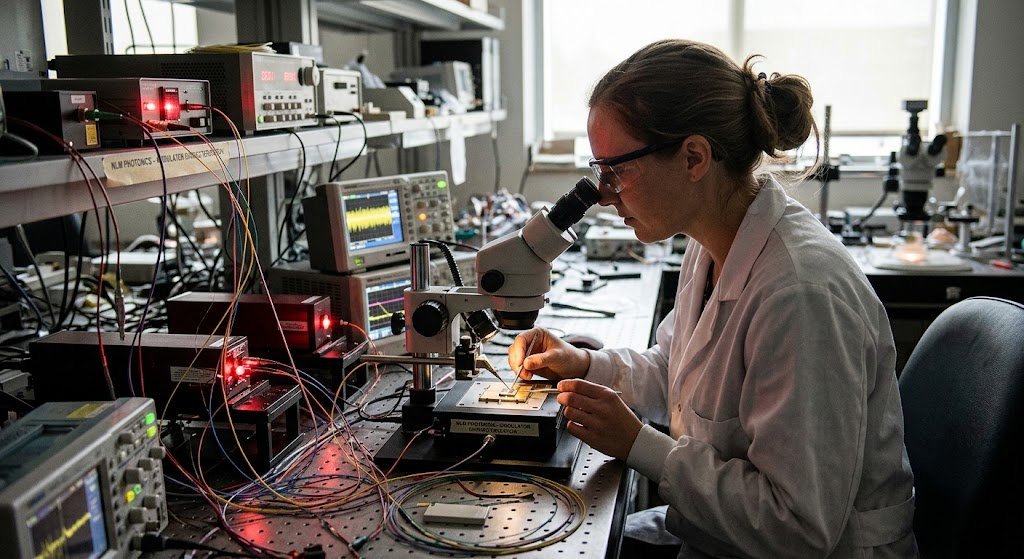
Don’t picture a fab when you think of NLM Photonics. Picture a liquid. Specifically, an organic electro-optic material that gets deposited onto an existing silicon photonics wafer, late in the manufacturing process, where it hardens into something close to glass.
That film then takes over the modulator’s job — turning electrical signals into pulses of light — from the silicon underneath it. And here’s the clever part: NLM isn’t asking any foundry to tear out silicon photonics and start from scratch. It’s asking them to bolt on one more processing step near the end of a line they already run. That’s a much easier pitch to a fab than “throw out your platform,” and it’s probably why the company has gotten as far as it has.
It started life as Nonlinear Materials Corporation back in 2018. The actual science goes way further back, though — roughly 25 years, tracing to organic electro-optic research done at the University of Washington, according to NLM’s own technology page. That’s an odd amount of patience for a startup pitch deck, honestly. Twenty-five years from lab bench to something a fab will actually run. But it also explains why the material finally looks stable enough to trust in a data center instead of just a journal article nobody outside academia reads.
Why the modulator is the actual bottleneck
Here’s the bit most explainers skip entirely. Silicon, it turns out, is kind of a mediocre material for electro-optic modulation. It just doesn’t respond strongly to an applied voltage. Engineers have spent two decades compensating for that with longer devices, more driver power, and increasingly clever circuit tricks — and every one of those workarounds costs something, whether it’s bandwidth, heat, or precious chip real estate.
There’s a number engineers use to measure this: Vπ, the voltage needed to flip a light signal by 180 degrees. Think of it like the muscle it takes to crank a stuck faucet handle. Most commercial silicon modulators today need somewhere around 3 to 5 volts for that. Oregon Venture Fund, one of NLM’s backers, pointed out that NLM’s patented material, Selerion-HTX, gets some designs under 1 volt. Not incremental. A real jump.
Why should you care about a voltage number? Because lower Vπ means less driver power, less heat dumped into a package that’s already thermally maxed out, and shorter devices — which matters a lot when you’re trying to squeeze more channels onto one chip.
The material itself: Selerion, and why “organic” doesn’t automatically mean fragile
Selerion-HTX is what’s called a crosslinkable organic glass. It goes on wet, then chemically crosslinks in place into a rigid thermoset plastic during processing. Small detail, big implications — organic EO materials have a genuinely rough reputation in this industry. Earlier generations looked fantastic in a lab demo and then quietly degraded within months under heat or light exposure. Not a great look. Its own published data claims thermal stability above 120°C long-term, with a projected t80 lifetime (the point where performance drops to 80% of its original value) of roughly 11 years after initial burn-in. It’s also described as cryo-compatible, for what that’s worth.
Reporting from Photonic Integrated Circuits News puts the EO coefficients on Selerion-HTX at 150 to 450 picometres per volt — 5 to 15 times higher than lithium niobate, the crystal most rivals lean on. There’s a newer sibling material too, Selerion-BHX, which reportedly crosses 1,000 picometres per volt while holding up at 85°C, and it apparently set a modulation-efficiency record for slot-waveguide devices along the way.
And the company backs this up with something closer to a real-world number, not just a lab spec sheet: independent testing with Keysight and VLC Photonics on an 8-channel silicon-organic hybrid PIC showed 224G PAM-4 data transmission at a modulation efficiency of 0.31 volt-millimetres. That’s a 10 to 15x improvement over traditional silicon photonics modulators — the kind of figure GeekWire zeroed in on when it covered the company’s most recent funding round.
Who’s actually funding this, and who they’re up against
NLM Photonics has raised roughly $10.5 million total, per PitchBook. It closed a Series A led by Emerald Technology Ventures, with Oregon Venture Fund and Idemitsu chipping in. More recently, it added a Series A2 — same core group returning (Emerald, Oregon Venture Fund, Idemitsu, Tokyo Ohka Kogyo, StoryHouse Ventures), plus two new strategic names: Pangaea Ventures and Diamond Edge Ventures, which is Mitsubishi Chemical’s venture arm.
Worth pausing on that investor list for a second. This isn’t just financial VC money chasing a hot sector. It’s materials-science money — chemical companies that understand exactly how hard it is to keep an organic compound stable inside a foundry environment for a decade. How large that latest round actually is, NLM hasn’t said.
Put that funding total in perspective and it looks almost modest. HyperLight, a Harvard spinout working with lithium niobate crystals instead of organics, has pulled in $117 million, including an $80 million round led by MediaTek. Lightwave Logic — a publicly traded company chasing a similar organic EO bet — actually named NLM Photonics among its smaller competitors in a 2024 annual report, which is a strangely nice bit of unintentional validation that the bigger players are watching.
AIM Photonics and Lumiphase round out the field, each betting on a different flavor of the same underlying problem: getting light and electricity to talk to each other without wasting so much energy doing it.
Anyone tracking where venture money is actually flowing right now — real hardware, not another SaaS skin — should set this next to broader climate-tech funding trends. Data-center power draw and climate-motivated infrastructure spending have basically merged into the same conversation at this point.
The milestones that actually mean something (not just PR)
Most startup news is noise, let’s be real. A handful of things NLM Photonics has done lately genuinely aren’t:
- Foundry validation, not just demos. In 2026 the company confirmed its silicon-organic hybrid modulator works on Tower Semiconductor’s high-volume PH18M platform, and separately said chips shipped to customers had already come off GlobalFoundries lines. Getting validated on more than one commercial process is the line between “cool lab thing” and “something a hyperscaler can order.”
- A trip to the International Space Station. As part of NASA’s MISSE-21 experiment, NLM’s Selerion-HTX and its research material JRD1 launched aboard a JAXA HTV-XI spacecraft in late October 2025, to see how the organic material holds up under space radiation and wild temperature swings over a full year. Brutal stress test, for a material a lot of engineers still assume is fundamentally fragile.
- Live bandwidth demos that hit real numbers. At OFC 50 in 2025, NLM showed the first commercial demonstration of a silicon-organic hybrid modulator on a multi-channel PIC, at 1.6 terabit performance. A 3.2T version followed not long after. The company claims 20 to 30% less power draw than conventional approaches for that bandwidth boost.
Should you actually care about this?
Working anywhere near AI infrastructure or telecom hardware? Then yes. The reason is almost boringly practical: power, not raw compute, is becoming the actual ceiling. Data center operators are already choosing sites near power plants instead of near population centers, because the grid simply can’t keep pace with GPU rack density.
A modulator that does the same networking job on a fraction of the wattage isn’t a nice-to-have feature you’d mention in a pitch deck slide. It’s a way to squeeze more AI capacity out of a power budget that stopped growing fast enough years ago. This is also part of why hardware innovation like this keeps bleeding into what used to be purely software territory — see the broader wave of AI infrastructure and tooling coverage for that shift in real time.
Now the honest caveat, because every glowing writeup needs one. NLM Photonics is still a 13-person company with single-digit millions in disclosed funding, up against better-capitalized rivals in an industry that’s been burned by organic-materials hype before — more than once. Sampling with foundries in 2026 is real progress. It’s not the same thing as getting designed into a shipping transceiver at volume, though. Watch for actual design wins with optical transceiver vendors over the next 12 to 18 months. That’s the signal that separates a genuinely disruptive material from an unusually good conference demo.
FAQs
What does NLM Photonics actually sell?
An organic electro-optic material, branded Selerion, deposited onto existing silicon photonics wafers to replace the modulator function. Not a full chip, not a system — just the material and the device architecture built around it.
How is NLM Photonics different from HyperLight?
HyperLight uses lithium niobate crystal thin-film technology. NLM Photonics uses a crosslinkable organic polymer/glass material instead. Both are chasing the same power-and-bandwidth bottleneck in optical modulators, but the materials science and the fabrication paths are pretty different.
Where is NLM Photonics based, and how big is the company?
Seattle, Washington. Around 13 employees as of recent filings, with the technical team having grown roughly 60% over the past year or so through new hires.
Is NLM Photonics publicly traded?
No — it’s private and venture-backed, having raised capital through Series A and Series A2 rounds from investors including Emerald Technology Ventures, Oregon Venture Fund, Idemitsu, and Mitsubishi Chemical’s Diamond Edge Ventures.
Why did NLM Photonics send materials to the International Space Station?
As part of NASA’s MISSE-21 program — to test how the Selerion-HTX and JRD1 materials hold up under the temperature extremes and radiation exposure of orbit. It’s essentially a proxy stress test for the long-term durability claims NLM makes about terrestrial data center use.

An IT career coach with 7 years of experience helping beginners map out certification paths that actually lead to interviews, not just another resume line. He’s guided dozens of career-switchers through their first AWS or CompTIA exam and writes for itechnova.io, covering IT certifications, cybersecurity, and the software tools people actually need to know.