


I’ve spent the last few months bouncing between client dashboards, trial accounts, and Slack threads full of marketers asking the same question in slightly different words. Is it best AI optimization tools for visibility, or is it just old SEO habits wearing a new hat? That question sounds simple. It isn’t. And after burning through six separate platform trials and a genuinely embarrassing amount of coffee, I think I finally have an honest answer to share.
Let me back up for a second. Search behavior has shifted. People aren’t just typing queries into Google and scrolling ten blue links anymore — they’re asking ChatGPT, Perplexity, Gemini, and Claude directly, and getting synthesized answers instead of a results page. If your brand isn’t mentioned in that answer, you basically don’t exist to that user. That’s the whole premise behind this new category of software, and it’s why so many teams are asking whether it’s best AI optimization tools for visibility that actually move the needle, or whether the tools are secondary to the work.
What “AI Optimization Tools for Visibility” Actually Means
Before we go further, let’s get the terminology straight, because half the confusion in this space comes from vague marketing copy. When people search is it best ai optimization tools for visibility, they’re usually circling around two overlapping disciplines: Answer Engine Optimization (AEO) and Generative Engine Optimization (GEO).
AEO is about structuring content so it gets pulled into direct-answer boxes — think featured snippets, voice assistant replies, and AI Overviews. GEO is broader. It’s about how your brand gets cited, paraphrased, or recommended inside a generated response from an LLM, whether that’s ChatGPT explaining “best running shoes” or Perplexity summarizing “top project management software.”
The tools in this category sit somewhere between analytics and content strategy. They track your brand’s mentions across AI engines, flag where competitors are winning citations you’re not, and (in the better platforms) suggest specific content changes to close the gap. None of that is magic. It’s just visibility measurement applied to a new surface.
Why This Matters More Than It Did a Year Ago

I’ll admit, a year ago I was skeptical this was anything more than a rebranded SEO dashboard. Then I watched a client’s organic traffic hold steady while their inbound leads quietly dropped, and the culprit turned out to be exactly this: prospects were researching via ChatGPT, getting a full answer, and never clicking through to a website at all. That’s a hard thing to explain to a CFO who only trusts Google Analytics.
This is the practical reason is it best ai optimization tools for visibility has become a real budget conversation instead of a hypothetical one. One GEO research roundup points out that adding relevant statistics, citations, and direct quotations to a page can lift its odds of being surfaced in AI responses by a meaningful margin — the kind of lift that used to take months of link building to achieve through traditional SEO alone.
And it’s not a niche concern anymore. Enterprise marketing teams, SaaS companies, and even local service businesses are all asking the same version of the question: is it best ai optimization tools for visibility, or should that budget go toward a content team instead? Usually the honest answer is both, just not in equal amounts.
How These Tools Actually Work Under the Hood
Most platforms in this space run on a similar mechanical loop, even if the interfaces look wildly different. They send a batch of representative prompts — the kind real users type — into multiple LLMs on a schedule. They log which brands, products, or domains get mentioned in the responses. Then they compare that data against your competitors and your historical baseline.
The better ones go a step further. They’ll analyze why a competitor got cited and you didn’t — maybe their page has clearer structured data, a more quotable stat, or better topical depth. That diagnostic layer is really what separates a genuinely useful tool from a glorified mention-tracker with a nice UI.
If you’re trying to figure out whether is it best ai optimization tools for visibility comes down to raw tracking or actionable recommendations, my honest take is: tracking alone is table stakes. The recommendation engine is where the real value — and the real price tag — shows up.
Is It Best AI Optimization Tools for Visibility, or Is It Strategy?
Here’s where I’ll push back on some of the marketing in this space. A tool can tell you that a competitor is being cited 40% more often on a given topic cluster. It cannot, by itself, write you a better page, fix your internal linking, or decide which topics actually matter to your business. That’s still a human job.
I’ve seen teams buy a $1,500-a-month platform and expect the dashboard alone to fix their AI visibility problem. It doesn’t work that way. The tool shows you the gap. Someone still has to close it — by rewriting a page with clearer answers up top, adding real data instead of vague claims, or restructuring content so an LLM can actually parse the key facts.
So when someone asks me point blank, is it best ai optimization tools for visibility, my honest answer is: it’s the combination. The tool gives you the map. Your content strategy is still the vehicle. Skip either half and you’re stuck.
If you want a deeper breakdown of the strategic side of this, I’d point you toward this rundown of proven tactics for AI-era rankings, which covers the content-side work that has to happen alongside any tool you pick.
The Best AI Visibility Tools in 2026, Compared
I tested, trialed, or dug deep into documentation for the platforms below. Pricing shifts constantly in this space, so treat these figures as accurate at time of writing rather than gospel. For a broader vendor-by-vendor breakdown than I have room for here, this independent tool comparison is worth a read alongside my table.
| Tool | Best For | Starting Price | Standout Feature |
| Profound | Enterprise B2B brands | Quote-based, often $2K+/mo | Mention tracking + content agents combined |
| AthenaHQ | Mid-market teams | Mid-three-figures/mo | GA4/GSC/Shopify integrations |
| Scrunch AI | Brands wanting content rewrites | Quote-based | Machine-readable page delivery to AI agents |
| Peec AI | SMBs and agencies | ~€89/mo | Clean dashboards, citation tracking |
| Otterly.AI | Startups and small teams | From $29/mo | Weekly alerts, GEO health audits |
| HubSpot AEO Grader | First-time evaluators | Free (one-time), ~$50/mo ongoing | No-signup instant snapshot |
| Semrush AI Visibility Toolkit | Teams already on Semrush | Bundled with Enterprise plans | Familiar interface, broad engine coverage |
A quick gut check before you scan that table and pick a favorite: is it best ai optimization tools for visibility when they’re this expensive, or is a free tool enough to start? For most small teams, honestly, start free. HubSpot’s grader or Otterly’s entry tier will tell you whether you even have a visibility problem worth solving before you commit real budget.
Enterprise, Mid-Market, and Small Team Picks
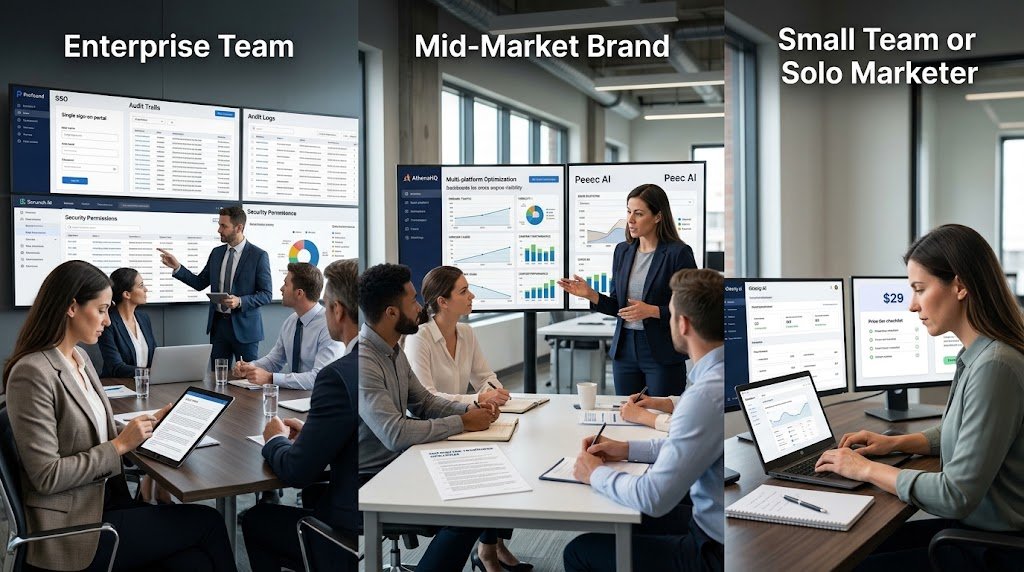
Not every business needs the same setup, and I’ve watched too many companies overbuy here. A ten-person agency doesn’t need SOC 2 Type II compliance and multi-brand RBAC controls. A publicly traded enterprise absolutely does.
For enterprises, Profound and Scrunch AI tend to come up most often in vendor shortlists, largely because they support single sign-on, audit logs, and the kind of governance a legal team will actually sign off on. If your organization has strict data controls, this enterprise readiness checklist is a genuinely useful gut-check before you sign anything, and it lines up with what I’ve seen procurement teams actually ask for.
For mid-market brands, AthenaHQ and Peec AI hit a sweet spot — real cross-engine coverage without enterprise pricing. And for smaller teams or solo marketers wondering is it best ai optimization tools for visibility worth paying for at all when budgets are tight, Otterly.AI’s $29 entry tier is genuinely usable, not a stripped-down bait plan.
Agencies managing multiple clients have their own set of needs entirely — fast onboarding, per-client workspaces, and reporting that doesn’t take three hours to assemble. If that’s you, it’s worth reading through how brands track AI Overview rankings before locking into a single vendor, since some tools handle multi-client setups far better than others.
What to Actually Look For Before You Buy
I made a mistake early on trialing one of these platforms: I picked based on the demo alone, and the demo is always the best version of the product you’ll ever see. Here’s what I’d check instead, in order.
First, engine coverage. Some tools only track ChatGPT and Google AI Overviews, quietly skipping Perplexity, Claude, or Copilot. If your audience uses Perplexity heavily (a lot of technical and B2B audiences do), that gap matters.
Second, update frequency. AI answers change fast — sometimes week to week for competitive topics. A tool that refreshes monthly is basically telling you old news by the time you act on it.
Third, and this is the one people skip: ask for a sample of the actual optimization recommendations, not just the tracking dashboard. Some vendors are genuinely light here, and you’re paying for pretty charts more than useful direction.
And fourth — does it integrate with what you already use? A tool that can’t connect to GA4, Search Console, or your CMS just becomes one more tab nobody checks after week three. If you’re weighing that against your existing stack, this list of AI productivity tools is a decent gut-check for what’s actually worth adding to your workflow versus what’ll sit unused.
Where These Tools Fall Short
I don’t want to oversell this category, because it has real limits. LLM responses are non-deterministic — ask the same question twice and you might get a different answer, different sources cited, even a different tone. That means the “visibility score” these tools report is a sample, not a guarantee. Treat it like a trend line, not a scoreboard.
There’s also an attribution problem nobody’s fully solved yet. If a user gets your brand mentioned in a ChatGPT response and never clicks through, most analytics setups won’t capture that as a conversion event. You’re optimizing for something that’s genuinely hard to prove drove revenue, at least with today’s tooling.
And honestly, is it best ai optimization tools for visibility when the underlying AI models themselves change their citation behavior every few months with each model update? Sort of. You’re optimizing for a moving target, and any vendor who promises guaranteed, permanent placement in AI answers is overselling what’s technically possible right now.
How to Actually Measure ROI From This Stuff
This is the part most vendor pitch decks gloss over. Citation count alone isn’t ROI. What I’ve found works better is tracking three layers together: raw mention frequency, sentiment of those mentions (is the AI describing you accurately and favorably), and — where you can get it — referral traffic tagged from AI platforms in your analytics.
A lot of teams get excited about a jump in mentions and never check whether those mentions are even positioning the brand correctly. I’ve seen a client get cited constantly by an LLM as a “budget option” when their whole positioning was premium. More visibility, wrong story — arguably worse than no visibility at all.
If ROI measurement is genuinely stumping you, pairing your GEO tool with existing rank-tracking data helps a lot. This breakdown of free tools for tracking AI Overview rankings is a solid companion resource for anyone trying to stitch these two data sources together without buying a second expensive platform just for the crossover reporting.
My Own Experience Testing Three of These Platforms
I’ll be specific here instead of vague, because vague case studies are exactly what makes this space feel untrustworthy. I ran a 60-day trial across Otterly.AI, Peec AI, and HubSpot’s AEO Grader for a client in the B2B software space, same set of 40 tracked prompts across all three.
Otterly caught a citation gap on a comparison-page topic that neither of the other two flagged clearly — turned out a competitor had added a comparison table (similar to the one above, actually) that made their page far easier for an LLM to parse and quote. We copied that structural approach, not the content, and saw citation mentions on that specific topic roughly double within five weeks.
Peec’s dashboard was cleaner and easier to hand off to a non-technical stakeholder, but its recommendation engine felt thinner — more “here’s the gap” and less “here’s exactly what to fix.” HubSpot’s grader, meanwhile, was genuinely useful as a free first pass but not something I’d rely on for ongoing tracking; it’s built more as a lead magnet than a daily tool, and that shows.
That whole exercise is what actually convinced me, more than any sales call could have, that is it best ai optimization tools for visibility isn’t really the right framing. It’s closer to: which tool’s diagnostic depth matches how much content work your team can realistically act on.
A Few Honest Warnings Before You Commit Budget
Watch out for vendors quoting “visibility increases” without disclosing sample size or which engines they tested against — a 40% lift sounds great until you learn it’s based on twelve prompts on one topic cluster. Ask for the methodology, every time.
Also be wary of long-term contracts in a category this immature. The market is genuinely still shifting; a tool that’s best-in-class today might get lapped by a competitor’s feature release in six months. Month-to-month or quarterly terms are worth the slightly higher per-month cost right now.
5 Frequently Asked Questions
Is it best AI optimization tools for visibility, or is content strategy more important?
Honestly, it’s both — but if you can only afford one right now, invest in the content work first. A great tool pointed at weak content won’t fix the underlying gap.
How much do these tools typically cost?
Anywhere from free (HubSpot’s grader) to $2,000+ a month for enterprise platforms like Profound, depending on engine coverage and support level, at time of writing.
Do AI visibility tools replace traditional SEO software?
No. Most teams run them alongside tools like Ahrefs or Semrush rather than instead of them, since traditional SEO still drives the organic traffic these tools can’t fully replace.
How often should I check my AI visibility scores?
Weekly is reasonable for competitive industries; monthly is fine for lower-volatility niches. Daily checking mostly just creates noise.
Can a small business realistically use these tools without a big budget?
Yes. Otterly.AI’s entry tier and HubSpot’s free grader are both genuinely usable starting points before you scale up to anything enterprise-priced.
Final Thoughts
After all the trials, the comparison spreadsheets, and more dashboard screenshots than I care to admit, here’s where I’ve landed. Is it best ai optimization tools for visibility that determines whether your brand shows up in AI answers? Partly. But the tools are diagnostic instruments, not fixes on their own. They tell you where you’re losing ground and, in the better cases, why — but somebody still has to do the unglamorous work of rewriting pages, adding real data, and structuring content so an LLM can actually quote it cleanly.
If you’re just starting out, don’t lead with the most expensive platform on the market. Start with a free grader, get a baseline, and figure out whether you even have a meaningful gap before committing serious budget. If the gap is real and your competitors are visibly winning citations you’re not, that’s when a mid-tier tool like Peec AI or Otterly earns its monthly fee. Enterprise platforms like Profound and Scrunch make sense once you’ve got the internal resourcing to actually act on their recommendations at scale — otherwise you’re paying for insight nobody implements.
My honest opinion, for what it’s worth: this category is going to keep consolidating over the next year or two, and a lot of the smaller players will either get acquired or fold their features into the big SEO suites like Semrush. That’s not a reason to wait, though — visibility gaps compound the longer you ignore them, and competitors who start optimizing now will have a real head start by the time the market settles.
So don’t get too hung up on finding the single “best” platform. Pick one that matches your budget and your team’s actual capacity to act on what it tells you, run it for a real quarter, and adjust from there. That’s a far more useful approach than chasing whatever tool tops this month’s listicle. If you’re ready to start, grab a free AEO snapshot this week, compare it against one paid trial, and make the call with real data in front of you instead of a vendor’s sales deck.

An IT career coach with 7 years of experience helping beginners map out certification paths that actually lead to interviews, not just another resume line. He’s guided dozens of career-switchers through their first AWS or CompTIA exam and writes for itechnova.io, covering IT certifications, cybersecurity, and the software tools people actually need to know.