

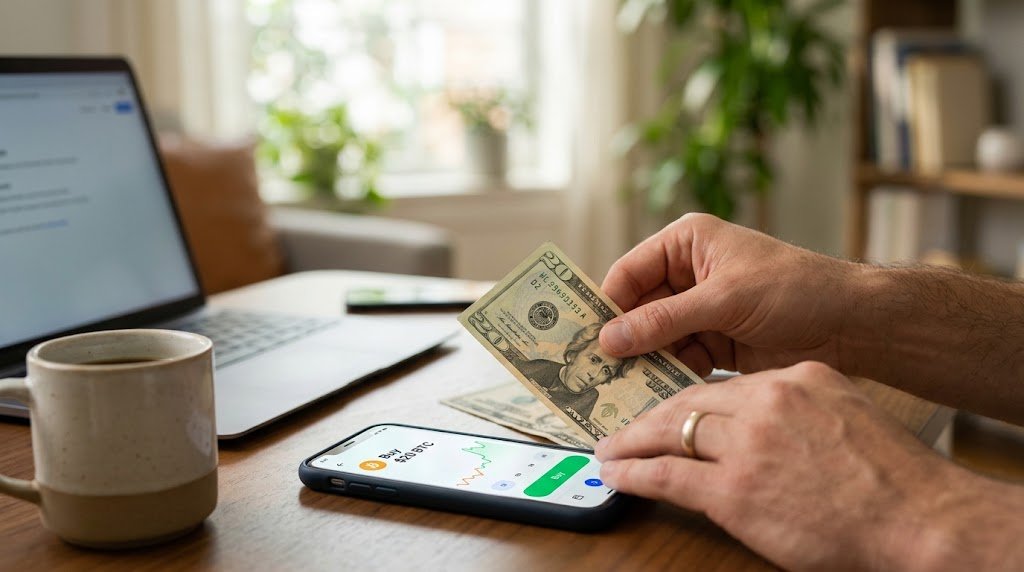
My cousin called me at 11pm on a Tuesday. Panicked. Bitcoin had dropped six percent that afternoon and she wanted to know if she should sell everything. She’d bought in eight days before that call. No wallet she controlled, no idea what a seed phrase even was, money that was supposed to go toward a car repair sitting in an app on her phone. That’s basically why this cryptocurrency for beginners guide exists — that one phone call.
If you’re reading up on cryptocurrency for beginners because a friend won’t shut up about it, or you saw some headline about a guy turning three hundred bucks into a house down payment — I get the pull. It’s real. But most beginner guides do one of two annoying things. Either they drown you in blockchain theory nobody asked for, or they skip straight to “just buy Bitcoin” without explaining what you’re actually doing when you tap that button.
I’m splitting the difference here. Enough context so you understand what you’re buying. Enough steps so you can actually do it. And, the part most guides skip — enough warning about where people lose money, so you don’t end up being the one making that 11pm call. For the bigger-picture stuff before we get into personal steps, the current state of digital asset trading is a decent five-minute read, though you don’t need it to follow along here.
Why People Get Into Crypto In The First Place

Let’s not pretend this is purely intellectual curiosity. Most people land on cryptocurrency for beginners content because they heard about someone making fast money. That’s the honest starting point for something like 80% of new buyers. Nothing shameful about admitting that.
Smaller reason, but real: distrust of traditional banking. People living with unstable currencies, or people who just don’t like the idea of a central bank steering monetary policy from a distance. Both are legitimate reasons to look into cryptocurrency for beginners territory. Neither one guarantees good decisions once you’re actually in.
Here’s the thing nobody says upfront though — the volatility that makes those viral success stories possible is the exact same mechanism that wipes out inexperienced buyers. Not a bug you’re dodging. It’s the whole game. Walk in knowing that.
What Cryptocurrency Is, Skipping The Textbook Part
Forget the dictionary definition for a second. Plain version: cryptocurrency is digital money living on a shared, public ledger instead of a bank’s private database somewhere. No central office running it. Thousands of computers worldwide check every transaction and agree on the record together.
That ledger’s called a blockchain. And it’s genuinely the clever bit — every transaction bundles into a “block,” gets cryptographically chained to the one before it, and once confirmed, rewriting it would mean altering every block after it, across thousands of machines, all at once. Basically impossible. That’s the “trustless” thing people keep saying. You’re not trusting a bank. You’re trusting math and a few thousand strangers’ computers agreeing with each other.
Bitcoin came first, 2009, built as an alternative to regular currency. Everything after — Ethereum, thousands of others — borrowed that core idea and bolted extra features on top. Get this one distinction straight and you’re already ahead of a lot of people knee-deep in cryptocurrency for beginners forums who’ve owned crypto for years without really grasping it.
The Types You’ll Actually Run Into
Not all cryptocurrency does the same job, and treating it as one big blob is probably the single biggest source of beginner confusion out there. Any real cryptocurrency for beginners breakdown should start here — before wallets, before buying, before any of it.
| Type | What It’s For | Risk Level |
| Bitcoin (BTC) | Store of value, digital gold comparison | Moderate — volatile but most established |
| Ethereum (ETH) | Smart contracts, decentralized apps | Moderate to high |
| Stablecoins (USDC, USDT) | Pegged to USD, used to park value or trade | Low, but not risk-free |
| Altcoins (thousands of others) | Varies wildly — speculation, niche use cases | High to extremely high |
| Meme coins | Mostly community hype, minimal utility | Extremely high, often near-total loss |
If a cryptocurrency for beginners plan involves putting real savings into anything below the “altcoin” line, pump the brakes hard. That’s not investing anymore. Closer to a lottery ticket with extra steps and a Discord server.
Bitcoin and Ethereum together still hold the majority of total market value. Not an accident — reflects which networks survived multiple crashes and kept running. Worth remembering next time a coin promising “1000x” shows up in your feed, because most cryptocurrency for beginners losses trace right back to ignoring that.
How To Buy Your First Coin

Mechanics time. This is the part most guides either skip entirely or way overcomplicate — and it’s what most people googling cryptocurrency for beginners actually came here for.
Pick a regulated exchange. Coinbase, Kraken, that tier. They exist specifically to make this step boring and safe, which, as a beginner, is exactly what you want. Skip anything you found through a random Telegram link or a DM from a stranger.
Verify your identity. ID upload for KYC compliance. Annoying, sure, but it’s a decent sign the exchange operates within actual regulatory frameworks instead of just… not.
Fund the account. Bank transfer’s usually cheapest. Card payments are faster but pricier — sometimes 3-4% just to buy in, which adds up fast.
Buy small first. Not caution for caution’s sake. Your first transaction teaches you more about fees, timing, and platform quirks than any cryptocurrency for beginners article ever could. Better that lesson costs $20 than $2,000.
Decide whether to move it off-exchange. This is where cryptocurrency for beginners content gets murky fast, and honestly — it’s the single most important call on this whole list.
Wallets: The Part Everyone Skips, Then Regrets
Nobody frames this clearly enough for people working through cryptocurrency for beginners material: coins sitting on an exchange aren’t fully yours. The exchange holds them. “Not your keys, not your coins” gets repeated constantly in crypto circles, and it exists because of real, expensive history — exchanges have collapsed and taken customer holdings with them, more than once.
A wallet is what actually hands you control. Software or hardware holding your private keys, the cryptographic proof specific coins belong to you. Skip this step and any cryptocurrency for beginners plan is incomplete, full stop. Worth understanding what a wallet does under the hood before moving anything meaningful off an exchange.
Two broad flavors. Hot wallets stay connected to the internet — convenient, more exposed. Cold wallets, usually a small physical device, stay offline except when you’re actually using them. Beyond a small experimental amount, cold storage is worth the $60-150 it usually costs. My cousin had neither. Everything sat in the exchange app. Fine for learning. Not fine for real savings.
Security Basics That Actually Matter
A handful of habits separate people who keep their crypto from people who lose it to a scam within year one. Arguably the most important section in any cryptocurrency for beginners resource — more than the buying steps, even.
Never share your seed phrase. The 12 or 24-word recovery code your wallet spits out. Not with anyone, ever. No legit support team will ask for it. Anyone requesting it is trying to drain your wallet — no exceptions, no “but they seemed official.”
Turn on two-factor authentication everywhere, and use an app rather than SMS when you can, since SIM-swapping specifically targets text-based codes. Be suspicious of anyone reaching out first — especially on social media — offering investment help or “guaranteed returns.” Scammers specifically hunt for people visibly new to this; posting publicly about starting cryptocurrency for beginners research makes you a target, unfortunately. The FBI’s rundown of common cryptocurrency fraud tactics is worth ten minutes before you go any deeper, because these patterns repeat endlessly and spotting them early is basically free insurance.
What Beginners Keep Getting Wrong
Watched a lot of new buyers make the same mistakes over and over. Pattern’s weirdly consistent — doesn’t matter their age, income, or how tech-savvy they seemed going in. Same handful of traps show up in cryptocurrency for beginners forums constantly.
Buying off hype instead of understanding what they’re buying. A coin trending on social media isn’t the same thing as a sound investment. That gap is where most losses live.
Checking prices constantly, reacting emotionally to short swings. Crypto moves fast — 10% in a day isn’t rare — and chasing every move is a great way to buy high and sell low, on repeat.
Investing money they can’t afford to lose. Not negotiable. It’s the floor. If a drop would touch your rent or your bills, that money has no business in crypto.
Ignoring fees until they add up. Frequent small trades on some platforms quietly eat 5-10% of your activity over time. Death by a thousand cuts.
How Much Should You Actually Start With
No universal number here, and anyone throwing out a specific figure without knowing your finances is just guessing. Still, a reasonable framework exists for cryptocurrency for beginners specifically.
Start with an amount you’d be completely fine losing — not “annoyed but fine,” genuinely fine. For most people, that lands somewhere between $50 and a few hundred dollars. Not a meaningful chunk of savings.
Once the mechanics click — buying, transferring, securing a wallet — reassess. Some people scale up slowly as comfort grows. Others try it, decide it’s not for them, and walk away. Both are completely valid outcomes for anyone who gave cryptocurrency for beginners investing an honest shot. For a broader framework on allocation and timing before scaling up, a structured approach to entering the market goes deeper than I can fit into one section here.
Investing Versus Trading Aren’t The Same Game

This trips up more beginners than almost anything else on this list. Investing means buying and holding for months or years, betting on long-term adoption. Trading means actively buying and selling on short-term price swings, trying to profit off the volatility itself.
Trading takes way more time, skill, and emotional discipline than most beginners expect walking in. Day trading crypto with zero experience is closer to gambling than investing, and retail trading data across most asset classes backs that up — most people underperform just holding. This is where cryptocurrency for beginners advice and advice for seasoned traders genuinely split, and mixing the two up is a common, expensive trap.
If long-term exposure is the goal rather than chasing daily swings, holding a small, diversified position and mostly ignoring day-to-day price movement produces a lot less stress, and usually better outcomes, than active trading ever does. Watching daily percentage movers can be genuinely fun to follow. Treating it as a shopping list is exactly the habit that burns new buyers.
Taxes And Regulation — Boring But Unskippable
Nobody enjoys this section, me included writing it, but skipping it costs people real money every year. Most cryptocurrency for beginners guides gloss right past it, which is a disservice. In most places, the US included, crypto counts as property for tax purposes, not currency. Selling, trading, even spending it can trigger a taxable event.
The IRS has published fairly detailed guidance on how digital asset transactions get reported, worth reading directly rather than trusting secondhand summaries, since the rules around what counts have shifted a fair bit over recent years. At time of writing, even swapping one crypto for another — not just cashing out to dollars — counts as taxable in the US.
Keep records. Every exchange, every transfer, every purchase. Most platforms let you export transaction history, and doing that quarterly instead of scrambling every April saves you a genuinely miserable evening later. Build that habit from day one of any cryptocurrency for beginners journey, not year two.
Where Crypto Fits Your Bigger Financial Picture
Rarely said plainly enough in cryptocurrency for beginners content: crypto shouldn’t be your emergency fund, your retirement plan, or your only investment. Most financial advisors put a sensible ceiling on volatile speculative assets — crypto included — somewhere in the single digits as a share of total net worth. That’s a ceiling, not a starting target.
Building broader financial literacy alongside this? Understanding how market cycles and analysis work gives useful context for reading price movement without panicking every time a chart goes red. Context is basically the antidote to most cryptocurrency for beginners mistakes on this whole list.
Is It Even Worth The Risk?
Fair question, not dodging it. For some people, honestly no — if watching a $50 position swing 20% in a week would keep you up at night, cryptocurrency for beginners territory might not be worth entering at all. That’s a rational conclusion, not a failure.
For others, a small, carefully managed position teaches real financial concepts — volatility, custody, basic security hygiene — that carry well beyond crypto itself. Whether cryptocurrency for beginners is “worth it” comes down to your own risk tolerance. Not whatever the market happens to be doing this particular month.
Frequently Asked Questions
Is cryptocurrency for beginners safe to get into right now?
Reasonably safe if you start small, use a regulated exchange, and secure your own wallet — most of the risk comes from behavior, not the tech itself.
Do I need to understand blockchain to buy crypto?
Not fully. A basic grasp helps, but most cryptocurrency for beginners can buy and hold responsibly without becoming technical experts first.
How much money do I actually need to start?
As little as $10-20 on most major exchanges. Starting small is the smarter move while you’re still learning the ropes.
What’s the single biggest mistake beginners make?
Buying off hype or social media trends instead of understanding what they’re purchasing and why — by far the most common trap in cryptocurrency for beginners investing.
Should I leave my crypto on the exchange or move it to a wallet?
Fine on the exchange for small experimental amounts. For anything meaningful, moving it to a wallet you control is worth the extra step.
Final Thoughts
If there’s one thing worth taking from all this: cryptocurrency for beginners isn’t hard because the concept itself is hard. It’s hard because the industry around it is loud, chaotic, and constantly trying to rush you into decisions before you’ve had time to actually think them through. Slow down. That’s not weakness — it’s probably the single most useful skill you can bring into this space.
Start with money you can genuinely afford to lose. Understand what you’re buying before you buy it, even if that means reading the same blockchain explanation three times before it clicks (it clicked for me on maybe the second real attempt, and I’d already been writing about tech for years by then). Secure your own wallet once you’re holding anything meaningful. Keep tax records from transaction one instead of reconstructing a mess later in a panic. All of it applies whether you’re brand new to cryptocurrency for beginners territory or you’ve already made a few mistakes off this list.
My cousin, for what it’s worth, didn’t sell that night. We talked it through, she moved her coins to a proper wallet the following week, and she’s still holding a small position two years on — treating it as what it actually is for her: a long-term experiment with money she was fine setting aside, not a get-rich scheme she checks hourly. That shift in mindset mattered more than any coin she picked. It’s the same shift I’d want for anyone starting cryptocurrency for beginners research today.
Crypto isn’t disappearing, and the tech underneath keeps finding new, occasionally genuinely useful applications beyond pure speculation. But your first move into this space doesn’t need to be dramatic. Take the boring path — small amount, real homework, proper security — and there’s a decent chance you’re still holding something meaningful a few years out, instead of explaining to a friend at 11pm why you panic-sold. That’s the whole point of doing cryptocurrency for beginners right. Start smaller than feels necessary. Add more once you actually know what you’re doing.

An IT career coach with 7 years of experience helping beginners map out certification paths that actually lead to interviews, not just another resume line. He’s guided dozens of career-switchers through their first AWS or CompTIA exam and writes for itechnova.io, covering IT certifications, cybersecurity, and the software tools people actually need to know.