

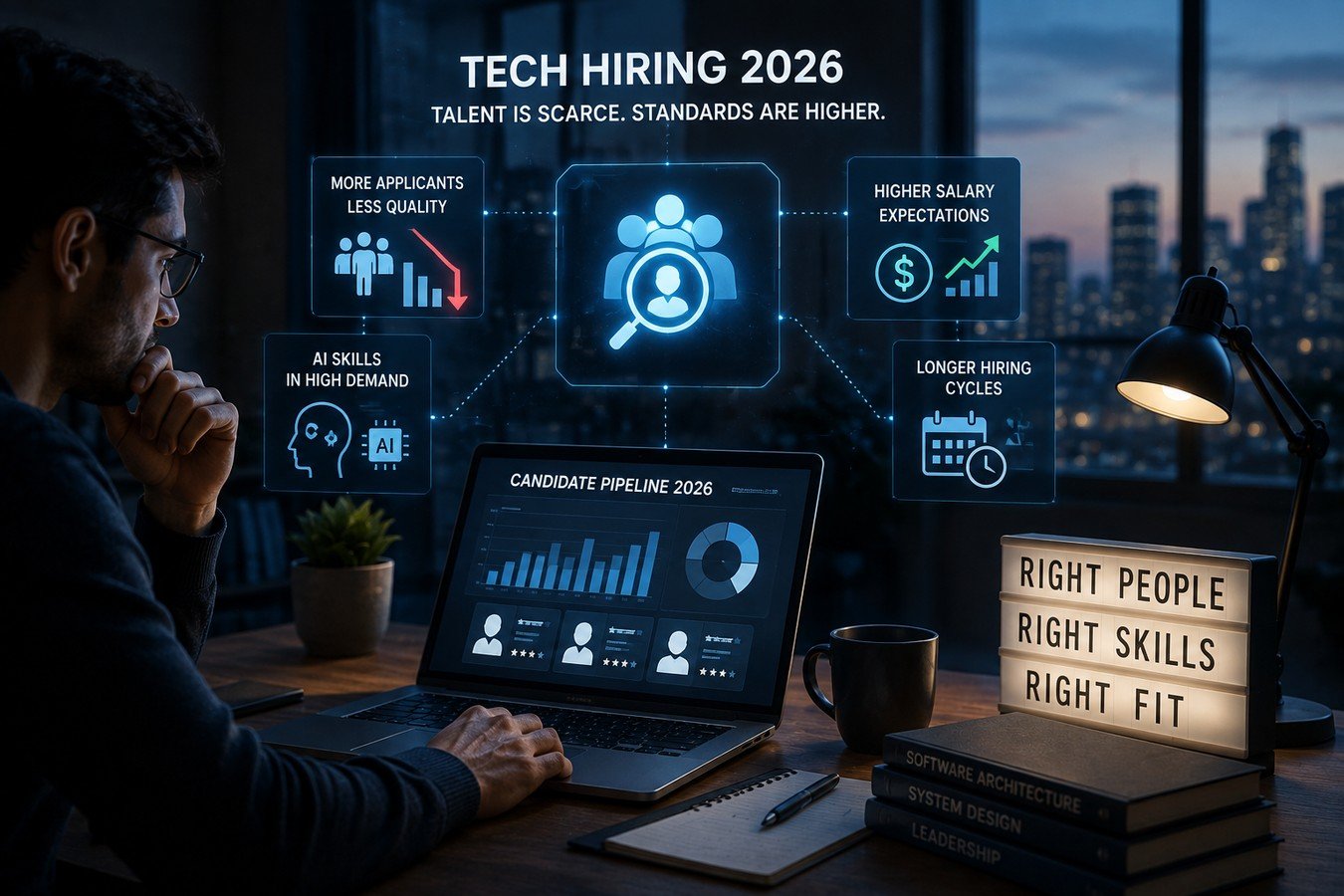
My inbox this month has been a mess of contradictions, and honestly, that’s basically what tech hiring news looks like right now if you zoom out. A friend at a mid-size firm got laid off in February. Her cousin, an ML engineer three years in, had two competing offers by April. Same industry, same year, wildly different luck.
That gap is the real story hiding underneath most tech hiring news headlines — not a single trend, but two trends wearing each other’s clothes. Nobody warned me hiring cycles could feel this split down the middle, yet here we are.
Same Industry, Two Completely Different Weather Patterns

Total tech postings still haven’t climbed back to where they sat before the last decade turned. Not close, really. Chart it out and the line dips hard, flattens, and just kind of sits there.
Now chart machine-learning-specific roles over that identical window. Different picture entirely — climbing, and not gently.
A recruiter I chatted with put it better than I could: hiring right now means dipping into two separate ponds. General software roles keep draining slowly. AI specialists sit in a shallow pond everyone’s fishing at once, with the same three hooks. Tech didn’t stop hiring people. It got picky, almost uncomfortably picky, about which seat matters.
Broad US tech listings sit close to a third below where they were five-plus years back, while machine-learning-focused openings pushed roughly 60% past that same starting point. General software engineering slid the other way, down nearly half. So no — hiring didn’t vanish. It just packed up and moved somewhere narrower.
Why The Layoff Numbers Only Tell Half The Truth

Layoffs are real, don’t get me wrong. Job-cut trackers counted over fifty thousand announced tech positions gone in the first quarter of 2026 alone — the roughest opening stretch in a few years. A short list of familiar big names carried most of that total, which explains why it feels louder in the news than it might actually be on the ground.
But something odd is happening underneath those numbers too. Companies keep pinning cuts on “AI” when the honest reason is duller — overhiring two years ago, a slow quarter, investors wanting leaner spreadsheets. People inside the industry have started calling this “AI redundancy washing,” basically slapping a trendy label on an ordinary budget call. Read those press releases skeptically. Sometimes AI really is the reason. Often it’s just the easiest excuse sitting on the shelf.
Anyone wanting a live, daily-updated feed of exactly which companies are cutting can check the tech layoffs tracker on TrueUp rather than relying on secondhand roundups.
| Metric | 2025 | 2026 (year to date) |
| Layoffs at tech companies | 783 | 548 |
| People impacted | 245,953 | 176,306 |
| Daily average people impacted | 674 | 760 |
| Q1 announced tech job cuts | — | 52,050+ |
Notice the pattern? Fewer separate layoff events this year, but each one hits harder. Bigger single rounds instead of scattered small ones.
Who’s Winning In This Market (Because Someone Always Is)
Here’s where tech hiring news stops being purely grim. Seasoned professionals — the ones with actual scar tissue from shipping under pressure — saw demand jump noticeably in early 2026, even while cut announcements kept rolling elsewhere. Quarter over quarter, requests for experienced talent rose by double digits. Year over year, still climbing, just at a calmer pace.
Newcomers aren’t sharing in that warmth at all. Entry-level hiring shrank compared to the same period a year prior, and mid-level manager hiring dropped even more sharply. Two years into your career right now? This particular chapter of tech hiring news probably feels personally aimed at you. Fair to say it kind of is.
Companies increasingly want people who own outcomes instead of just clearing tickets. Someone who looks at a messy problem, makes a call, adjusts when the tooling shifts again next quarter. Much harder to teach than a framework — which is exactly why it commands a premium now.
Where Demand Is Actually Concentrated
- AI and machine-learning engineering keeps topping fastest-growing job lists, two years running now.
- Senior AI-focused engineers earn a real, measurable premium over similarly ranked non-AI peers.
- Security, cloud infrastructure, and applied research roles hold steady while generalist postings shrink.
- Customer service, data entry, and junior content roles overlap most heavily with what current AI tools already handle.
None of this means panic-learn AI overnight. It means replaceable, task-shaped work is the part getting squeezed hardest, and that squeeze shows no sign of easing soon.
Geography Quietly Rewrites This Story Too
Location matters more than people admit. Big tech-heavy metros — Seattle’s a fair example — sit near or below pre-pandemic posting levels despite population growth continuing regardless. Smaller and mid-sized metros, especially across the South and Mountain West, are holding up noticeably better in comparison.
For deeper monthly data straight from source rather than a secondhand summary, the Indeed Hiring Lab’s labor snapshot tracks postings, wages, and openings nationally each month.
Curious how another country’s hiring shift compares? Our piece on Japan’s HR tech hiring shift shows a different pattern entirely — shaped more by demographics than AI substitution.
What Recruiters Told Me They’re Doing Differently
I asked a few recruiters what actually changed on their end. Same answer, roughly: fewer postings, but each one written narrower. Job descriptions read like wish lists lately — five years experience, three specific tools, plus soft-skill requirements once reserved for management hires.
That narrowness cuts both directions. Candidates who match closely close offers within weeks. Everyone else applies into what feels like a black hole, which fuels a good chunk of the frustration baked into current tech hiring news coverage.
Funding shifts inside HR technology matter here too — startups building tools specifically to help companies hire smarter under tighter budgets. Our recent look at funding activity inside HR tech breaks down who’s raising money to solve exactly this problem.
2022 Versus 2026: Not The Same Storm

| Factor | 2022–2023 Wave | 2026 Pattern |
| Trigger | Post-pandemic overhiring correction | AI adoption plus budget discipline |
| Scale | 300,000+ impacted globally | Fewer, larger concentrated rounds |
| Entry-level impact | Broad across all levels | Disproportionately entry-level |
| Recovery signal | Gradual stabilizing by 2025 | Split — specialists thrive, generalists stall |
Side by side, it’s obvious this isn’t a repeat performance. It rhymes with 2022, sure, but the machinery underneath runs differently enough that treating them as identical would be a mistake.
So, Should You Actually Worry?
Depends entirely on your lane. Generalist developer with nothing specialized on the resume? Yes, things are slower and tighter than they’ve been in a while. Picked up applied AI work, security depth, or genuine ownership on past projects? Hiring managers are still moving fast, sometimes surprisingly fast, for exactly you.
My honest take, for whatever it’s worth: loud layoff headlines rack up clicks, but they undersell how much quiet, steady hiring keeps happening beneath them. It’s just less dramatic, so nobody bothers trending it.
For broader context on tooling reshaping how hiring teams operate, our roundup of tech ideas reshaping the web touches on some of the same efficiency shifts showing up inside recruiting departments.
Wrapping This Up
The current run of tech hiring news isn’t one clean story — it’s two markets stapled awkwardly together. Layoffs remain real and ongoing, hitting entry-level and generalist roles hardest. Specialized, senior, AI-literate talent stays genuinely scarce, pulling premiums and faster offers than almost anything else in the market right now. Geography and company size tilt the picture further still, with smaller metros quietly outperforming giants nobody expected to slow down.
If there’s one thing worth carrying away from this stretch of tech hiring news, it’s that “is tech hiring or not” was never the right question to begin with. The better one, the one that actually predicts your odds, is: hiring for what, exactly, and where.
Frequently Asked Questions
Is tech hiring actually slowing down in 2026?
Overall postings sit below pre-pandemic levels, though specialized roles like AI and cloud engineering keep growing fast despite the broader slowdown.
Why do layoffs and hiring news seem to contradict each other lately?
Companies are cutting generalist and entry-level roles while simultaneously competing hard for scarce, specialized technical talent at the same time.
Are AI-related layoffs really caused by AI adoption?
Some genuinely are, but analysts note many cuts get labeled “AI-driven” when the real cause is cost-cutting or leftover overhiring from prior years.
Which tech roles are safest from the current hiring slowdown?
Machine learning infrastructure, applied AI research, cybersecurity, and senior cloud architecture roles remain in consistently strong demand right now.
Is entry-level Tech Hiring News recovering anytime soon?
Not clearly yet — entry-level and mid-manager hiring both declined recently, and managers remain unusually selective when filling those junior seats.
Do smaller cities offer better tech job prospects right now?
Often yes — mid-sized metros show more resilient postings compared to large, tech-heavy metros still sitting below pre-pandemic hiring levels.
Should I switch specializations to survive this hiring market?
Not necessarily switch entirely, but layering AI-adjacent or security skills onto your existing specialty noticeably improves your odds either way.
How reliable are the tech layoff numbers reported in the news?
Reasonably reliable directionally, though exact figures vary between trackers depending on which companies and regions each one chooses to count.

An IT career coach with 7 years of experience helping beginners map out certification paths that actually lead to interviews, not just another resume line. He’s guided dozens of career-switchers through their first AWS or CompTIA exam and writes for itechnova.io, covering IT certifications, cybersecurity, and the software tools people actually need to know.
3 thoughts on “Tech Hiring News: An Honest, Startling 2026 Reality Check”