

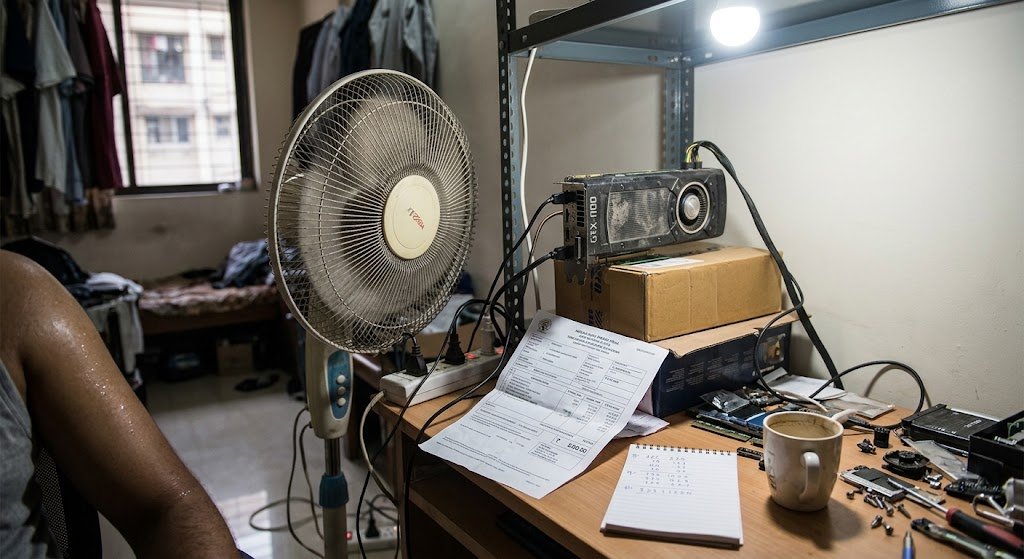
The cheapest way to understand cryptocurrency mining is to look at a bill, not a diagram.
I learned that in 2017. One borrowed graphics card, propped on a shelf beside a pedestal fan, running cryptocurrency mining software day and night for six weeks straight. Earnings: under twelve dollars. Extra electricity: comfortably more than that. My education cost me the difference, and it was worth every rupee, because it answered the question faster than any tutorial could.
So let’s treat what is cryptocurrency mining as an economics problem wearing a computer-science costume, not a currency problem.
What Is Cryptocurrency Mining, Mechanically?
A network running on cryptocurrency mining has no branch manager. No settlement desk closes at five. Somebody still has to decide which transfers are real and lock them into the record permanently, and the system’s answer is unusual — it hands that authority to whoever proves they spent genuine physical resources competing for it. That competition is cryptocurrency mining.
Those resources are watts. Converted into computation, spent on a race, and settled roughly every ten minutes.
Winners of cryptocurrency mining collect twice over: freshly issued coins, plus the fees riders attached to their transactions. This is the only way new bitcoin enters existence. Not printed, not granted — paid out as wages for securing the ledger through cryptocurrency mining.
Proof-of-work is the technical name for cryptocurrency mining’s core rule. Ethereum left it behind in favour of staking; Bitcoin kept it, and so did Monero, which matters more than it sounds like it should. Monero-style cryptocurrency mining turns up again in the ugly half of this article. Anyone tracking the wider market week by week can dip into our rolling crypto updates for the news side of things.
How Cryptocurrency Mining Actually Works, Step By Step

Mechanically, cryptocurrency mining is dumber than people expect.
Take the block. Bolt a disposable number onto it. Hash the whole thing. Is the output below the current target? Almost certainly not. Change the number, hash again. Repeat until your hardware or your patience gives out.
Trillions of attempts per second, over and over. No shortcut exists in cryptocurrency mining, and that’s deliberate — a shortcut would make the whole cryptocurrency mining system worthless as a security tool.
Because more machines would otherwise produce blocks faster, the protocol keeps re-tuning the difficulty behind cryptocurrency mining. Bitcoin does it on a 2,016-block cycle, landing near two weeks, holding block times around ten minutes regardless of how much hardware joins or leaves. Recent live readings have sat near 127 trillion difficulty against something close to 906 exahashes per second across the network. Those numbers shift constantly, so it’s better to read retarget figures live than to trust any cryptocurrency mining snapshot printed in a blog post, including this one.
Against 906 EH/s, one laptop’s contribution to cryptocurrency mining rounds to nothing.
Is Cryptocurrency Mining Still Profitable In 2026?
Every four years or so, the pay for cryptocurrency mining gets halved. That’s written into the code, and it’s not negotiable.
Fifty coins per block at launch in 2009. Cuts followed in 2012, 2016, 2020, then April 2024, which dropped the subsidy to 3.125 BTC. Around 2028, cryptocurrency mining rewards halve again. By then the overwhelming majority of all bitcoin that will ever exist has already been issued.
Miners measure cryptocurrency mining income as hashprice — dollars per petahash per day. Recent months have seen it drift in the low-to-high thirties, and here’s the part that should worry operators: transaction fees have been contributing well under one percent of total cryptocurrency mining revenue on ordinary days. Income is therefore almost purely a bet on the coin price. There’s no second stream propping it up.
Industrial cryptocurrency mining farms cope through power contracts cheap enough to make hobbyists wince, immersion cooling, and machines rated in joules per terahash. On a household tariff, cryptocurrency mining is a hobby you subsidise, not a side income.
Criminals ran the same sums and found the flaw. If power is the cost that destroys the cryptocurrency mining margin, arrange for someone else to pay it.
When Cryptocurrency Mining Happens Without Your Consent
That’s cryptojacking — cryptocurrency mining software installed on hardware whose owner never agreed, never noticed, and keeps paying to run it.
Nothing gets encrypted. No ransom note appears. The device simply takes on unpaid cryptocurrency mining work at night, and the only bill that changes is yours.
Compare the two versions of cryptocurrency mining honestly:
| Consensual cryptocurrency mining | Cryptojacking | |
| Power paid by | Whoever runs the rig | The victim, unknowingly |
| Delivery route | Bought, plugged in, configured | Trojanised installer, script injection, stolen cloud keys |
| Coin chosen | Mostly Bitcoin via ASICs | Mostly Monero, because CPUs can do it |
| Goal | Profit per watt | Staying invisible for months |
| Telltale sign | None needed | Fan noise, heat, flat battery, strange invoice |
Scale first, then nuance. SonicWall’s research recorded over a billion cryptojacking hits tied to unauthorised cryptocurrency mining in a single year, with a triple-digit percentage surge behind that figure. Cloud environments are where the cryptocurrency mining money concentrates — attackers holding valid credentials can launch GPU instances at someone else’s expense, and there are documented cases of bills running into six figures before anyone opened the billing console.
Google’s own cloud threat research found unauthorised cryptocurrency mining in around two-thirds of compromised accounts on its platform, and the company now offers customers up to a million dollars in protection against undetected cryptocurrency mining through its premium security tier. Nobody insures a theoretical risk. Before adding another security product, it’s usually smarter to spend an afternoon scoring your exposure and working out which workloads could quietly run someone else’s cryptocurrency mining operation.
(Keyword checkpoint at halfway: 18 exact mentions of “cryptocurrency mining” so far — on pace.)
A Real Cryptocurrency Mining Attack: March 2026

Enough theory. Here’s a cryptocurrency mining campaign with a date, a vendor report, and a target profile.
Microsoft’s Defender researchers documented an operation where malicious download pages reached victims through poisoned search rankings and — the newer twist — through links surfaced inside AI chatbot answers. The fake sites impersonated hardware utilities: CrystalDiskInfo, HWMonitor, Display Driver Uninstaller, FurMark, K-Lite Codec Pack, PDFgear, all chosen to lure people who own the hardware that makes covert cryptocurrency mining worthwhile.
Read that list once more. Those aren’t random brands. They’re what you download when you own a serious graphics card, and a serious graphics card is what makes GPU-based cryptocurrency mining worth stealing.
More than 150 attacker-controlled domains sat behind this cryptocurrency mining operation, with activity traced back to March 2026 and the chatbot route appearing in April. The installers dropped a malicious DLL that sideloaded into a legitimate program, planted ScreenConnect for remote access, then ran a loader that hollowed out signed Microsoft .NET binaries to host the cryptocurrency mining payload. Persistence came through scheduled tasks, registry Run keys and a startup shortcut. Defender exclusions were added on the way in.
And the cryptocurrency mining was the least of it. That remote-access tool gave the operator a door they could walk back through later for theft, lateral movement, or something worse. If you want the technical chain step by step, Defender’s full teardown covers it, and there’s separate reporting on the chatbot delivery route for anyone interested in how that lure worked.
Who’s Actually At Risk From Hidden Cryptocurrency Mining
Traders and crypto firms barely feature in cryptocurrency mining attacks. It’s mostly everyone else.
- Public sector and hospitals. Cisco Talos incident data through early 2026 put government and healthcare at the top of engagements, roughly a quarter each, with public administration leading repeatedly. Old equipment plus stretched staff equals cryptocurrency mining payloads that sit undisturbed.
- Multi-cloud companies. Most organisations now split workloads across several providers, which means several consoles, several billing views, and several chances to miss a cryptocurrency mining spike.
- People with good graphics cards. Gamers, editors, 3D artists. See the cryptocurrency mining campaign above.
- Phone owners. Mobile cryptocurrency mining cases climbed steeply through 2025, and a large share of firms permitting personal devices have no way to inspect them at all.
Now an opinion, unhedged. On a personal machine, unauthorised cryptocurrency mining is a nuisance with a thermal cost — irritating, not ruinous. Inside an organisation it’s serious, because the cryptocurrency mining process is rarely alone. It’s the visible tenant in a property someone else already holds keys to.
Detecting Cryptocurrency Mining On Your Own Devices
A designer friend once called me about a “tired” workstation. Nothing open. CPU pinned near seventy percent anyway. The offending process had a bland, bureaucratic name and was being fired off by a scheduled task nobody remembered creating. Diagnosis took under half an hour, and it was cryptocurrency mining malware the whole time.
Run through this list:
- Shut every application, wait two minutes, then read idle CPU and GPU load in Task Manager, Activity Monitor or htop — high idle load is the clearest cryptocurrency mining tell.
- Feel the exhaust vent. Heat with nothing running is data.
- Read your scheduled tasks, cron entries and Run keys. Cryptocurrency mining persistence has to live somewhere.
- Open your antivirus exclusion list. Entries you didn’t write mean the machine is compromised — treat it that way.
- Watch outbound connections for mining-pool ports such as 3333, 4444 and 5555, the standard cryptocurrency mining pool range.
- In cloud consoles, treat unexplained GPU spend as the equivalent of a screaming fan.
Browser-based cryptocurrency mining largely died with Coinhive’s 2019 closure, though it resurfaces. If the spike only exists while one tab is open, you’ve found it.
Preventing Unauthorised Cryptocurrency Mining
Warnings without instructions are just noise, so:
- Type vendor domains yourself. Not an ad, not a chatbot’s link. That single habit defeats the entire 2026 cryptocurrency mining campaign described above.
- Enable tamper protection so exclusions can’t be added silently.
- Put MFA on every cloud console and kill long-lived API keys, since stolen credentials are how cryptocurrency mining reaches expensive hardware.
- Set billing alerts at a figure you’d actually react to, and cap instance families you never legitimately use.
- Block known pool domains at the DNS layer to cut off cryptocurrency mining traffic before it starts.
- Patch anything exposed to the internet quickly — open Redis, Docker and Kubernetes endpoints remain dependable entry points for cryptocurrency mining malware.
- After any unexplained slowdown, remove the persistence mechanism, not just the running process.
None of that needs budget approval, and a handful of low-effort precautions prevent more cryptocurrency mining incidents than most purchased products manage.
Tools For Spotting And Blocking Cryptocurrency Mining
Native tools handle most home cryptocurrency mining situations. Defender with tamper protection is free and competent. Sysinternals Autoruns exposes persistence in one screen.
On cloud, Security Command Center and AWS GuardDuty both treat cryptocurrency mining as its own detection category. Pi-hole or a managed DNS filter cuts pool traffic cheaply. For curiosity rather than defence, minerstat and CoinWarz publish the live difficulty and hashprice numbers that make the economics of legitimate cryptocurrency mining so unforgiving. Smaller teams usually start by working through tooling comparisons, while anyone without staff awake overnight should price outside eyes overnight against the cost of finding a four-month cryptocurrency mining infection on an invoice.
FAQs
Is cryptocurrency mining legal?
Generally yes, including at home. Doing cryptocurrency mining on machines you don’t own or have permission to use is not.
Does cryptocurrency mining wreck hardware?
It accelerates wear on fans, paste and batteries through constant load. Catastrophic failure is uncommon; shortened life isn’t.
Can phones be used for cryptocurrency mining?
Yes, and cryptocurrency mining cases rose sharply in 2025. Watch for heat, fast battery drain, and apps installed outside official stores.
Why Monero and not Bitcoin for hidden cryptocurrency mining?
Monero mines acceptably on ordinary processors and its privacy design makes tracing cryptocurrency mining payouts difficult.
Is browser-based cryptocurrency mining finished?
Mostly, since Coinhive shut in 2019. Occasional cryptocurrency mining cases remain, identifiable by CPU spikes tied to one open tab.
Final Thoughts
Answering what is cryptocurrency mining properly means accepting an unromantic truth: it’s a costly guessing competition that converts electricity into trust, and pays the winner in new coins. The legal version of cryptocurrency mining has consolidated into an industry with margins a home user can’t reach. The version most readers will actually meet is the parasitic one — quiet, patient, and billed to somebody who never agreed.
Spend ten minutes this week on the machine you use most. Idle load, scheduled tasks, exclusion list. If something looks wrong, pull out the persistence and then work backwards to find the door it came through.

An IT career coach with 7 years of experience helping beginners map out certification paths that actually lead to interviews, not just another resume line. He’s guided dozens of career-switchers through their first AWS or CompTIA exam and writes for itechnova.io, covering IT certifications, cybersecurity, and the software tools people actually need to know.