


Picture this—you type world tech news otvptech into a search bar at 7 a.m., hoping for a tidy morning briefing, and get a pile of near-identical pages instead. Happens more than people admit. The phrase sits somewhere between a brand, a typo and a habit. This guide sorts out what it points to, how to tell reliable reporting from filler content, and which technology trends actually matter this year. If you’d rather skim a wider mix of global tech stories first, start there and come back.
I Searched the Phrase First. Here’s What Came Back

I did the lazy thing before writing a word of this. I typed world tech news otvptech into a search bar and read whatever came up.
What came back was samey. Several pages described OTVPTech as a company reshaping industries through AI, cybersecurity and sustainability, and the words “technology news” appeared so often they started to sound like a chant.
What I couldn’t find bothered me more. No founder. No address. No product page, no funding round, no customer anyone would name. Lots of adjectives, zero receipts.
Does that mean OTVPTech doesn’t exist? No, and I won’t claim it. A tiny startup can have a thin footprint. All I can say, at the time of writing, is that I found nothing independent that confirms it as a company, a publication or a product. So when a blog tells me what world tech news otvptech is “doing for the industry,” I file it under unverified and move on.
People miss something here: a search phrase isn’t a source. Somebody sees a strange word, searches it, and content sites rush to fill the gap with confident paragraphs. Those get indexed. Other sites copy them. Five pages agreeing starts to feel like proof when it’s really one paragraph with five addresses (we cover another tech-news brand on this site if you want a comparison).
So I’d treat the keyword as a doorway, not a destination. Whoever types world tech news otvptech probably wants something plain: dependable, current technology reporting from around the globe. The rest of this article tries to hand that over.
Why Do People Search World Tech News OTVPTech at All?
Intent behind a phrase like this is never one thing. After looking at what ranks, I’d guess there are four kinds of searcher.
Some saw the word once, in a link or a group chat, and want a one-line answer. They owe it no loyalty. Right now world tech news otvptech gives them a messy answer.
Others want a feed. They heard there’s a place that rounds up global headlines and they’d gladly bookmark it, so the label matters less than the output.
Then come the investors and job seekers hunting for a company to watch. Pages calling OTVPTech a “rising star” feed this crowd directly, which is exactly why I’m cautious. Money decisions need primary sources, not recycled enthusiasm.
And the last group is other publishers. I write SEO content for a living, so I know how the machine runs: someone spots an odd phrase with a trickle of traffic, and a dozen pages appear. Demand for world tech news otvptech partly exists because pages about world tech news otvptech exist.
None of this makes the searcher foolish. Everyone chases a half-remembered term now and then, and the way people consume news these days makes it easier than ever.
Where Readers Really Get Their Tech News Now
General habits explain why a vague phrase can turn into a search term. The annual Reuters study for 2026 surveyed close to 100,000 people across 48 markets, and the headline is split attention. Social media and video networks (54%) edged past TV (52%) and news websites (51%) as ways people reach news online. News websites and apps were the only category tracked that lost users between 2023 and 2026, down five percentage points.
Trust is the sobering part. Overall trust in news fell to 37 percent, the lowest level since the study began. Anyone reading world tech news otvptech pages on social platforms or through a chatbot is standing on the shakiest ground in the table below.
| Where the news arrives | Share who trust news there |
| News overall | 37% |
| Search engines | 32% |
| Social media | 22% |
| AI chatbots | 20% |
Figures from the Reuters Institute Digital News Report 2026, as reported at time of writing.
Chatbots deserve their own paragraph. Ten percent of people now use them for news, up from seven percent last year, and that climbs to 16% among under-35s. Only 1% call a chatbot their main source. The pull is obvious: the most popular feature, named by 42% of users, is being able to ask follow-up questions.
One more number worries me. Across 27 markets, only 4 percent say they always or often click through from a chatbot to the original source. A polished summary of a thin source is still a thin source. If you research world tech news otvptech through a chatbot, open the original page every time, whether a person or a machine wrote the summary.
Creators matter too, though they’re not the whole story. Around 46% of people get some news from creators of any type, and just 3 percent rely on them alone. Think of them as commentary sitting on top of reporting.
A Five-Minute Test Before You Trust Any Tech Source
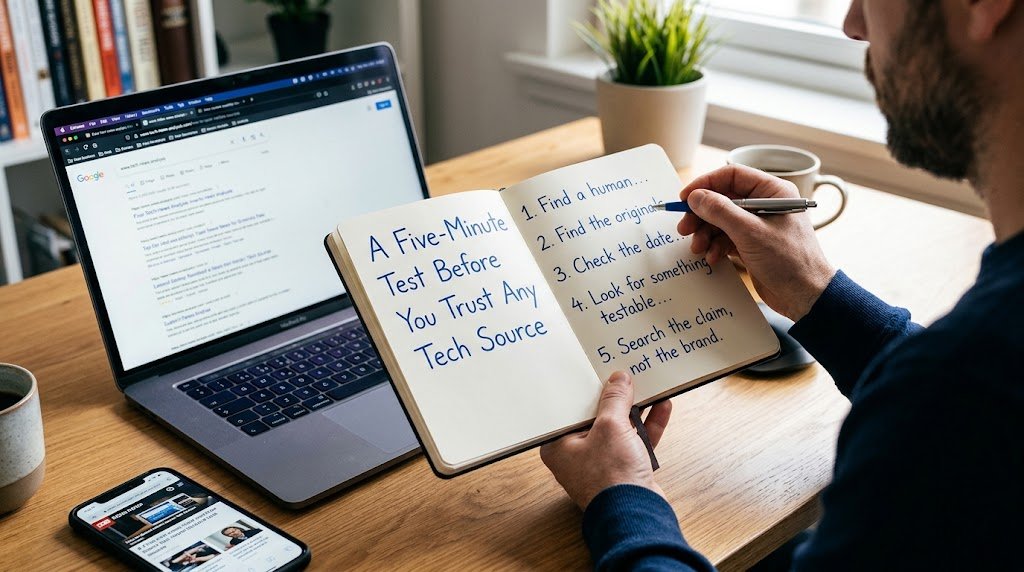
Whether the source is a newsletter, an aggregator or something you only found through world tech news otvptech searches, the same checks apply. I run them in this order and rarely need more than five minutes.
Find a human. A named author with a track record you can verify elsewhere. An “Admin” byline over a stock-photo headshot tells you plenty.
Find the originals. A solid tech story links to the filing, the press release, the paper or the product docs. If every link loops back to the same site, that’s a circle, not a source.
Check the date. Stale pages with fresh timestamps are everywhere. Compare the date on the page with what the text actually discusses.
Look for something testable. A named quarter, a filing, a product version, a city. “Experts recognize its potential” can’t be tested. “The filing lists a new subsidiary” can.
Search the claim, not the brand. Pick one striking statement and search it with “filing” or “announcement” beside it. If nobody credible repeats it, pause.
Most pages about world tech news otvptech fail at the first or second check. That doesn’t make them worthless (some are harmless summaries), but I wouldn’t build a decision on them.
Say a page tells you a firm is “revolutionizing” a sector. You go looking for the press release, the filing or a customer quote. If all you find is more pages echoing each other, you’ve learned the claim has no visible anchor, and that’s worth knowing before you share it.
Last habit: keep a short list of outlets you’ve already vetted and check them first. Anything new that surfaces through a phrase like world tech news otvptech has to clear the same bar before it earns a place on that list.
How Pages About a Phrase Like This Get Built
Picture the assembly line. Someone notices that world tech news otvptech gets a trickle of searches and little competition. They open a template, add a heading called “What is OTVPTech?”, another for “Key focus areas,” and fill both with general lines about innovation, sustainability and growth.
The skeleton is predictable. Short intro, buzzword list, a “challenges” section that name-drops giant competitors for borrowed credibility, then a closing question asking if the brand is the next big thing. After a few of these you spot it in seconds.
One page I read says the company’s solutions are already having an effect on its market. An effect on whom? Measured how? Reported by which outlet? The sentence doesn’t say. A real report would name a customer, a metric or a date. Every time I see a vague line like that on a world tech news otvptech page, I ask what I could actually check, and usually the answer is nothing.
I don’t blame the individual writers. Briefs often arrive as a keyword and a word count and nothing else. If no facts exist, adjectives fill the space. That’s the uncomfortable truth about world tech news otvptech content, and about plenty of keyword-driven writing generally.
So when a page about world tech news otvptech has the same skeleton as ten others, stop reading it as reporting. It’s a placeholder for reporting that hasn’t happened yet.
What Is Actually Moving World Tech in Late 2026
Strip away the branding and the real stories look similar across serious outlets. For an anchor I like Gartner’s planning research, because it forecasts where enterprise money is heading. Its 2026 trends list came out in October 2025, so read it as a forecast, not a scoreboard, and check Gartner’s own announcement for the full list.
Specialist models are crowding out the generalists
Gartner forecasts that by 2028, over half of enterprise generative AI models will be domain-specific. Plain version: companies want tools tuned for contracts, medicine, logistics or code, not one giant model for everything.
You’ll see this in world tech news otvptech style roundups as a flood of “AI for X” launches. Some are real. Plenty are a wrapper and a logo. Ask what data the model was tuned on and who checks the output.
Security is moving earlier
Gartner predicts that by 2028 more than 50% of enterprises will use AI security platforms, and that by 2030 half of all security spending will go to preemptive solutions. The industry is edging from “detect and respond” toward “stop it sooner.”
When a headline calls a vendor “predictive,” look for a named customer and a described method. Without those it’s marketing, and I’d say the same about any world tech news otvptech list.
Provenance, or proof of where things came from
Gartner warns that skipping investment in provenance could mean sanction risks worth billions by 2029. Provenance is the paper trail for software, data and media: who made it, what changed, whether you can trust it.
It lands close to home for readers. Synthetic pages get generated for odd keywords constantly, and world tech news otvptech is a textbook example of a phrase that attracts them.
Two more forecasts from the same release are worth a line. Gartner expects over 40% of leading enterprises to adopt hybrid computing by 2028 (up from 8% at the time of its announcement), and 80% of organizations to shift from large engineering teams to smaller AI-augmented ones by 2030. Hold both loosely. They’re predictions.
None of this needs the label world tech news otvptech to make sense. These stories surface in earnings calls, regulatory filings and vendor roadmaps, which you can read yourself. If a story about world tech news otvptech can’t be tied to one of them, or to some other checkable development, I treat it as background noise.
Which Topics Deserve a Place in Your Feed?
Nobody needs every beat. A world tech news otvptech search tends to return a grab-bag that feels like coverage but behaves like noise, so I’d rather you pick three beats on purpose.
The first should match your job. Marketers follow search and AI visibility changes, security analysts follow vulnerabilities and policy, founders follow funding and hiring. You should be able to act on it within a month.
The second is a curiosity beat, something with nothing to do with your paycheck that you swap every few months. It keeps reading enjoyable, which is what makes a routine last past February.
The third is geographic. One region followed closely teaches more than twenty followed lightly.
Write the three beats down somewhere visible. It sounds silly, but a list stuck to a monitor stops a world tech news otvptech tab from turning into an hour of drifting.
Everything else gets a monthly glance. If a topic matters it’ll keep turning up, and you can promote it later.
There’s a quiet failure in world tech news otvptech style browsing: feeling informed without changing anything you decide or do. Information that never touches a decision is entertainment. Fine, but call it that. And if you read ten stories a day and remember none, halve your beats.
Reading the World Without Reading Everything
Tech news isn’t produced in one place. A regulation in Brussels, a chip plant in Asia and a startup round in Lisbon can all matter to the same reader in the same week. Nobody can follow it all, and the phrase world tech news otvptech promises more coverage than any single page can deliver.
My approach is a few regions tracked closely and a lighter scan of the rest. Choose the places that touch your work. A software lead cares about talent markets, which is why a country-level view such as Poland’s local coverage can be more useful than a vague global feed. A hardware seller watches supply chains instead.
Language is the quiet barrier. Local-language reporting can break stories before English outlets pick them up, and browser translation has gotten good enough to try (just double-check names and numbers).
A decent world tech news otvptech style scan, if such a thing exists, should do three jobs. Name its sources. Give the date. Separate what happened from what someone predicts. If a page can’t do those, keep walking.
Pair each region with one or two sources you trust, and rotate them every quarter so you don’t drift into an echo chamber. When two independent outlets in different countries report the same development, your confidence should rise. When only world tech news otvptech pages mention it, it shouldn’t.
A Weekly Routine That Fits in 40 Minutes

Routines beat willpower. Mine is small enough that I actually follow it, and you can steal the shape.
Monday gets ten minutes: headlines only from two or three vetted outlets, no deep reading. You’re just noticing what rose over the weekend.
Wednesday gets another ten. Pick one story and trace it to the primary source, whether that’s the announcement, the filing or the paper. This habit alone filters out most junk, including anything you stumbled on while searching world tech news otvptech.
Friday gets twenty minutes for one longer piece from a specialist outlet or a good newsletter, then two sentences on why it matters to your work. Those sentences become your own record of the year. After a couple of months you’ll see patterns no single article shows, and that file has taught me more than any pile of world tech news otvptech roundups ever did.
The table below is my own judgment of how common source types compare. It isn’t survey data, so adjust it to your experience.
| Source type | Speed | Depth | Main risk |
| Official announcements and filings | Fast | Narrow | Corporate spin |
| Specialist trade press | Fast | High | Paywalls, narrow beats |
| Weekly newsletters | Slow | Medium | Curator bias |
| Video and creators | Fast | Varies | Opinion dressed as fact |
| AI chatbots | Instant | Shallow to medium | Summaries rarely checked |
| Keyword aggregators | Varies | Thin | Copied, unverified claims |
Notice where world tech news otvptech pages land: the bottom row. Useful as a pointer, almost never as proof.
What the Headlines Mean for Your Job Search
If you’re hunting for work, the most valuable tech news is whatever predicts hiring. Forecasts about smaller, AI-augmented engineering teams matter because they change which skills employers pay for.
I’d read them calmly. Smaller teams don’t mean no teams. They tend to mean higher expectations per person and more weight on judgment, review and communication. A skills story, not a doom story. To see who’s actually hiring, watch the postings themselves, since who’s hiring this quarter says more than any prediction.
When a world tech news otvptech page hypes some company as a hot employer, check its careers page and leadership team before applying. A real company has both, and they’re usually easy to find.
Security roles show how to read signals. Preemptive spending sounds abstract until you notice job titles drifting from “responder” to “engineer” on postings. Small clues add up.
It also helps in interviews. People love a candidate who can discuss a recent development with specifics. Skip the vague hype you might absorb from world tech news otvptech pages and bring one verified story, one number with its source and one opinion of your own.
Following the Money Without Chasing Hype
Funding news is the easiest category to get wrong. A “raise” can mean a signed term sheet, a closed round or a hopeful rumor, and aggregator pages blur all three.
My rule: find the company’s own announcement, then the investor’s page, then a regulatory filing where one applies. Two out of three is decent confidence. One out of three is a rumor. If sustainability startups are your beat, there’s a roundup on funding for climate startups that follows the same sort of rounds.
Valuations deserve extra suspicion. They’re headline bait and can change before you finish reading. Anything under a world tech news otvptech banner that includes one should be traced to a named source or ignored.
A mild opinion: retail investors reading aggregator pages for tips are playing a game the authors aren’t playing. The writers get paid for traffic. You pay for mistakes.
Wait a day if you can. Real announcements pick up follow-up coverage, analyst reactions and corrections. Inflated ones go quiet. If a claim you spotted through world tech news otvptech is still standing after a day of scrutiny, it earned a second look.
Where Smart Readers Still Get Fooled

Even careful people slip, me included, usually when I’m tired. These are the patterns I see most.
Volume looks like credibility. Ten pages repeating a claim feels like confirmation. Check whether they cite anything besides each other.
Novelty looks like importance. A strange new name feels like a scoop when it’s often just unfamiliar. Ask whether it changes anything for the people it’s supposed to affect.
Silence looks like secrecy. A company missing from reliable coverage may be tiny, new or invented. Silence in reputable outlets is information, but it isn’t proof either way, which is why world tech news otvptech claims need patience rather than a verdict.
Confident tone fools people constantly. Phrases like “undoubtedly a rising star” sound authoritative and prove nothing; adjectives are cheap. Old dates do the same job: a launch from two years ago, reposted with a new timestamp, can look current for months. And headlines get written to win clicks, so the caveat that undoes the claim often sits in paragraph six.
The chatbot trap is worth repeating. A summary is a starting point, and as the numbers earlier show, hardly anyone clicks through to confirm one. Same with search results. Getting hits for world tech news otvptech doesn’t confirm anything except that pages exist.
Sometimes the trap is simply speed. A story breaks, a dozen pages rush out a version, and the first one you open becomes the one you remember. Waiting an hour often lets the corrections arrive. Reading a world tech news otvptech summary at full speed, on a phone, between meetings is how most of my own mistakes happen.
The fix is dull and reliable: slow down for thirty seconds, find the original, then decide.
What Do You Do With a Claim You Can’t Verify?
This is the situation most readers actually face. You’ve found something interesting under world tech news otvptech, the source is murky, and a primary document is nowhere in sight. Now what?
I sort those claims into three piles. The first is “interesting but unconfirmed.” I don’t share it, I don’t act on it, and I might jot it in a notes file with the date. If nothing backs it up in a few weeks, it quietly drops out.
The second pile is “low stakes.” A rumor about a gadget color or a product name rarely hurts anyone, so I can hold it loosely and enjoy it. Just don’t repeat it as fact.
The third is “high stakes”: money, health, security, a job. Those never leave the unconfirmed pile without a primary source, full stop. A line on a page about world tech news otvptech is not enough to move savings, install software or quit a job.
One practical trick is to write down what would change your mind. If the company is real, what would you expect to find? A registered business, a named team, a customer willing to be quoted, a product you can use. If none of those turn up after twenty minutes of looking, that tells you something, even if it can’t prove anything.
And if you’re a writer working with a murky term, say so on the page. Readers forgive “I couldn’t confirm this.” They don’t forgive confident nonsense.
Should Publishers and Site Owners Care About This?
If you run a content site, this question hits harder than it does for readers. A page built around world tech news otvptech can win a few clicks, but it also tells visitors, and search systems, how much you care about being right.
Search engines have spent years nudging sites toward experience, expertise, authority and trust. You don’t need a checklist to see why. A page with a named author, linked sources and a visible update date looks like something a careful person made. One without them looks like a template.
So if you cover a murky term like world tech news otvptech, say so. Tell readers what you could confirm and what you couldn’t. Admitting uncertainty reads as confidence, oddly, because anyone can write a bold paragraph and very few will write an honest one.
Keep sourcing visible. Point to the primary document, link the original announcement, and date every number that can change. Flag prices, versions and forecasts as “at time of writing.” It costs a few sentences and saves readers from acting on stale facts.
There’s a practical upside too. Pages that show their work tend to get linked to, quoted and bookmarked, and links earn more over time than a week of keyword traffic ever will. A page that cites a regulator, a research institute or a company filing gives other writers something safe to reference. A page that only repeats world tech news otvptech claims gives them nothing.
Sites that last are the ones people return to without needing a keyword. Chasing world tech news otvptech traffic is fine as a start. Earning a bookmark is the goal.
FAQs
Is OTVPTech a real company?
I found no independent confirmation at the time of writing. The pages describing it lack founders, addresses or filings, so treat their claims as unverified until a primary source backs them up.
What does world tech news otvptech mean in search?
It’s a search phrase mixing a global tech-news interest with a label I couldn’t verify. Most results are aggregator pages, so use it as a prompt to find vetted sources.
Where can I find reliable world tech news?
Start with official announcements, specialist trade press and newsletters from named authors. Confirm any surprising claim against a primary source before you share or act on it.
Can I use AI chatbots for tech news?
Yes, as a first pass. About one in ten people do now, but trust is low and few click through, so always open the original source.
How often should I check tech news?
Three short sessions a week are enough for most people, even if you follow world tech news otvptech style roundups. Scan early in the week, trace one story midweek, read one deeper piece at the end.
Final Thoughts
Let me pull this together. The phrase world tech news otvptech is real as a search habit, but I couldn’t confirm it as a company, a publication or a product. That gap between popularity and proof is the most useful thing to take away.
The method matters more than the term. Find the human, find the originals, check the dates, look for something testable, and search the claim instead of the brand. Do that and the junk mostly filters itself out.
The reading landscape has also shifted under our feet. Attention is split across social platforms, video, creators and chatbots, trust sits at a historic low, and very few people verify what they read. That’s no reason to give up on the news. It is a reason to build a routine that does the verifying for you.
And the real stories are bigger than any keyword. Specialist AI models, preemptive security, provenance, hybrid computing and smaller teams are shaping budgets and careers, and they deserve your attention far more than a buzzword does.
My own take, plainly: I think the world tech news otvptech phrase will fade the way most oddly named search terms do, replaced by the next one in a few months. The habits you build while sorting through it will outlast it. Vetted sources, primary documents and a modest weekly routine serve you in every news cycle, whatever the keyword of the moment happens to be.
The best readers I know hold two thoughts at once: curiosity about new names, and stubbornness about proof. That balance is what keeps a search for world tech news otvptech from turning into a wasted afternoon. And a little generosity toward the writers behind these pages helps too. Many work under traffic pressure, and some produce useful summaries. Judge each page on what it shows, not what it claims.
So here’s your next step. Pick three outlets today that name their authors and link to originals, and bookmark them. Block out forty minutes this week and run the five-minute test on the first unfamiliar source you meet. If it holds up, add it to your list. If it doesn’t, you’ve lost five minutes and gained a better filter. Do that consistently and world tech news otvptech stops being a mystery and becomes one more search you know how to handle. Start with one story today, trace it to its source, and see what you find.

An IT career coach with 7 years of experience helping beginners map out certification paths that actually lead to interviews, not just another resume line. He’s guided dozens of career-switchers through their first AWS or CompTIA exam and writes for itechnova.io, covering IT certifications, cybersecurity, and the software tools people actually need to know.