

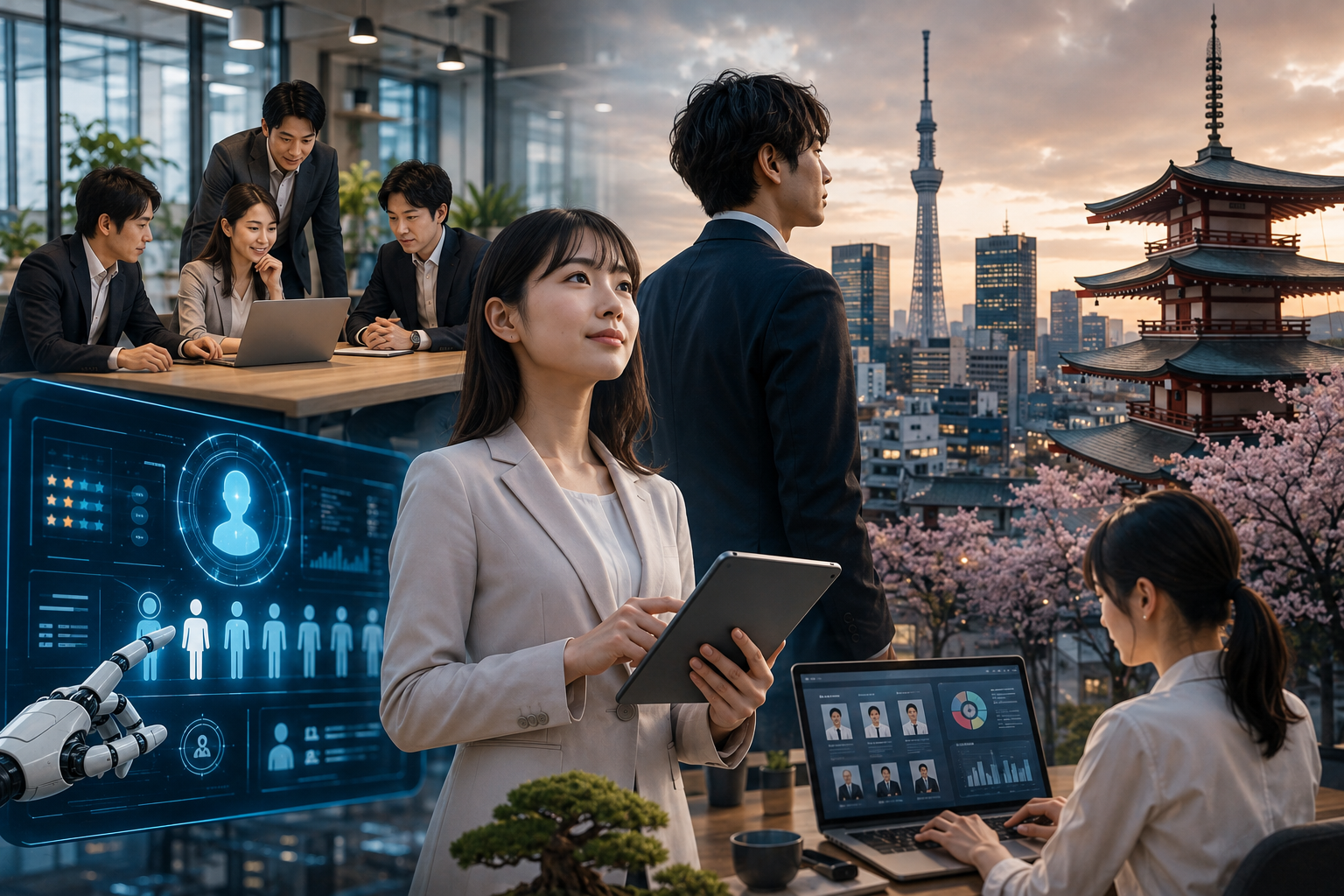
I’ve spent a good chunk of the last few years talking to HR managers across Tokyo and Osaka, and here’s the thing nobody tells you upfront: japan hr tech news isn’t really about software anymore. It’s about survival math. Companies are running out of people, plain and simple, and the tools they’re buying reflect that panic.
Every time I check japan hr tech news this month, it’s the same undercurrent — fewer applicants, more automation, and HR teams quietly rewriting how hiring even works. This isn’t a trend piece. It’s what’s actually happening on the ground, told the way a friend over chai would tell it, not the way a press release would.
What’s Actually Driving All This Japan HR Tech News Right Now
Let’s get the boring-but-important part out of the way first. Japan’s population has been shrinking for over a decade, and the working-age slice of it is shrinking faster than almost anywhere else on earth. That’s not speculation — it’s the reason every second headline in Japan HR tech news mentions “labor shortage” like it’s a company name.
Teikoku Databank’s spring 2026 survey found that just over half of Japanese companies were short on full-time staff, and that’s the fourth April in a row above the halfway mark. Information services companies had it worst, with two out of three firms saying they simply couldn’t find enough skilled people. Read that twice. Tech companies — the ones supposedly building the AI that fixes everything — are themselves the most understaffed, and that irony shows up constantly in Japan HR tech news coverage.
So when I say HR tech in Japan is exploding, I don’t mean it in some breezy “digital transformation” way. I mean companies are buying software because they physically cannot hire humans fast enough. That’s a very different kind of demand, and it explains why vendors, buyers, and even government ministries are all suddenly speaking the same language in every Japan HR tech news roundup you read this year.
The Labor Shortage Behind Every Japan HR Tech News Headline
Job boards used to be enough. Post a listing, wait, interview, hire. That model is basically dead for a huge chunk of Japanese industries now, and it’s the single biggest theme running through Japan HR tech news right now.
Recruit Works Institute, which has been publishing these forecasts for years, put out a projection that’s honestly a little unsettling — it suggests Japan could face a shortage of around 11 million workers by 2040, driven almost entirely by demographics rather than anything cyclical. Their labor shortage forecast report breaks it down region by region, and outside Tokyo, nearly every prefecture is expected to struggle to keep basic services staffed.
That’s the backdrop every HR tech buyer in Japan is operating against. You’re not choosing between “nice to have” software and doing nothing. You’re choosing between smarter systems or watching roles sit empty for months — and that’s exactly why this keeps dominating Japan HR tech news cycle after cycle.
Why AI Hiring Tools Took Over So Fast
Here’s a small thing I noticed talking to a recruiter friend in Yokohama — she stopped screening resumes manually almost two years ago. Not because she wanted to, but because the volume-to-headcount ratio made it impossible. AI-assisted screening, chatbot pre-interviews, automated scheduling — none of this is glamorous, but it buys HR teams hours they don’t have, and it’s a recurring subplot in nearly every piece of Japan HR tech news covering recruitment.
And it’s not just recruiting. Onboarding, payroll adjustments, even internal transfers are getting automated because the HR departments themselves are short-staffed too. There’s a strange irony in that — the people managing the labor shortage are also victims of it.
SmartHR And The Cloud Shift Everyone’s Watching
If you want one company name that keeps popping up in every conversation about domestic HR software, and honestly in most Japan HR tech news coverage from the last year, it’s SmartHR. Late last year they pulled in a large minority investment from a major international growth-equity firm, which is a pretty strong signal that outside investors think Japan’s HR cloud market still has runway left.
What’s interesting isn’t the funding number itself — it’s what it represents. Japanese HR has historically leaned on paper, hanko stamps, and fax machines longer than almost any other developed economy. Watching a domestic platform attract serious foreign capital tells you the paper-to-cloud migration is finally past the tipping point, not just starting, and it’s become one of the most-cited data points in Japan HR tech news this year.
I’ll admit a mild opinion here: I think the shift is overdue by about a decade. Plenty of mid-sized Japanese firms were still manually re-entering employee data into three separate systems as recently as 2022. That’s not a technology gap, that’s a habit gap, and habits are the hardest thing to automate around.
Predictive Analytics: A Quiet But Growing Japan HR Tech News Story
This part genuinely surprised me the first time I saw it demoed. Some of the newer workforce platforms in Japan pull attendance patterns, performance review language, and even internal messaging cadence to flag employees at risk of burnout or resignation — weeks before either one happens. It’s not a headline-grabbing feature, but it’s quietly become one of the more talked-about threads in Japan HR tech news among HR directors.
It sounds a little invasive, and honestly, it kind of is. But given how tight the labor market is, losing even one skilled mid-career employee can mean months of unfilled work. So companies are trading a bit of employee privacy for early warning signals. Whether that trade is fair is a separate conversation, but it’s happening regardless of what any of us think about it.
Robots, AI Employees, And The Weird New Org Chart
Now for the part that sounds like science fiction but isn’t, and it’s arguably the most-shared kind of Japan HR tech news on social media right now. Some Japanese firms have started giving AI systems actual company email addresses and defined job responsibilities — not as gimmicks, but as functioning team members handling recurring coordination work.
Meanwhile, on the physical side, Japan’s Ministry of Economy, Trade and Industry has publicly floated wanting a meaningful share of the global “physical AI” market by 2040, largely to plug labor gaps in warehouses, factories, and eldercare. Fortune covered this shift well, describing how the country’s labor crisis is accelerating robotics adoption in roles that, frankly, most Japanese workers don’t want anyway — hard physical jobs in construction, logistics, and elder home care.
It’s a strange kind of relief valve. Nobody’s losing a desirable job to a robot here. They’re filling roles nobody was lining up for in the first place.
Compliance Is The Unglamorous Half Of Japan HR Tech News
None of this AI-and-analytics enthusiasm means Japan has gotten loose about data. If anything, the opposite. The Act on the Protection of Personal Information puts real constraints on how employee data can move, get stored, and get analyzed, and any HR tech vendor operating here has to build around that from day one, not bolt it on later.
I’ve seen international HR platforms stumble badly trying to enter the Japanese market because they assumed compliance frameworks from Europe or the US would transfer over cleanly. They don’t. Local hosting requirements, consent language, and audit expectations are different enough that a copy-paste approach usually backfires within the first year — a lesson that shows up quietly in a lot of Japan HR tech news failure stories nobody publicizes.
Wage Pressure Is Quietly Reshaping Japan HR Tech News Priorities
One thing that doesn’t get enough attention in the usual coverage: wages are climbing at a pace Japan hasn’t seen in decades, and that’s changing what HR tech even needs to do. Shunto wage negotiations this year pushed average pay increases above 5% for a third straight year, which sounds modest by global standards but is a genuinely big deal in a country famous for wage stagnation.
That matters for software buyers because payroll systems built for near-zero annual raises suddenly need to handle more frequent recalculations, more granular reporting, and tighter integration with performance data to justify who gets what. A flat, static payroll tool just doesn’t cut it anymore, and expect this to feature more in upcoming Japan HR tech news.
What This Means If You’re Following Japan HR Tech News Closely
If I had to boil this down to something actionable rather than just interesting, it’d be this: stop treating HR tech as a productivity upgrade and start treating it as a staffing survival tool. The companies pulling ahead in every recent Japan HR tech news story aren’t necessarily the ones with the flashiest AI features. They’re the ones who picked systems that actually fit Japan’s compliance reality, scale with wage volatility, and free up whatever human HR staff they have left to do higher-judgment work.
There’s also a cultural piece that outside observers tend to miss. Japanese workplaces still value a certain amount of process and formality, and tools that ignore that — no matter how efficient — tend to get quietly abandoned within a year.
Where Japan HR Tech News Is Probably Headed Next
My honest guess, and it’s just a guess, is that the next wave of Japan HR tech news will center less on hiring tools and more on retention engineering — platforms built specifically to keep the workers companies already have, because finding new ones is only getting harder. Expect more blending of wellness tracking, workload analytics, and career-pathing tools into single platforms.
Foreign investment will likely keep flowing in too, following SmartHR’s lead, especially as international investors realize Japan’s demographic crunch isn’t temporary. It’s structural, and structural problems tend to attract long-term capital rather than short-term bets.
Final Thoughts
None of this is theoretical anymore. The Japan HR tech news cycle right now is really just a slow-motion documentation of a country adapting to a workforce that’s shrinking faster than any policy fix can offset. Some of the responses — predictive burnout detection, AI coworkers with actual job titles — feel uncomfortable to type out. Others, like cloud migration finally catching up, feel almost overdue.
Either way, if you’re watching Japan HR tech news professionally, the smart move isn’t chasing every new tool that gets announced. It’s understanding why the demand exists in the first place, because that demand isn’t going away by 2030, or honestly, by 2040 either.
FAQs
What’s driving most of the recent Japan HR tech news?
Mostly demographics — Japan HR tech news keeps pointing to a shrinking working-age population, with over half of companies reporting staff shortages in 2026.
Is SmartHR the biggest name shaping Japan HR tech news right now?
Arguably yes, especially after a large minority investment from an international growth-equity firm last year boosted its visibility significantly.
Are Japanese companies really using AI as “employees”?
In some notable cases, yes — a trend covered widely in Japan HR tech news, where AI systems now have email addresses and coordination duties.
Why does data privacy matter so much for HR tech vendors entering Japan?
Strict personal-information protection laws mean vendors assuming US or EU-style compliance transfers cleanly often run into real trouble here.
Will robots actually replace Japanese office workers, based on current HR tech news?
Not really. Robotics investment mostly targets physical labor roles like construction and eldercare, not white-collar office positions.
What should HR teams follow from Japan HR tech news when choosing new tools?
Compliance fit and wage-recalculation flexibility matter more long-term than flashy AI features or trendy automation add-ons.
Is this labor shortage a recurring theme in Japan HR tech news, or temporary?
Structural, per most forecasts, tied to demographic shifts rather than an economic cycle, so it won’t ease soon.

An IT career coach with 7 years of experience helping beginners map out certification paths that actually lead to interviews, not just another resume line. He’s guided dozens of career-switchers through their first AWS or CompTIA exam and writes for itechnova.io, covering IT certifications, cybersecurity, and the software tools people actually need to know.
2 thoughts on “Japan HR Tech News: 11 Honest Signs Real Change Is Here”