


I still remember watching a college trainer strap a GPS vest onto a midfielder before a scrimmage, back when half the coaching staff thought it was a gimmick. Nobody thinks that anymore. Sports tech news used to mean a press release about a new stopwatch.
Now it means sensors, algorithms, and cameras quietly rewriting how games get played and watched. Chasing sports tech news today feels less like following gadgets and more like tracking a slow-motion power shift — from gut instinct toward data, and from stadium seats toward whatever screen happens to be nearby. That shift is what this piece is actually about, not the shiny press photos.
What Is Sports Tech News, Really?
Strip away the buzzwords and it’s simple: sports tech news is coverage of any tool, device, or piece of software that changes how athletes train, how officials make calls, or how fans experience a match. That’s it. No mystery.
But here’s the part people miss. It’s not one industry — it’s four or five smaller ones stitched together. Wearables live in one lane. Broadcast tech lives in another. Betting apps, stadium infrastructure, officiating software — all separate worlds that happen to share a hashtag.
So when someone says they “follow sports tech news,” ask them which slice they mean. A GPS vest story and a VAR controversy have almost nothing in common except the label.
There’s also a timing element people gloss over. A lot of what gets labeled as breaking sports tech news is really a slow-cooked project that’s been running for two or three years in the background. The “announcement” is just the moment a team decided to talk about it publicly. Behind almost every flashy demo covered in sports tech news cycles, there’s a quieter pilot program that ran for a full season without anyone noticing.
I’d also push back gently on the idea that this space is purely technical. A huge chunk of it is behavioral. Getting a twenty-two-year-old athlete to actually wear a sensor correctly, every single practice, without treating it as an annoyance, is arguably harder than building the sensor itself. Engineers underestimate that constantly.
Why This Stuff Actually Matters
Here’s my honest opinion, and I’ll probably get pushback for it: most people underestimate how much of modern sport is decided off the field, in a data room, before a ball is even kicked. That’s not hype — that’s just where the budget goes now.
Money follows attention, and attention has moved. Teams don’t win championships purely on talent anymore; they win them partly on who reads the data faster. Coaches who ignored this a decade ago got quietly replaced by ones who didn’t.
A few reasons this beat deserves real attention:
- Player safety decisions increasingly come from sensor data, not just a trainer’s gut feeling.
- Officiating calls that used to spark decade-long arguments now get resolved in ninety seconds.
- Fans without stadium tickets get near-broadcast-quality access through apps and second-screen tools.
- Smaller clubs use cheap tech to compete with teams that have ten times their budget.
None of that is speculative anymore. It’s Tuesday-afternoon normal in most professional leagues.
There’s a business angle too, one that doesn’t get nearly enough attention. Broadcasters pay more for rights when they can promise viewers extra layers — stat overlays, tracking cams, real-time win probability graphics. That means the tech itself indirectly drives the massive TV deals that keep leagues financially afloat. Take away the tech layer and a chunk of that revenue disappears with it.
And there’s a competitive-integrity angle that keeps surfacing in league meetings, according to people who’ve sat in on them. If one club invests heavily in performance analytics and a rival doesn’t, is that an unfair advantage or just smart spending? Leagues haven’t fully answered that question, and I doubt they will soon. It’s the same debate baseball had over statistical scouting decades ago, just wearing a different jersey this time around.
Something else worth noting: fan trust is fragile here. A single high-profile officiating error involving new technology can set public opinion back years, even if the system is right the other ninety-nine times. That asymmetry is part of why leagues roll these tools out cautiously, piloting them in lower-stakes matches before trusting them in a final.
The Main Types and Features Worth Knowing
Let me break this into categories, because lumping everything together is where most articles on this topic go wrong.
| Category | What It Actually Does | Who Uses It Most |
| Wearable sensors | Tracks heart rate, sprint load, fatigue markers | Pro and college athletes |
| Officiating systems | Reviews close calls using multiple camera angles | Referees, league officials |
| Fan engagement apps | Delivers stats, replays, and personalized alerts | Ticket holders and remote viewers |
| Broadcast enhancement | Adds graphics, tracking overlays, virtual cameras | TV networks, streaming platforms |
| Recovery and biomechanics tools | Measures joint stress, sleep quality, workload | Medical and performance staff |
Each row deserves its own article, honestly, but here’s the short version of what makes each one tick.
Wearables got smaller and cheaper faster than anyone predicted. A vest that cost thousands a decade ago now costs what a mid-range phone costs.
Officiating tech is where most of the public drama lives. People either love it for fairness or hate it for slowing down the game — sometimes in the same sentence.
Fan apps quietly became the biggest revenue driver in this whole space, even though they get the least press coverage compared to flashy sensor gadgets.
Broadcast enhancement deserves more credit than it gets too. The virtual first-down line in American football, or the little speed readouts during a sprint, look simple on screen. Behind them sits a stack of calibrated cameras, tracking software, and rendering pipelines that took years to get right. Viewers just see a number pop up; nobody sees the engineering underneath it.
Recovery and biomechanics tools are the least glamorous category and, in my opinion, the most quietly important one. A tired shoulder joint doesn’t make headlines the way a robo-umpire controversy does, but it’s often the difference between a player finishing a season healthy or missing the playoffs entirely.
It’s worth mentioning that these categories overlap more than league marketing departments admit. A wearable sensor feeding data into a broadcast graphic is technically doing two jobs at once — performance monitoring and fan engagement — using the exact same raw feed.
The Real Benefits (Not the Brochure Version)
Every vendor selling this stuff will tell you it’s revolutionary. I’m going to be a little more boring and a little more useful.
Injury prevention is the benefit that actually holds up under scrutiny. When a hamstring strain shows up in workload data three days before it happens, that’s not marketing — that’s a season saved.
Fairness in officiating is trickier. Automated systems remove certain kinds of human error, sure. But they also introduce new arguments about precision versus feel, which nobody solved just by adding cameras.
Fan reach is the quiet winner here. A fan in a small town can now follow a game with more contextual data than someone sitting courtside twenty years ago. That’s a genuinely strange flip if you think about it for more than a second.
And smaller organizations get a real shot at competing. A mid-tier club with smart sensor use can occasionally outperform a wealthier rival who’s still relying on spreadsheets and hunches.
There’s a less obvious benefit too — recruitment. Scouts used to rely almost entirely on tape and gut feel. Now a scout can pull three seasons of movement data on a prospect before ever watching a single highlight reel. That doesn’t replace human judgment, but it does narrow the guesswork considerably, which matters a lot when a contract decision involves millions of dollars.
Coaching staffs also benefit in a way that rarely gets mentioned: fewer arguments internally. When two assistant coaches disagree about whether a player is overtraining, workload data settles it faster than a debate ever could. That’s not thrilling to read about, but it saves real time during a hectic season.
None of this means the human side disappears. If anything, the good organizations I’ve read about use tech to free up staff time for the stuff machines still can’t do — building trust with a nervous rookie, reading a locker room’s mood before a big match, that sort of thing.
Examples Pulled From Real Locker Rooms
Generic examples bore me, so here are ones that actually happened, not the textbook cases every other article recycles.
A regional volleyball program I heard about through a coaching contact started using floor-pressure sensors combined with simple motion tracking to catch landing mechanics that cause knee injuries. Nothing fancy — no NBA-style budget — just smart, targeted use of cheap hardware.
Soccer’s semi-automated offside reviews are the example everyone brings up, and for good reason. During a recent major tournament, officials used camera-based limb tracking to settle calls that used to take five minutes of shouting and replay arguments. One widely discussed World Cup controversy showed both the upside and the mess of this: the technology was mathematically precise down to millimeters, yet the human decision about when to even review a play still caused most of the backlash — a distinction well explained in World Cup officiating tech reporting.
Tennis phased out human line judges almost entirely in several major tournaments, trusting camera systems that track ball position with more consistency than a tired judge at hour four of a five-set match. I’ve watched that shift happen live, and honestly, the game feels calmer without the arguing.
Patent filing data tells its own quiet story too — golf equipment and swing-tracking devices dominate a huge share of sports-related patents, which tells you where actual R&D money is flowing behind the scenes, a pattern documented in WIPO’s sports patent report.
That golf-specific innovation gets its own dedicated coverage in our golf tech news roundup, which tracks the swing-sensor and equipment side of this space in more depth.
A basketball example that stuck with me involved a mid-market team using camera-based tracking, originally built for injury prevention, to also improve shot-selection coaching. Nobody planned for the crossover use. It just happened because someone on the analytics staff noticed the same raw footage could answer two very different questions.
Even amateur leagues are catching on. A recreational cricket club I read about started using a basic phone-mounted camera rig with free tracking software to review dismissals that used to spark endless arguments over tea afterward. Cheap, imperfect, but good enough to settle most disputes before they ruined a Sunday.
Tips for Following Sports Tech News Without Drowning
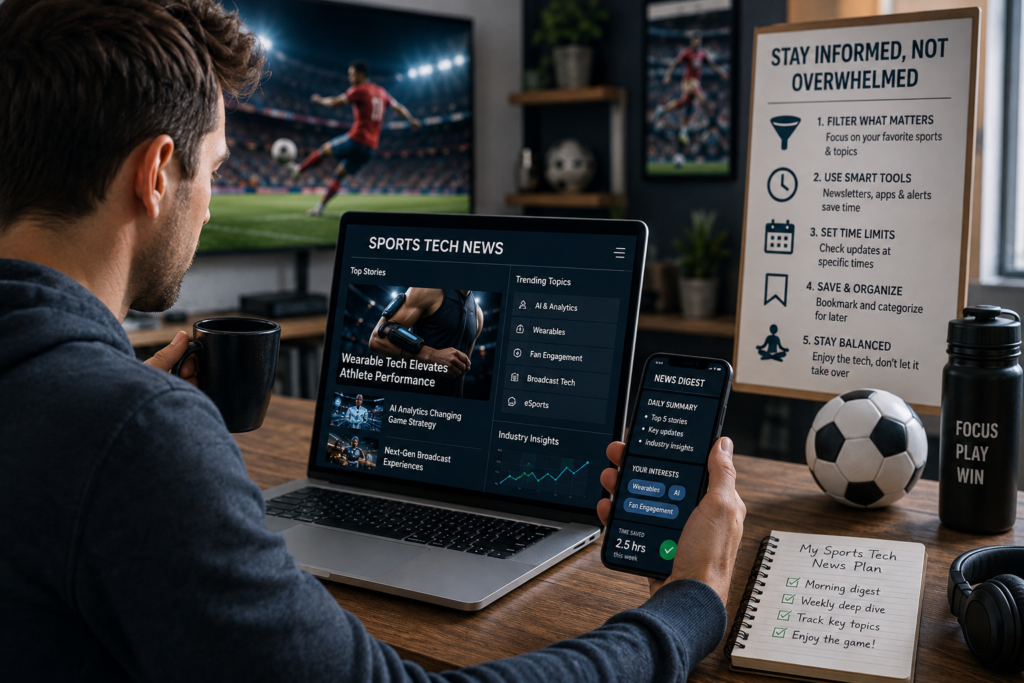
Nobody needs to read every press release from every wearable startup. Here’s what’s actually worth your time.
- Follow the officiating stories first — they affect actual outcomes fans argue about for years.
- Skip vendor blog posts that only quote their own CEO. That’s marketing dressed as journalism.
- Pay attention to injury and recovery tech during preseason; that’s when the real changes get tested quietly.
- Watch smaller leagues, not just the giants — budget constraints force more creative tech use.
- Ignore hype cycles around “the metaverse of sport.” Most of that fades within a season.
Something I’ve noticed, and this might be an unpopular take: the most useful sports tech news rarely comes from the biggest headlines. It comes from small local beat writers covering minor league teams experimenting on shoestring budgets.
- Cross-check big claims against at least two sources before repeating them. A lot of “AI predicts injuries with 95 percent accuracy” headlines fall apart under a second look.
- Read the quiet trade publications occasionally, not just mainstream sports tech news sites. That’s where the unglamorous but genuinely useful stories tend to surface first.
- Give new officiating tech at least one full season before forming a strong opinion. Early rollouts are almost always rougher than the finished version.
One more thing worth saying plainly — don’t assume every league adopts tools at the same pace. American professional leagues, European football clubs, and Asian esports organizations are often years apart on the same technology, and coverage that treats them as one blob misses that entirely.
Common Mistakes People Make Reading This Beat
First mistake — treating every new gadget announcement as a breakthrough. Ninety percent of these tools fail quietly within eighteen months. Nobody writes the follow-up story about the failure.
Second mistake — assuming officiating tech removes controversy. It doesn’t. It just moves the argument from “did the ref see it” to “should the algorithm have flagged it.”
Third mistake, and this one bugs me personally: people conflate broadcast gimmicks (fancy camera angles, augmented graphics) with actual performance technology. They’re different worlds serving different goals, even though press coverage blends them constantly.
Fourth mistake — ignoring cost and access gaps. A story might frame a tool as universally available when in reality only top-tier programs can afford it, at least for the first few years.
Fifth mistake — forgetting that athletes themselves often push back. Not every player wants a sensor strapped to them every practice. That resistance is a real part of this story, and it rarely makes it into coverage.
Sixth mistake — assuming tech coverage is neutral. A lot of it gets shaped, directly or indirectly, by vendor sponsorships and access agreements. That doesn’t mean every story is compromised, but it’s worth asking who benefits from a particular headline sounding as dramatic as it does.
Seventh mistake, and maybe the most common one — treating a single tournament or season as proof a technology “works.” Semi-automated offside calls, for instance, performed differently across different competitions depending on camera placement, lighting, and even stadium architecture. One good tournament doesn’t mean universal reliability, and one rough tournament doesn’t mean the whole approach failed.
Conclusion
If there’s one thing worth taking from all this, it’s that sports tech news isn’t really about gadgets — it’s about who gets to make decisions and how confident they are in making them. A coach with better data makes faster calls. A referee with camera support makes calls that hold up under replay scrutiny. A fan with a good app feels closer to a game they might never physically attend.
None of that is flashy on its own. But stacked together over a decade, it’s changed who wins, how fairly games get officiated, and how far a fan’s living room feels from the actual field. I don’t think that trend reverses. If anything, the gap between teams that use this stuff well and teams that treat it as an afterthought is going to widen, not shrink.
My honest advice for anyone trying to keep up: don’t chase every headline. Watch the officiating stories, watch the injury-prevention stories, and mostly ignore anything that sounds like it was written by a marketing department pretending to be a journalist. The real shifts are usually quieter than the press releases suggest, and they show up in small decisions long before they show up in big scores.
It also helps to remember this beat is still young, relatively speaking. A lot of the tools getting coverage today will look primitive in five years, the same way early GPS vests look clunky compared to what teams use now. That’s fine. Nobody following this space needs to treat any single tool as permanent or perfect.
What matters more than any specific gadget is the pattern underneath it — organizations that build a habit of testing, questioning, and slowly trusting data tend to outperform ones that either resist it entirely or swallow every vendor pitch whole. That balance, not the shiny hardware, is the actual skill worth tracking.
That, more than any single device or app, is the actual story behind modern sports tech news — a slow, uneven, occasionally messy move toward decisions built on evidence instead of gut feeling alone, happening one practice session and one replay review at a time.
FAQs
Q1: What counts as sports tech news exactly?
Anything covering tools or software that change training, officiating, or how fans watch and engage with games.
Q2: Is wearable tech only for professional athletes?
No. Costs dropped enough that college programs and even serious amateurs use similar sensors now.
Q3: Does officiating technology eliminate controversy?
Not really. It shifts arguments from human judgment errors toward debates about how strictly rules should be enforced.
Q4: Why do smaller teams care about this beat?
Because smart, targeted tech use lets budget-limited programs compete against wealthier rivals in specific areas like injury prevention.
Q5: Where should a beginner start following this topic?
Start with officiating and injury-prevention coverage — that’s where the most real, verifiable change actually happens season to season.

An IT career coach with 7 years of experience helping beginners map out certification paths that actually lead to interviews, not just another resume line. He’s guided dozens of career-switchers through their first AWS or CompTIA exam and writes for itechnova.io, covering IT certifications, cybersecurity, and the software tools people actually need to know.
1 thought on “Sports Tech News: 9 Real Shifts Fans Didn’t See Coming”