

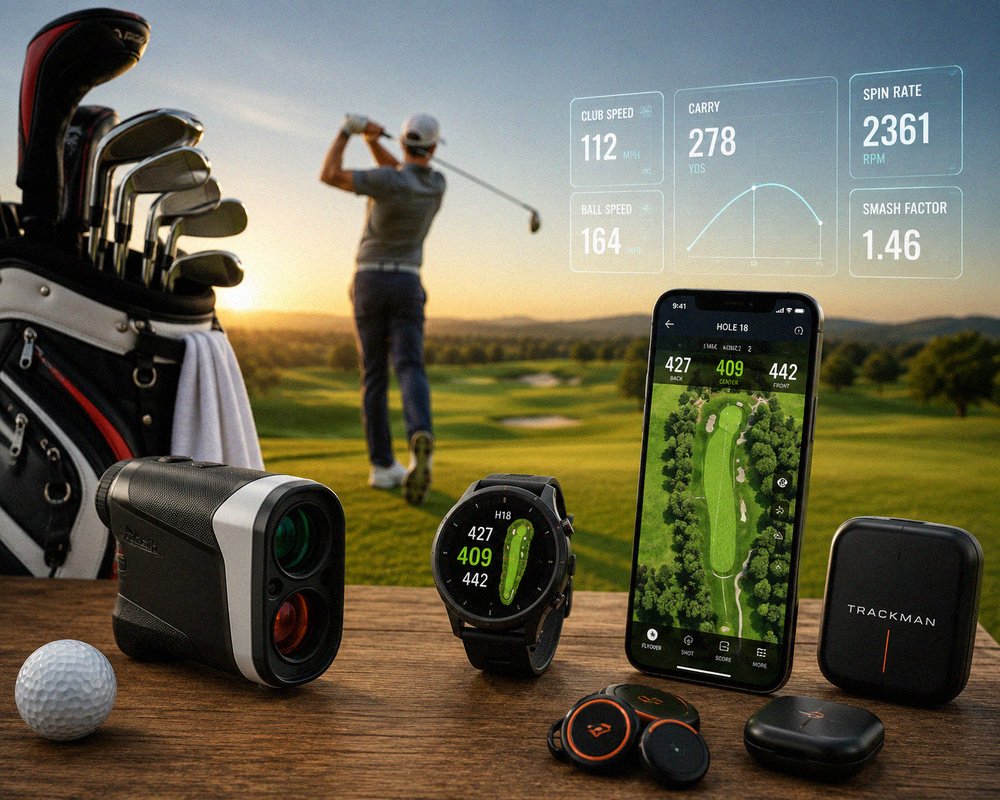
So I was at the range last weekend, half-listening to a buddy rant about his slice, when I realized how much golf tech news has quietly changed since I last paid attention. Three years ago you needed a studio membership to touch a real launch monitor. Now there’s one in his golf bag that cost less than his shoes.
That’s the thing about golf tech news right now — it’s not hype, smart golf gadgets are actually landing in people’s hands, and even swing analysis tools are getting genuinely usable. Some of it’s worth talking about, some of it’s noise, and figuring out which is which is exactly what this piece is for.
What’s Actually Driving Golf Tech News This Year
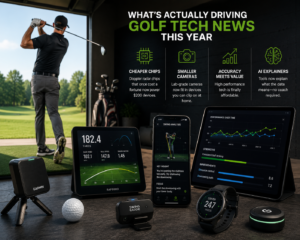
Here’s the honest answer: money got cheaper to spend on golf hardware, and the hardware got smarter about spending it wisely. Doppler radar chips that used to cost a fortune now sit inside $200 devices. Cameras that once needed a lab setup fit into something you clip onto a hitting mat in your garage.
None of this happened overnight, by the way. It’s been building for a few PGA Shows in a row. But this is the year it tipped — where “affordable” and “accurate” finally stopped being opposites in the same sentence.
There’s also an AI angle nobody saw coming quite this fast. Swing analysis tools that used to just spit out numbers are starting to actually explain what those numbers mean, in plain language, without a coach standing next to you translating.
Launch Monitors Are Where the Real Story Is
If you want to understand golf tech news in one category, start here. Launch monitors used to be a five-figure investment reserved for fitting rooms and pro studios. That gate has basically fallen apart.
Shot Scope’s LM1 landed at around $200 and it’s not a toy — it tracks ball speed, clubhead speed, smash factor, carry and total distance using Doppler radar, the same underlying tech that used to justify much steeper prices. At that price point, it’s opened the door for everyday golfers who couldn’t previously justify the spend, and coverage from recent launch monitor testing backs up just how far entry-level accuracy has come.
On the pricier end, Square Golf’s Omni Edition pushed things forward too, adding club data and outdoor grass compatibility that the original budget Square unit was missing, all without an annual subscription tacked on.
And Garmin’s Approach R50 has quietly become the one people mention when they want an all-in-one unit that doesn’t ask you to also buy separate simulator software.
Here’s a rough breakdown of where things stand right now, price-wise and feature-wise:
| Device | Approx. Price | Best For | Standout Feature |
| Shot Scope LM1 | $200 | Budget-first golfers | Doppler radar accuracy at entry price |
| Square Omni Edition | $1,600 | Indoor/outdoor flexibility | No subscription, full club + ball data |
| Garmin Approach R50 | Premium tier | All-in-one setups | Built-in simulator software |
| Rapsodo MLM2Pro | Mid-tier | Serious amateurs | Callaway RCT ball support for indoor accuracy |
Prices shift constantly, so treat that table as a snapshot, not gospel. Still, it tells you where the category’s heading — down in price, up in what you actually get.
AI Is Creeping Into Swing Coaching, Slowly
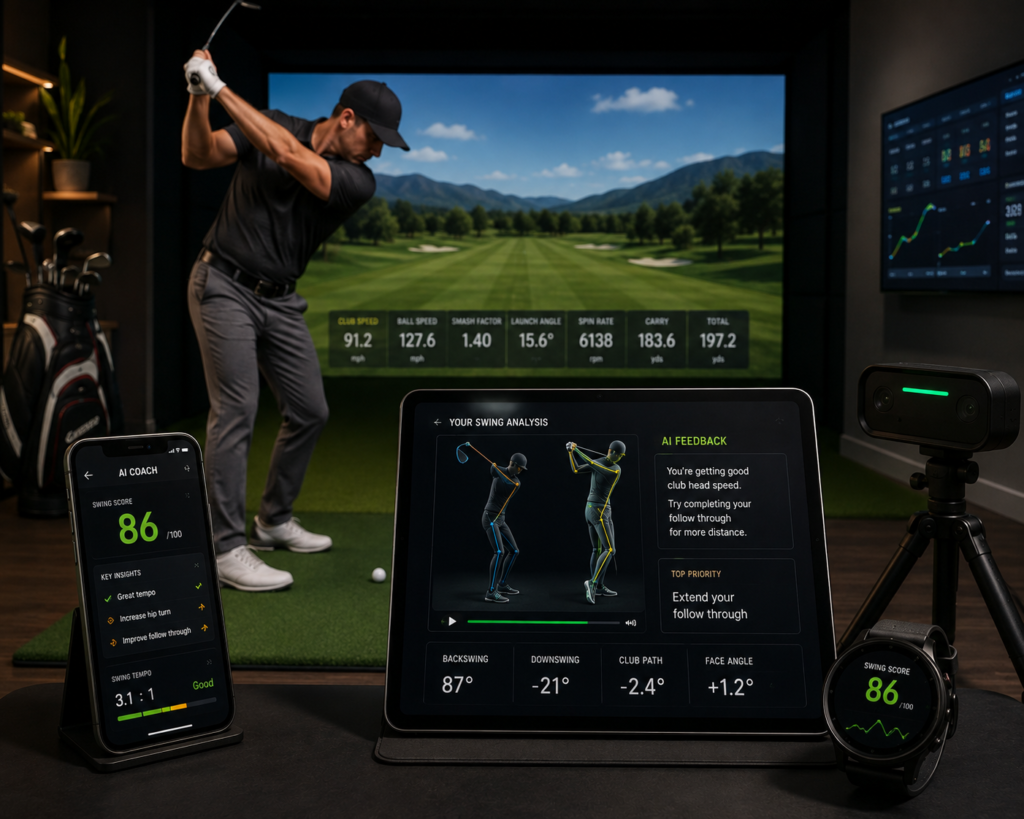
I’ll be blunt: I was skeptical about AI swing advice for a long time, and I still am, somewhat. Golf swings are weird, personal, full of compensations that build over years. A camera and an algorithm don’t automatically get that.
That said, one product got real attention at this year’s PGA Show — Uneekor’s AIMY, a prototype using at least two cameras to break down a golfer’s swing and flag specific flaws with corrections attached. It’s not shipping yet, but the buzz around it was hard to ignore among the people actually testing golf tech news firsthand at the show floor. If you want the wider picture on how AI is showing up across sports gear generally, our sports tech coverage hub tracks that trend beyond just golf.
Even the founder of Practical Golf, who covers this space closely, admitted in PGA Show AI coverage that he doesn’t think AI is fully ready to give genuinely good swing advice yet — the golf swing is too nuanced for that leap right now. Which, honestly, tracks with what most serious coaches will tell you off the record too.
So where does that leave things? AI-assisted feedback is useful as a second opinion, not a replacement for a human who’s watched you swing a hundred times. Treat it that way and you’ll get more value out of it.
Wearables and On-Course Gadgets Worth Knowing About
Beyond the mats and monitors, there’s a whole second wave of gear worth mentioning in any honest golf tech news roundup.
MILESEEY’s GeneSonic Pro is essentially a golf speaker with a detachable GPS handheld built in, giving subscription-free yardages without needing your phone or a signal out on the course. Small thing, but genuinely useful if you’ve ever fumbled with an app mid-round.
On-Pin’s Verifeye system took a different angle entirely — using AI and passive RFID tracking to manage pace of play, with claims of cutting round delays by up to 21 minutes on a busy course. That’s less about your swing and more about not standing around for four and a half hours.
Toptracer, meanwhile, is pushing further into the bay experience with QR-code-based scanning tools that make its ball-tracking tech easier to access without extra hardware installs.
A few smart insoles and pressure-sensing wearables also showed up this cycle, aiming to measure weight transfer through the swing. I’d file those under “interesting, not essential” for now — early days, worth watching rather than buying immediately.
Simulator Software Is Finally Catching Up to the Hardware
For years, the hardware in golf simulators outran the software running on top of it. You’d get gorgeous ball-flight numbers dumped into a course-play screen that looked like it belonged on an old console. That’s shifting fast now.
Foresight’s newer course-play platform is a good example. The graphics jumped noticeably, and the company’s clearly betting on the software experience mattering as much as the sensor accuracy underneath it. That’s a meaningful shift in priorities for a brand historically known for pure data precision.
There’s also consolidation happening behind the scenes. Bushnell Golf and Foresight Sports merging their product lines under one umbrella means less confusion for buyers trying to figure out which launch monitor actually fits their setup and budget.
Why does this matter for anyone just reading golf tech news casually? Because software updates are often free or cheap, unlike hardware. If you already own a decent launch monitor, checking whether its companion app got smarter recently might save you from buying a whole new unit.
Frame rate, course library size, and multiplayer options are quietly becoming bigger differentiators than raw sensor specs for a lot of home-simulator buyers. Worth factoring in before you drop money on hardware alone. For the software-and-app side of things across other categories too, our rotating industry headlines page is worth a scan.
GPS Watches and Rangefinders Aren’t Just Distance Tools Anymore
The on-course side of golf tech news doesn’t get as much attention as launch monitors, but it’s arguably changed just as much.
Garmin’s Approach S70 is a decent snapshot of where GPS watches have landed. It’s not just spitting out yardages anymore — it tracks scores automatically, logs shot distances by club, and pulls live wind data so you can actually factor conditions into a club decision instead of guessing.
Course libraries have ballooned too. Devices now ship preloaded with tens of thousands of mapped courses worldwide, which used to be a paid add-on feature not that long ago.
Then there’s the subscription-free angle, which keeps popping up across this whole category. MILESEEY’s GeneSonic Pro speaker-GPS hybrid, mentioned earlier, is part of a broader pushback against golf apps that lock accurate yardages behind monthly fees. More brands seem to be reading the room on that one.
My honest opinion? If you’re choosing between a flashy new rangefinder and a decent GPS watch, the watch usually wins for everyday play. Rangefinders are still more precise for pin-seeking, sure, but the day-to-day convenience of a wrist-based system is hard to beat once you’ve gotten used to it.
Smart Courses Are the Quiet Side of This Story
Not all golf tech news is about what’s in your bag. Some of the more interesting shifts are happening at the course level itself, and they barely make headlines.
On-Pin’s Verifeye platform, which I touched on earlier, is part of a bigger trend toward AI-assisted pace-of-play management. Passive RFID tracking on carts and players lets courses spot bottlenecks before they snowball into a four-and-a-half-hour round.
A handful of clubs are also experimenting with dynamic pricing tools tied to real-time weather and tee-sheet data, adjusting green fees on the fly the way airlines adjust ticket prices. It’s early, and a bit controversial among traditionalists, but it’s happening.
GOLFZON’s expansion into U.S. indoor golf locations is another piece of this. Screen-golf venues built around simulator tech are becoming a genuine alternative to a full round, especially in colder markets where course access is seasonal.
None of this replaces walking eighteen holes on a real course. But it does mean the “tech” side of golf tech news is expanding well past personal gadgets and into how courses themselves operate. Curious how other industries are handling similar automation shifts? Our curated daily updates feed covers that ground too.
What This Means If You’re Actually Shopping

Reading golf tech news is one thing. Deciding what to actually buy is a different problem entirely, and I get asked about this a lot.
My honest take: if you’re a beginner or mid-handicapper on a budget, start with something like the Shot Scope LM1. It gives you real numbers without the financial commitment of a full simulator setup.
If you’re building an indoor practice space and want the whole experience — visuals, course play, the works — that’s when a Garmin R50 or a Foresight unit starts making more sense, even with the higher price tag attached.
And if pace of play frustrates you more than your handicap does, keep an eye on how RFID and course-management tech rolls out at your local club. That side of golf tech news doesn’t get talked about enough, honestly.
To make it easier, here’s roughly how I’d break the buying decision down by budget tier, based on what actually matters at each price point:
| Budget Tier | What To Prioritize | Skip For Now |
| Under $300 | Entry launch monitor, GPS watch | Full simulator software, wearable sensors |
| $300–$1,500 | Better accuracy, indoor/outdoor flexibility | Premium display screens |
| $1,500–$4,000 | All-in-one units, simulator software | Course-management/RFID tech (not consumer-facing) |
| $4,000+ | Studio-grade setups, custom enclosures | N/A — this tier gets most features already |
That table isn’t a hard rule, obviously. Your actual priorities — indoor space, how often you practice, whether you care about visuals versus raw numbers — should shift where you land on it.
One more thing worth saying plainly: don’t assume newer always means better for your specific situation. A two-year-old radar-based unit that’s been discounted might genuinely serve a casual golfer better than this year’s flagship camera system, especially if you’re mainly checking ball speed and carry distance rather than chasing tour-level spin data.
Common Mistakes People Make Chasing Golf Tech News
A few patterns keep showing up, so worth flagging them directly instead of dancing around it.
People buy the most expensive launch monitor assuming price equals accuracy. Sometimes true, sometimes not — the $200 unit and the $10,000 unit can both be “accurate enough” depending on what you’re actually trying to fix in your swing.
Another one: expecting AI feedback to replace a coach entirely. It won’t, not yet, and probably not for a while given how individual golf mechanics really are.
Last one — buying gear based on hype from a single trade show demo rather than waiting for real-world reviews once a product actually ships. PGA Show buzz is fun to follow, but shipping dates slip, and specs change between prototype and retail.
Where Golf Tech News Is Probably Headed Next
If I had to guess where this all goes over the next year or two, it’s less about brand-new categories and more about the existing ones getting cheaper and more integrated with each other.
Expect launch monitors and GPS watches to start talking to the same app more often, instead of forcing golfers to juggle three different companion apps for range sessions, on-course rounds, and simulator practice. That fragmentation is a real pain point right now, and someone’s going to solve it properly.
AI swing coaching will keep improving, but I’d bet it stays a supplementary tool rather than a coach replacement for at least a couple more product cycles. The nuance problem isn’t a software problem — it’s a genuinely hard modeling problem.
And course-level tech, the RFID and dynamic-pricing stuff, will likely spread from bigger resort courses down to municipal ones faster than people expect, mostly because pace-of-play complaints cost courses real revenue through reduced tee-time turnover.
None of that’s guaranteed, obviously. But if the last two PGA Shows are any indication, golf tech news is only going to get busier from here, not quieter.
Conclusion
If there’s one honest takeaway from this year’s golf tech news, it’s that the gap between “professional-grade” and “actually affordable” has genuinely narrowed, and it’s narrowed fast. A $200 device can now do things that used to require a studio membership and a waiting list. That’s not marketing spin — that’s just where the hardware landed.
At the same time, it’s worth staying a little skeptical about the AI side of things. The coaching tools are getting more capable, sure, but they’re still not a substitute for someone who’s actually watched your swing change over months and years. Treat AI feedback as a helpful extra layer, not the whole answer, and you’ll avoid the trap a lot of buyers fall into.
The wearables and course-management gadgets are the quieter story here, but they matter too — especially anything tackling pace of play, since that affects every round regardless of your handicap. Keep an eye on how RFID-based systems roll out at courses near you over the next year or so.
Bottom line: don’t chase every headline. Figure out what you’re actually trying to fix — swing data, course speed, on-course convenience — and let that decide which piece of golf tech news is actually worth your money. The category’s moving fast enough that waiting a few months rarely hurts, and rushing into a trade-show prototype almost always does.
FAQs
Is golf tech news worth following if I’m just a casual weekend player?
Yes, somewhat — you don’t need every gadget, but knowing what’s out there helps you spot genuinely useful, affordable tools instead of overpaying for features you’ll never use on a casual round.
What’s the cheapest reliable launch monitor available right now?
Shot Scope’s LM1 sits around $200 and uses Doppler radar for real ball-speed and clubhead-speed data, making it one of the more accessible entry points into serious practice technology.
Can AI actually fix my golf swing on its own?
Not fully, no. Current AI swing tools are useful for spotting patterns and giving a second opinion, but most golf coaches agree they can’t yet replace personalized, hands-on coaching.
Do I need a subscription for most modern launch monitors?
It varies by brand. Some units, like the Square Omni Edition, specifically avoid subscription fees, while others bundle software access into an annual cost — always check before buying.
What’s the difference between camera-based and radar-based launch monitors?
Camera-based units use photometric imaging for precise club data, while radar-based ones track ball flight through Doppler signals; each has trade-offs in setup space and indoor accuracy.
Are wearable golf sensors actually useful yet?
They’re improving but still early-stage. Smart insoles and pressure sensors show promise for tracking weight transfer, though most serious golfers still treat them as supplementary, not essential, gear.
Will golf tech news keep focusing on affordability going forward?
Likely yes. The trend across the last few PGA Shows points toward cheaper, more capable hardware, so expect that pricing pressure to keep shaping new releases going forward.
Where can I track ongoing golf tech news without getting overwhelmed?
Stick to a handful of trusted outlets covering launch monitors, simulators, and course-management tech specifically, rather than trying to follow every single product announcement as it happens.

An IT career coach with 7 years of experience helping beginners map out certification paths that actually lead to interviews, not just another resume line. He’s guided dozens of career-switchers through their first AWS or CompTIA exam and writes for itechnova.io, covering IT certifications, cybersecurity, and the software tools people actually need to know.
1 thought on “Golf Tech News: Real Gadgets, Surprising Wins This Year”