


Okay, chai first, then the update — that’s how these things should go. If you’ve been half-following AI video tools news over the last few months, you already know it hasn’t been a quiet stretch. One app disappeared almost overnight, three others got noticeably better at handling sound and motion, and a bunch of new legal paperwork landed on top of all of it.
This piece of AI video tools news isn’t a spec sheet. It’s more like the conversation I’d actually have with a friend who asked “so what’s going on with AI video generators these days” over a second cup.
Why AI Video Tools News Actually Matters Right Now
Here’s the thing nobody says out loud enough: this category stopped being a novelty a while back. It’s now a line item in budgets. Marketing teams schedule around it. Freelancers build entire businesses on it.
So when a tool shuts down, or a new model quietly becomes twice as good at keeping a character’s face consistent across a scene, that’s not trivia. That ripples into deadlines, into client pitches, into whether a small studio survives the quarter.
I’ve watched this happen from close enough that I’d call it whiplash. Six months ago the pitch was “look how cool this clip is.” Now it’s “can this survive an audit, hold up in three languages, and not get flagged by a platform’s labeling system.” Different game entirely.
Sora’s Exit Changed the Conversation Overnight
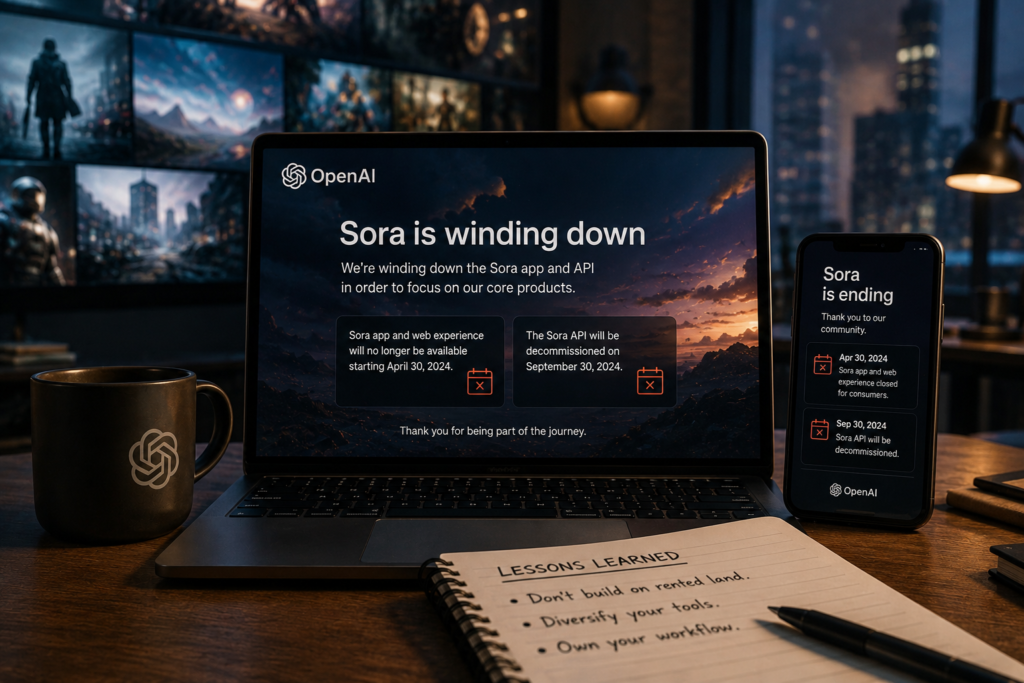
Let’s start with the one that actually stunned people. OpenAI pulled the plug on Sora’s consumer web and app experience, and the shutdown wasn’t a slow fade — it happened fast, with the API set to follow not long after. Consumer access closed near the end of April this year, and developer access through the API is set to disappear by late September, a timeline you can double-check on OpenAI’s Sora wind-down page.
What made this land so hard wasn’t just the timeline. It was the contrast. This was a product that had reportedly pulled in a partnership deal with a major entertainment studio worth serious money, and then it was gone within months. That’s the kind of thing that makes buyers nervous about betting a whole workflow on a single closed platform.
If there’s a lesson buried in there, it’s a boring one but a true one: don’t build your entire pipeline around one vendor’s roadmap, no matter how flashy the demo looked last quarter.
The New Front-Runners: Veo, Kling, and Seedance
With Sora stepping back, three names have basically absorbed the spotlight, and each one is playing a different sport.
Google’s Veo 3.1 leans hard into cinematic control — camera language, native audio, believable physics. Full details on what it’s built to handle sit on DeepMind’s official model overview, and it’s genuinely one of the stronger options if realism matters more than speed.
Kling 3.0, from Kuaishou, went a different direction. It pushed native 4K output and multilingual audio, and it’s become something of a favorite for teams that care about style consistency across long sequences. Seedance 2.0, from ByteDance, climbed leaderboards fast too — though it also picked up copyright scrutiny after clips featuring real actors went viral, which is still an open question nobody’s fully resolved.
None of these are “better” in some universal sense. They’re just built for different jobs, and that’s honestly the most useful thing to internalize here — stop looking for one universal winner and start matching the tool to the actual brief in front of you.
A Quick Snapshot of Who’s Winning Where
Numbers shift fast in this space, so treat this as a general shape rather than gospel. Still, it helps to see it side by side instead of scattered across ten browser tabs.
| Tool | Best Fit | Standout Feature | Rough Pricing Feel |
| Veo 3.1 | Cinematic, ad-quality clips | Native audio + camera control | Mid-to-premium |
| Kling 3.0 | Long, consistent scenes | Style locking across shots | Budget-to-mid |
| Seedance 2.0 | Fast social-ready output | High leaderboard scores | Budget |
| HeyGen / Synthesia | Talking-head, avatar video | Multilingual lip sync | Subscription-based |
| Runway | Editing plus generation | Pro post-production tools | Mid-to-premium |
Worth saying: none of these tables age well for long. Per-second pricing at the cheaper tiers has been dropping faster than at the flagship end, so whatever you see today, double-check it before locking a budget.
Watermarks, Laws, and the Paperwork Nobody Wanted

This is the part people skip, and honestly, I almost did too while writing this. But it’s arguably the biggest structural shift buried in this round of AI video tools news.
Europe’s newer AI rulebook, the part known as Article 50, kicked into enforcement in early August this year. Put simply: any AI-made video reaching EU viewers now needs a machine-readable tag showing where it came from, and skipping that isn’t a small fine — it can climb into the tens of millions depending on company revenue. Meanwhile, California brought in its own disclosure law for AI content shown to residents there, which took effect at the start of the year.
On top of the legal side, platforms are doing their own labeling. TikTok alone has tagged more than a billion AI-generated clips using content-credential detection. If your workflow doesn’t already think about provenance and disclosure, this is the year that catches up with you.
None of this is meant to scare anyone off the category — it’s more of a heads-up that “just generate and post” isn’t the whole job anymore.
Where Creators and Small Teams Actually Feel This
Big studios have compliance teams for this stuff. Small creators and lean marketing teams don’t, and that’s where the real friction shows up.
A solo creator making product demos doesn’t have time to research watermarking standards between client calls. A three-person agency doesn’t want to explain to a client why a clip got flagged on a platform. Practical workflows matter more than raw model quality here, which is honestly a shift in what “good” even means in this space.
If you’re managing multiple AI outputs across writing, video, and other formats, it’s worth glancing at how teams are handling the latest writing tool changes too, since disclosure norms are creeping into text content the same way they’re hitting video.
What This Means If You’re Choosing a Tool Today
I’ll be blunt: there’s no single right answer, and anyone selling you one is skipping the nuance on purpose.
If cinematic quality is the priority and budget allows it, Veo 3.1 is a strong current pick. If you’re running long-form tutorial or story content and need faces and settings to stay consistent, Kling’s style-locking is worth a serious look. If speed and social-ready output matter more than perfect realism, Seedance and similar budget tools do the job without draining the account.
And if what you actually need is a talking presenter in six languages for training content, none of the cinematic models are even the right category — that’s HeyGen or Synthesia territory instead.
A decent chunk of teams are also blending video generation with broader automation workflow tools so the output doesn’t just sit in a folder — it actually moves into a publishing pipeline without someone dragging files around manually.
The Trends Worth Watching Before Year-End
A few threads are worth keeping half an eye on, even if you’re not ready to act on them yet.
Native audio generation is quickly stopping being a differentiator — by the end of the year, it’ll likely just be table stakes across every serious platform. Character consistency past the 60-second mark is still genuinely hard, and whoever cracks it cleanly first will probably pull ahead for a stretch. Provenance marking, the watermarking stuff we talked about above, isn’t optional anymore for anyone distributing into regulated markets.
There’s also a quieter trend worth naming: buyers are getting tired of prompt spectacle. Repeatable, brand-safe output that a team can actually reuse is winning over the flashiest single demo clip. That’s a real maturity shift, not just a marketing line.
For anyone tracking adjacent categories, it’s also worth a glance at how music generation platforms are handling the same audio-native shift, since a lot of the underlying tech and licensing questions overlap more than people expect.
How Buyers Are Actually Testing These Tools Now

Something I’ve noticed talking to people actually buying these tools, not just reviewing them: nobody trusts a single demo reel anymore. The good ones run their own small pilot before committing budget, and it usually takes less than a week.
The pattern looks something like this. Pick two or three real assets you’d actually publish — not a hero shot, something ordinary like a product explainer or a training clip. Run the same brief through two or three models. Then hand the raw outputs to whoever normally approves creative, without telling them which tool made which clip.
That blind step matters more than people expect. Brand and creative teams have opinions about which platform “feels premium,” and half the time those opinions don’t survive an actual side-by-side look. Letting the output speak first, before the tool’s reputation gets involved, tends to produce better decisions.
Cost testing works the same way. Sticker price per second rarely tells the full story once you factor in revision credits, export limits, and how many attempts it takes to get a usable clip. A cheaper tool that needs six retries isn’t actually cheaper.
There’s also a growing habit of pairing generation tools with review and visualization layers, so a team can actually see performance data instead of guessing. If reporting and dashboards are part of your stack already, it’s worth checking how data visualization platforms are being used to track which video variants are actually converting, rather than just which ones look impressive in a pitch deck.
Frequently Asked Questions About AI Video Tools News
Is Sora completely gone now, or can I still access old projects?
The consumer web and app shut down on April 26, 2026. The API keeps running until September 24, 2026, so developers still have a short migration window before that access disappears entirely too.
Which AI video tool is best for someone just starting out?
It genuinely depends on your goal. For quick social clips, budget-friendly tools like Seedance work fine. For polished, ad-ready output, Veo 3.1 tends to reward the extra learning curve.
Do I legally need to label AI-generated video now?
If you’re distributing to EU or California audiences, yes — disclosure and machine-readable marking requirements are already active, with real financial penalties attached for non-compliance.
Why did copyright concerns come up around Seedance 2.0?
Viral clips featuring real actors’ likenesses spread shortly after release, triggering scrutiny that hasn’t been fully resolved. It’s a reminder that realism brings legal risk along with it.
Can AI video tools fully replace a human editor?
Not yet, and probably not soon. They’re excellent at speeding up early drafts, storyboards, and short-form content, but final polish and judgment calls still lean on human hands.
How often should I re-check pricing on these platforms?
More often than feels reasonable, honestly. Budget-tier pricing has shifted multiple times within a single quarter this year, so locking numbers into a long-term plan is risky right now.
Are avatar tools like HeyGen part of this same AI video tools news story?
Sort of, but they solve a different problem — presenter-style, multilingual business video rather than cinematic generation. Worth knowing the category split before comparing tools directly.
What’s the biggest mistake teams make when adopting these tools?
Betting everything on one vendor. Sora’s shutdown is the clearest cautionary tale here — durable workflows spread risk across more than one model or provider.
Final Thoughts
If you take one thing away from this round of AI video tools news, let it be this: the category matured faster than most people’s habits did. A year ago, picking a tool meant picking whichever one made the prettiest demo clip. That’s just not how it works anymore, and pretending otherwise is how teams end up stuck when a provider makes a decision you didn’t see coming.
Sora’s exit proved that even a headline-grabbing product can vanish within months. Veo, Kling, and Seedance proved that competition genuinely benefits buyers, pushing quality and audio realism up while budget tiers get cheaper. And the wave of legal requirements — EU Article 50, California’s SB 942, platform-level watermarking — proved that this space isn’t operating in a legal vacuum anymore, whether creators like that or not.
None of this means you need to panic or rebuild your entire process overnight. It means treating tool choice a little more like choosing a business partner and a little less like picking a filter. Ask what happens if the vendor pivots. Ask whether your content needs disclosure where it’s published. Ask whether the model’s strengths actually match the job you’re doing, instead of chasing whichever one trended this week.
The tools themselves keep getting better, almost embarrassingly fast. The judgment about how and where to use them responsibly is still very much a human job — and honestly, I don’t see that changing anytime soon. That’s probably the healthiest place for this category to land, even if it took a shutdown and a stack of new regulations to get there.
A practical note before you close this tab: whatever you decide today, revisit it in ninety days. This space has proven, over and over this year, that the “best” answer has a short shelf life. What was the obvious pick in March looked outdated by June, and there’s no reason to think that pace slows down before winter.
Keep an eye on this space. It’s not slowing down, and the next few months of AI video tools news will likely reshape the leaderboard all over again.

An IT career coach with 7 years of experience helping beginners map out certification paths that actually lead to interviews, not just another resume line. He’s guided dozens of career-switchers through their first AWS or CompTIA exam and writes for itechnova.io, covering IT certifications, cybersecurity, and the software tools people actually need to know.
1 thought on “AI Video Tools News: The Real, Shocking Shift This Year”