

I still remember the week a client’s traffic dipped for no obvious reason, and it took me three days of poking around to realize Google had started answering their exact-match keyword inside an AI Overview. Nobody clicked past it.
That’s when finding the best google ai overview checking tools stopped being a nice-to-have on my desk and became something I check before I check email. If you’re writing content, running an agency, or just trying to figure out why your best-ranking page suddenly gets no traffic, this is for you. I’ll walk through the tools I actually use, the ones I tried and dropped, and what I’d tell a friend starting from zero.
Why Tracking AI Overviews Is a Different Animal
Regular rank tracking is simple math. Position one, position five, done. AI Overviews don’t play by that rulebook.
A query might trigger an Overview on Tuesday and show a plain old SERP on Wednesday. Same keyword, same location, completely different result. I’ve watched this happen to my own test queries more times than I can count.
And here’s the part that trips people up — ranking well organically doesn’t guarantee a citation inside the Overview anymore. Pages sitting at position 40 get pulled in while the number one result gets skipped entirely. Google’s query fan-out process splits your search into a handful of related sub-questions behind the scenes, and a page can get cited for answering one of those sub-questions without ever ranking for your original term.
So a checker built for blue-link rankings just doesn’t cut it. What you actually want is a checker built to catch a moving target — which is exactly the gap the best google ai overview checking tools are meant to close.
How These Trackers Actually Pull Citation Data
Worth pausing here, because a lot of people treat these tools like magic and never ask what’s happening underneath.
Most checkers run a query through a rendering engine that mimics a real browser, capture the full page, and then parse out the AI Overview block specifically, since it doesn’t follow the same HTML structure as a normal organic listing. From there, the tool extracts every cited URL, timestamps the capture, and stores it so you can compare against yesterday’s snapshot.
That rendering step is where cheap tools fall apart. A checker that only scrapes the raw HTML without actually rendering the page the way Google serves it to a real user will miss Overviews entirely, because a chunk of that content loads dynamically. If a tool’s citation data looks suspiciously thin, this is usually why.
The good platforms also normalize URLs before comparing them — stripping tracking parameters, matching www versus non-www versions, that kind of housekeeping. Skip that step and you’ll see the same domain counted as two different citations across two reports, which throws off every trend line built on top of it.
What a Real AI Overview Checker Needs to Actually Do

Before I trust any tool with a client’s tracking, I run it through a short mental checklist. Most tools fail at least one of these.
Confirming Whether an Overview Shows Up At All
Sounds obvious, but plenty of “AI tracking” tools just assume every query has an Overview and report zero when it doesn’t — without telling you that’s what happened. You want a clear yes-or-no flag before anything else.
Pulling the Actual Cited URLs
A checker that only tells you “you’re in the Overview” without listing every other cited source is basically useless for competitive work. I want the full list, ranked in the order Google displayed them if the tool can manage it.
Watching How Citations Shift Over Time
One snapshot tells you almost nothing. The value shows up after two or three weeks of daily or weekly checks, when you can see which pages hold their citation and which ones fall out after a content update on a competitor’s site.
Separating Google’s AI Surfaces From Each Other
AI Overviews and AI Mode are not the same feature, even though they look related. A query can trigger one without the other, and citation overlap between the two sits well under half in most of the data I’ve seen. If your tool lumps them together, you’re losing information you’ll want later. Search Engine Land’s own breakdown of what triggers AI Overviews gets into this distinction better than most vendor pages bother to.
The Tools I Reach for First
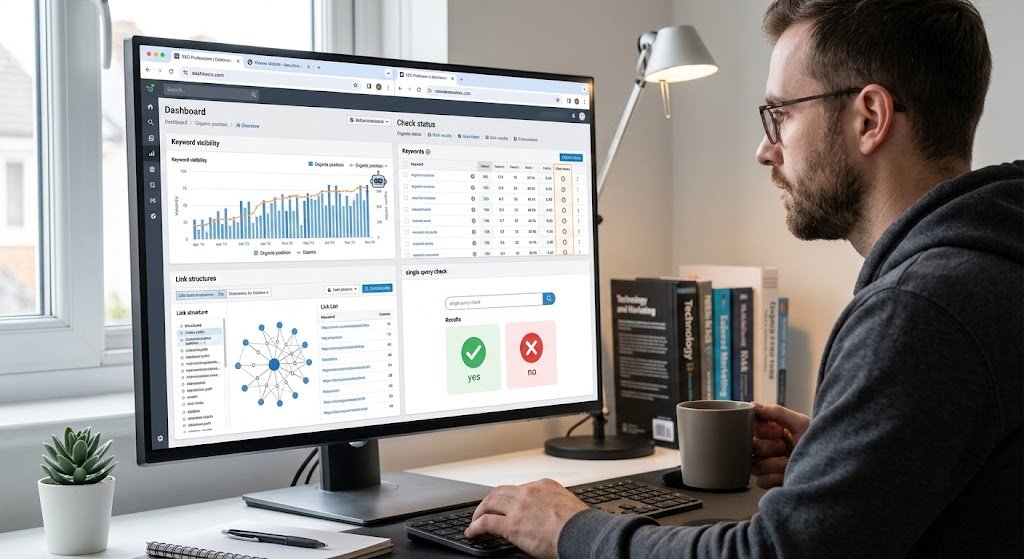
I’ve cycled through more of these than I’d like to admit while hunting for the best google ai overview checking tools for my own client roster. Here’s what earned a permanent spot in my workflow, and why.
Semrush’s AI Visibility Tracking
This is where I start for most client accounts, mostly because it’s already sitting inside the same dashboard as their regular position tracking. No context switching, no separate login. I appreciate that they treat this as an extension of the same suite handling Site Audit and Keyword Magic, rather than a bolted-on side product. The trade-off is cost — you’re paying for the whole suite, not a standalone checker. Their own guide to AI Overview tools and software is a decent starting reference if you want the vendor’s own framing of the feature set.
SE Ranking’s Built-In Detection
I recommend this to smaller agencies who don’t need the full Semrush price tag. It bakes AI Overview detection right into the daily rank check, so you’re not running two separate reports every morning. Coverage on the AI side is thinner than the SEO side, but for a Google-only focus it does the job at a fraction of the enterprise price.
Ahrefs for Digging Into Citation Patterns
Ahrefs isn’t primarily an AI Overview tool, but I still open it constantly for one reason — its historical Search Console data makes it easy to spot the click-through drop-off tied to an Overview appearing. Pull up their crawl of roughly 300,000 keywords and the top organic spot loses more than a third of its clicks once an Overview lands above it. That single chart has done more to convince skeptical clients than any pitch deck I’ve built.
Free One-Off Checkers for Tight Budgets
When someone just wants a quick answer — does this one keyword trigger an Overview, right now — there’s no reason to pay for anything. A handful of free checkers exist that run a limited number of daily queries and hand back a straightforward yes/no plus the citation list. I lean on these for spot-checks between the bigger scheduled reports from paid tools.
If you’re building or refining content around this whole category, there’s some solid ground in AI visibility tools worth reading alongside this, since tracking and visibility overlap more than people assume.
Semrush, Ahrefs, and SE Ranking Side by Side
People ask me to just pick one and rank the best google ai overview checking tools in order, so here’s the closest thing to a straight answer I’ve got.
Semrush wins on breadth — you get AI Overview data sitting next to backlinks, technical audits, and content grading in one place, which matters if one person on your team is wearing five hats. It’s also the priciest of the three by a noticeable margin.
Ahrefs wins on historical depth. Nobody else lets you slice click-through data by position the way their Search Console integration does, and that’s gold for proving a point to a skeptical client. It’s weaker specifically on live AI Overview detection compared to the other two.
SE Ranking wins on value. It’s not as polished, and the AI-side reporting feels a step behind the other two, but for a small team tracking a modest keyword list on a modest budget, it covers the essentials without the enterprise price tag attached.
None of the three is objectively “best.” I’ve swapped which one I open first depending on the client’s budget more times than I’d like to admit.
What I Do When a Page Loses Its Citation
This happens constantly, and the instinct to panic is real. Here’s my actual process instead.
First step — check whether the query itself still triggers an Overview at all. Sometimes Google just stopped showing one for that search, and it has nothing to do with your page.
Second — pull up whoever replaced you in the citation list and skim their page. Nine times out of ten there’s something concrete they added that you didn’t: a comparison table, a specific number, a recent update date visible on the page.
Third — check your own page’s last-modified date. Stale content loses citations to freshly updated competitors constantly, and refreshing even a single section with a current statistic sometimes reclaims the spot within a week or two.
Fourth — resist the urge to rewrite the whole page. I’ve seen people torch a page that was performing fine everywhere except one volatile Overview citation, and lose organic traffic in the process. Fix the specific gap, don’t nuke the page.
The Content Signals That Seem to Earn Citations
Nobody outside Google knows the exact mechanics, but patterns show up if you track enough pages over enough months.
Pages with a clear, direct answer near the top tend to get cited more than pages that bury the answer under three paragraphs of preamble. Google’s synthesis process seems to reward content structured for extraction, not persuasion.
Specific numbers beat vague claims almost every time. A page that says “costs around $50 a month” gets skipped in favor of one that says “$49 for the starter tier, $129 for the team plan.”
Recency matters more than people expect. A page updated within the last few months has a real edge over one that hasn’t been touched in two years, even if the older page still ranks fine organically.
And original data — a survey you ran, numbers pulled from your own product usage — shows up in citations disproportionately often relative to how much of that content exists on the web. Google seems to lean on it precisely because it’s not duplicated everywhere else.
Turning Raw Citation Data Into Something a Client Understands
Dumping a spreadsheet of citation snapshots on a client is a fast way to lose their attention. I learned that the hard way early on.
What actually lands is a simple before-and-after: here’s your citation share last month, here’s this month, here’s the one competitor who gained the most ground and what their page does differently. Three data points beat thirty rows nobody reads.
I also pair the citation numbers with a plain-language note on what changed on our side — did we publish something new, refresh an old page, add a table. Clients connect the dots faster when the tracking data sits next to the actual work log rather than living in a separate tab.
For agencies reporting across several accounts at once, this is usually where the reporting habits from broader AI tools for business end up folding in — the same lightweight dashboard habits that work for general ops reporting tend to work fine here too, no need to reinvent the format for every client.
Daily Checks Versus Weekly Checks — Picking a Cadence
People assume more frequent tracking is always better. Not quite.
Daily checks make sense for a short list of commercial, high-value keywords where a citation change could actually move revenue. You want to catch that fast, react fast, and daily data supports that.
Weekly checks are plenty for the long tail — informational terms, supporting content, anything that isn’t directly tied to a conversion path. Checking those daily just generates noise you’ll never act on anyway.
I’ve found the sweet spot is roughly a 20/80 split. Twenty percent of the keyword list gets daily attention, the rest gets checked weekly, and that balance keeps the reporting manageable without missing anything that actually matters.
Setting Expectations Before You Start Tracking
Worth saying plainly before wrapping up — nobody controls whether Google shows an Overview for a given query, and nobody controls exactly why one page gets cited over another.
Tracking tools give you visibility into a system you don’t operate. That’s still useful, plainly useful, but it’s a different kind of useful than a rank tracker where a specific optimization tends to produce a specific, measurable result.
Set that expectation with clients up front. Citation tracking tells you where you stand and where the gaps are. It doesn’t come with a guarantee attached, and any tool or agency promising one is overselling what the data can actually deliver.
Where a Manual Check Still Beats Every Tool
I’ll say something that might sound backwards coming from someone recommending five paid platforms — sometimes the fastest, most accurate check is just opening an incognito browser and searching it yourself.
Tools batch-process queries on a schedule, usually once a day. If a client asks “am I showing right now,” the tool’s data might be twelve hours stale. A manual search costs nothing and takes ten seconds.
I also manually check anytime a client disputes what a tool reported. Location settings, device type, even the exact phrasing of a query can flip an Overview on or off, and a manual search lets you control every variable a bulk tool might be averaging away.
Setup Mistakes That Quietly Ruin Your Tracking Data
A few habits I’ve had to unlearn, and a few I watch other people fall into constantly — even people who’ve already invested in the best google ai overview checking tools money can buy.
Tracking too few keywords is the biggest one. Five keywords tell you almost nothing about a trend — you need enough volume that a single query flipping doesn’t skew your whole report.
Ignoring device differences comes second. Mobile and desktop trigger Overviews at different rates for the same query, and a tool reporting only one device type is showing you half the picture.
Skipping the location setting trips people up too. AI Overviews vary by region in ways regular organic rankings mostly don’t, so a national average can hide a serious local drop.
Mixing branded and non-branded keywords into one blended report is another quiet problem. Branded searches behave completely differently from generic informational ones, and averaging them together buries the signal you actually care about.
Forgetting to re-check your competitor list is a slower-burning mistake. New competitors earn citations constantly, and a tracker only watching the same three domains from six months ago is blind to whoever just showed up.
And treating a single day’s snapshot as a trend — that one’s everywhere. One bad reading doesn’t mean anything. Wait for a pattern across at least a week before you tell a client to panic, or before you panic yourself.
Building a Tracking Workflow That Doesn’t Fall Apart in a Month
Here’s roughly how I’d set this up for a new client, start to finish.
First, pull the twenty to thirty keywords that actually drive revenue or leads — not everything you rank for, just the ones that matter financially. Feed those into your primary checker on a daily or every-other-day schedule.
Second, run a manual spot-check on your top five keywords once a week, just to sanity-check what the automated tool is reporting.
Third, export citation data monthly and actually compare it against the previous month instead of just glancing at the current snapshot. This is where the real patterns show up — which competitors are gaining citation share, which of your pages keep losing their spot.
Fourth, tie the tracking data back to your content calendar. If you’re producing new pages or refreshing old ones, this is also a good moment to lean on solid AI writing tools that keep pace with how fast the citation landscape shifts — content that sat untouched for a year rarely holds its spot.
Fifth, and this one gets skipped constantly, write down what changed on pages that lost or gained citations. Over six months that log becomes more useful than any dashboard.
A Quick Story From Last Quarter
One client came to me convinced their whole content strategy had collapsed because a single high-traffic guide dropped out of the Overview for their main keyword.
Turned out the Overview itself had disappeared for that query entirely — Google stopped showing one for about ten days across the whole niche, based on what three separate tracking tools all reported independently. Their page hadn’t lost anything. The feature had just gone quiet.
That’s the exact situation where owning more than one checker pays off. If all three tools agree the Overview vanished, you stop wasting a week rewriting a page that never needed it.
Budget Tools Versus Enterprise Platforms — Picking What Actually Fits

Which of the best google ai overview checking tools you should pay for comes down almost entirely to scale, so here’s the short version of my answer.
If you’re a solo blogger or run one small site, don’t buy an enterprise suite. A free checker plus a weekly manual spot-check covers ninety percent of what you need, and you’ll save yourself a subscription you’d barely touch.
If you’re running an agency managing ten-plus client accounts, the math flips. The time saved from one dashboard covering both regular rankings and AI Overview citations pays for itself within the first month, easily.
Mid-sized in-house teams sit in the awkward middle. My honest advice there — start with whatever tool already sits in your existing SEO suite before adding a new line item. Most of the major platforms have added AI Overview tracking over the last year, so check what you’re already paying for before shopping around.
Teams juggling this alongside broader operational tooling might also want to glance at AI tools for business, since a lot of the workflow and reporting habits carry over from general AI adoption strategy, not just SEO specifically.
Reading the Data Without Overreacting to It
One thing I’ve had to train myself out of — treating every citation loss as a crisis. Overview citations rotate constantly, and losing one for a week doesn’t mean your content strategy failed.
What actually matters is direction over a longer stretch. Is your citation share climbing or shrinking across a month, not a day? That’s the number worth showing a client, and it’s the only one I trust myself on.
Click-through data backs this up too. Search Engine Land recently covered a study tracking that recovery — the rate bottomed out at 1.3% in December, then nearly doubled to 2.4% by February. Numbers like that swing fast, which is exactly why a single snapshot from any checker means so little on its own.
Pair your AI Overview data with regular productivity habits too — a lot of teams I’ve worked with end up folding this tracking into the same AI productivity tools they already use for reporting dashboards, rather than running yet another standalone spreadsheet nobody opens after week two.
When Tracking This Isn’t Really Worth Your Time
I don’t want to oversell this. Some sites shouldn’t bother much.
If your traffic comes mostly from transactional or branded searches — people already searching your product name, or ready to buy — AI Overviews barely touch you. They show up far more on informational, question-style queries than on commercial ones.
Very small sites with a handful of pages targeting low-competition terms often see so little Overview presence either way that a monthly manual check covers it fine. No dashboard needed.
The teams that need real tracking infrastructure are the ones publishing content at volume around informational topics — guides, comparisons, how-tos — where a big share of the keyword list realistically could trigger an Overview on any given day.
Final Thoughts
Chasing AI Overview citations feels a bit like chasing a moving target that occasionally stops existing altogether. That’s the nature of the feature right now, and no tool changes that underlying unpredictability — the good ones just help you see the pattern faster than staring at incognito searches all day would.
Pick a tool that fits your actual scale, not the one with the flashiest dashboard demo. Layer in manual checks when something looks off. And give the data a few weeks before you draw conclusions from it — a single bad reading has sent more than one of my clients into a panic that turned out to be nothing.
At the end of the day, the best google ai overview checking tools aren’t the ones with the longest feature list. They’re the ones you’ll actually open every week.
If you’re just getting started, grab a free checker this week, run it against your top ten keywords, and see what comes back. That fifteen minutes tells you more than any article, including this one.
Frequently Asked Questions
Do free AI Overview checkers give accurate results?
Mostly, yes, for a single point-in-time check. They fall short on historical trend data and usually cap how many queries you can run per day, so they work better as spot-checks than as your only tracking method.
How often should I check my AI Overview citations?
Daily works for high-value commercial keywords, weekly is enough for lower-priority terms. Anything less frequent than monthly and you’ll miss the pattern entirely, since citations shift faster than regular rankings.
Can a page rank low organically but still get cited in an AI Overview?
Yes, and it happens more often than most SEOs expect. Google’s fan-out process cites pages that answer a sub-question well, regardless of where that page sits in the traditional results.
Is AI Overview tracking the same as AI Mode tracking?
No — they’re related but separate surfaces with different trigger conditions. A tool that tracks only one is giving you half the visibility picture, so check what your platform actually covers before assuming it’s comprehensive.
What makes a tool count among the best google ai overview checking tools?
Three things, mainly — a clear yes/no on whether an Overview even appeared, the full list of cited URLs rather than just your own status, and a history you can compare week over week instead of a single snapshot.
Should small businesses bother tracking AI Overviews at all?
If informational or question-based keywords drive any meaningful traffic, yes. Even a lightweight free checker run monthly beats flying blind, especially since citation loss can explain a traffic dip that otherwise looks mysterious.

An IT career coach with 7 years of experience helping beginners map out certification paths that actually lead to interviews, not just another resume line. He’s guided dozens of career-switchers through their first AWS or CompTIA exam and writes for itechnova.io, covering IT certifications, cybersecurity, and the software tools people actually need to know.
1 thought on “Best Google AI Overview Checking Tools Worth Using”