


Last winter I typed our own product name into ChatGPT, mostly out of curiosity, and got handed a competitor I’d genuinely never heard of. Not a wrong answer exactly. Just not us. A lot of marketing people are stumbling into that same moment right now, usually by accident, which is what sent me down a proper AI search visibility comparison instead of trusting one random prompt. Tools for monitoring brand visibility in AI interfaces like ChatGPT went from a weird niche curiosity to something clients bring up by name within about a year.
It isn’t really a traditional SEO problem, even though it borrows the vocabulary. Ranking on page one used to mean something you could point at. Now a big chunk of buying research happens inside a single generated paragraph, and your brand is either named in it or it quietly, invisibly, isn’t. Tools for monitoring brand visibility in AI interfaces like ChatGPT exist specifically to close that gap, and this piece gets into what they actually track, which ones earn their subscription cost, where the category still falls apart, and how to get one running without burning a month figuring it out solo.
Quick disclosure before we get into it: this space changes fast. Prices move, coverage expands, vendors get acquired. Anything price- or version-specific here reflects what’s true at time of writing, not a permanent fact carved in stone.
What “Brand Visibility in AI Interfaces” Actually Means
Old-school visibility meant a blue link sitting on a results page. AI visibility is fuzzier and honestly harder to pin down. Does a model mention your brand when someone asks a relevant question? If it does, is what it says even accurate?
That gap matters more than it sounds. A brand can sit at number one on Google for a term and still be totally absent from ChatGPT’s answer to that same exact question, because the model isn’t crawling live rankings. It’s pulling from training data, retrieved sources, sometimes real-time web results depending on the mode it’s running in. This is exactly the disconnect that tools for monitoring brand visibility in AI interfaces like ChatGPT were built to catch, because search rank and AI mention parting ways isn’t some rare edge case. It’s closer to the norm.
There’s a second layer here too, and it trips people up constantly. Getting mentioned isn’t the same thing as getting recommended. A model can list your brand next to five competitors without favoring you at all, and a business only counting raw mentions would completely miss that. Good tools for monitoring brand visibility in AI interfaces like ChatGPT separate “showed up somewhere in the answer” from “was the actual pick,” and that difference changes what you’d do with the data.
Why This Suddenly Matters (It’s Not Hype)
ChatGPT crossed roughly 900 million weekly active users by February 2026. Sit with that number for a second, because it reframes the whole conversation about discovery. This isn’t some side channel anymore. Meanwhile, an estimated 58.5% of U.S. Google searches now end without a single click — the answer itself has become the destination instead of a doorway to your site.
Gartner has projected traditional search volume could drop by a quarter over the next couple of years as chatbots absorb more everyday queries. Whatever the exact figure lands on, the direction isn’t really in question. What I find more interesting, personally, is the conversion data: AI referral traffic reportedly converts around 14.2%, versus roughly 2.8% for traditional Google traffic, per research cited by several vendors, including a detailed breakdown of the shift that’s worth a read if you want the full context. People arriving via an AI recommendation already trust the answer more, and that’s exactly the pressure driving adoption of tools for monitoring brand visibility in AI interfaces like ChatGPT instead of just guessing where you stand.
None of this means traditional SEO died overnight, and I’d push back hard on anyone claiming that. It means there’s a second discovery layer sitting on top of search now, and tools for monitoring brand visibility in AI interfaces like ChatGPT are basically the only window into it that exists right now.
How These Tools Actually Work Under the Hood
Most platforms run on a fairly simple loop, even when the dashboard makes it look complicated. Send a big batch of realistic customer prompts to several AI models, log every response, scan for brand mentions, competitor mentions, and cited sources. That loop, run at scale, is the engine behind nearly every product in the tools for monitoring brand visibility in AI interfaces like ChatGPT category.
Prompt-Based Testing
This is the dominant method by far. A tool keeps a library of industry-relevant prompts — things like “best project management software for small teams” — and runs them repeatedly across ChatGPT, Perplexity, Gemini, and others, tracking how often your brand surfaces across that sample. Consistency is the whole game here, since one lucky mention proves nothing. The better tools for monitoring brand visibility in AI interfaces like ChatGPT run each prompt dozens of times per cycle rather than once, because a single query is basically a coin flip.
Citation and Source Tracking
Better platforms go a layer deeper and log exactly which pages the AI model cited or pulled from when naming a brand. This is where things get genuinely useful. It doesn’t just tell you you’re missing from an answer — it tells you which specific piece of content might need to exist for you to earn that citation next time around.
Structured Data Parsing
A smaller handful of platforms parse the actual structure of an answer, not just its raw text. Did your brand land in a numbered list? A comparison table the model generated on the fly? Or buried in one throwaway sentence nobody’s going to read twice? Position inside the answer turns out to matter almost as much as being mentioned at all, and it’s a detail plenty of budget tools for monitoring brand visibility in AI interfaces like ChatGPT skip capturing entirely.
What Metrics Actually Matter Here
Not every platform measures the same things. Honestly, some measure almost nothing beyond a raw mention count, which isn’t worth much by itself.
Metrics worth caring about across serious tools for monitoring brand visibility in AI interfaces like ChatGPT:
- Share of voice — how often your brand shows up relative to named competitors across the same prompt set
- Sentiment scoring — positive, neutral, or negative, often on a scale like -100 to +100
- Citation sources — which specific pages or domains the model actually pulled from
- Prompt-level breakdowns — the exact questions triggering a mention, genuinely useful for content planning
- Trend lines over time — improving or quietly eroding, month over month
- Position within the answer — headline recommendation, or a footnote nobody notices
Sentiment tracking specifically catches people off guard. A brand mentioned constantly can still be losing ground if the tone keeps skewing negative, and that shift can go unnoticed for months without one of these tools watching for it. This is one area where tools for monitoring brand visibility in AI interfaces like ChatGPT genuinely beat a manual spot check, since sentiment drift is nearly impossible to catch by eye.
Which AI Platforms Actually Get Monitored

Coverage varies a lot by vendor and by pricing tier, so check carefully before committing to anything. Most entry-level plans cover ChatGPT, Perplexity, and Google AI Overviews as the baseline. Gemini, Claude, and Microsoft Copilot often sit behind a mid-tier plan or get charged as add-ons. A few platforms go further and include Grok, DeepSeek, Meta AI, even Amazon’s Rufus shopping assistant — usually only at the enterprise level though.
Reddit deserves its own callout, oddly enough. Research floating around several vendors suggests Reddit accounts for roughly 40% of AI citations tied to buying questions. A scheduling tool, a SaaS product, a local service business — any of them ignoring Reddit visibility is missing a huge chunk of what actually feeds these answers. The more thoughtful tools for monitoring brand visibility in AI interfaces like ChatGPT treat Reddit as a first-class signal rather than an afterthought, and tend to surface insights the others just don’t catch.
Coverage gaps between platforms can be bigger than they look on the surface too. Two vendors claiming “multi-engine coverage” on their homepage can mean genuinely different things in practice: one might run live queries against six engines, another might run five and quietly proxy the sixth through a similar model without saying so plainly.
The Tools Themselves: A Real Comparison
Here’s where things get concrete. Pricing and coverage shift constantly in this space, so treat what follows as accurate at time of writing rather than fixed in stone.
| Tool | Best For | Engine Coverage | Starting Price | Notable Trait |
| Otterly.AI | Budget-conscious prompt tracking | ChatGPT, Perplexity, Google AI Overviews | ~$29/month | Cheapest legitimate entry point |
| Peec AI | Marketing dashboards & reporting | ChatGPT, Perplexity, Google AIOs (Claude, Gemini as add-ons) | ~€89-95/month | Clean reporting UI |
| Profound | Enterprise agent analytics | 10+ engines including Copilot, Grok, DeepSeek | 99-499/month | Deepest engine coverage |
| Semrush AI Toolkit | Teams already inside Semrush | ChatGPT, Perplexity, Gemini, Copilot | From $139/month | Bundled with existing SEO data |
| Scrunch AI | Compliance-heavy enterprise teams | ChatGPT, Perplexity, Google AIOs, Copilot | $250/month | SOC 2 compliance |
| Rankscale | Small teams just testing the waters | ChatGPT, Perplexity | ~€20/month | Lowest cost overall |
This table covers the six names that come up most often when people compare tools for monitoring brand visibility in AI interfaces like ChatGPT, though the list is far from exhaustive. Worth noting: a lot of these same vendors get covered in a comprehensive AI visibility roundup too, which is a decent second opinion on the same category. There’s also an independently tested ranking of 21 platforms if you want a methodology-first take rather than something closer to vendor-adjacent content.
Free and Budget-Friendly Options
Not every business needs a $250-a-month platform on day one. Pretending otherwise does a disservice to smaller teams that just need a baseline reading. At the low end, Rankscale and Waikay (roughly $24.95/month) offer a stripped-down but functional version of the same core idea — a defined prompt set, run on a schedule, checked for mentions.
The tradeoff is coverage. Cheaper tools for monitoring brand visibility in AI interfaces like ChatGPT tend to skip Claude and Gemini entirely, or wall them off as paid add-ons. For a solo founder or a small agency, that’s a fair compromise. If you’re competing in a crowded, AI-driven category, though, it’s a real gap worth thinking about.
There’s also a genuinely free manual method I’ll get into properly further down, since it doesn’t require signing up for anything at all. Plenty of businesses jump straight to paid tools for monitoring brand visibility in AI interfaces like ChatGPT without ever trying that free check first, and end up paying for a subscription that just confirms what a twenty-minute manual test would’ve shown for nothing.
Mid-Tier Tools Worth Your Attention
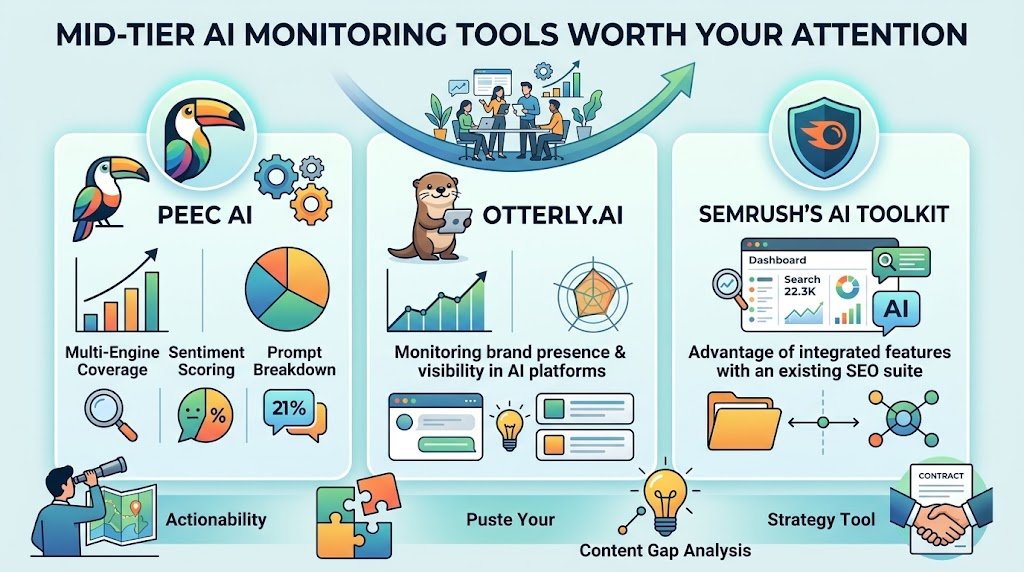
This is where most growing companies land, and honestly where I’d point most people first. Peec AI and Otterly.AI both sit comfortably here — multi-engine coverage, sentiment scoring, prompt-level breakdowns, without the enterprise price tag attached. Semrush’s AI Toolkit fits a slightly different niche: if your team’s already paying for Semrush’s core SEO suite, folding AI visibility tracking into the same login sidesteps yet another tool subscription, and that convenience alone justifies the switch for a lot of teams.
What separates a decent mid-tier tool from a mediocre one usually comes down to actionability. Some platforms just tell you where you stand. The better tools for monitoring brand visibility in AI interfaces like ChatGPT tell you exactly what content gap is causing the miss — that’s the actual difference between a dashboard and a strategy tool.
Enterprise-Grade Platforms
Profound sits at the top of most serious comparisons, and for good reason. Coverage across ten-plus AI engines, agent-level analytics, integrations built for large marketing orgs — that depth justifies the steeper price when AI-driven discovery genuinely moves revenue for you. Scrunch AI plays a similar game but leans harder into compliance, with SOC 2 certification that matters a lot to regulated industries like finance or healthcare.
At this tier, pricing stops being a simple monthly number. Custom quotes, onboarding calls, sometimes minimum contract terms come into play. If your business has real budget behind this, request demos from two or three enterprise vendors rather than assuming the priciest option is automatically the best fit. I’ve watched teams overpay for engine coverage on enterprise tools for monitoring brand visibility in AI interfaces like ChatGPT that they never once actually query.
What This Actually Costs, Realistically
Pricing spans an enormous range in this category — anywhere from about €20 a month to custom enterprise contracts running into the thousands. That gap usually tracks with three things: how many AI engines get monitored, how deep the sentiment and citation analysis goes, and whether the platform bothers giving you content recommendations or just raw tracking numbers.
Here’s a rule of thumb I’ve landed on after watching several clients go through this: pay for engine coverage that matches where your actual customers are asking questions, not wherever the vendor’s pricing page suggests everyone should be. A B2B SaaS company probably cares far more about ChatGPT and Perplexity than about Amazon’s Rufus. A consumer product brand might care a lot about Rufus and barely at all about Copilot. Don’t let a shiny pricing page decide which tools for monitoring brand visibility in AI interfaces like ChatGPT actually fit your business.
AI Visibility vs Traditional SEO Trackers
People confuse these two constantly, and that confusion costs money on redundant subscriptions. A traditional rank tracker like Ahrefs or SEMrush’s core product tells you where a URL sits on a results page for a given keyword. That’s deterministic, or close enough to it. Run the same check twice, get roughly the same answer.
AI visibility tracking is a different animal, because the underlying models aren’t deterministic at all. Ask ChatGPT the exact same question twice on the same day and you can get two different answers, sometimes with entirely different brands named. That’s precisely why tools for monitoring brand visibility in AI interfaces like ChatGPT run large batches of repeated prompts instead of a single query — one snapshot tells you almost nothing reliable on its own. If you’re evaluating standalone rank tracking software separately, a dedicated SEO reporting comparison covers that ground without mashing the two categories together the way a lot of vendor content tends to.
AI Visibility Monitoring vs Brand Reputation Monitoring
People conflate these constantly too, and they’re not the same thing. Brand reputation tools like Mention or Brand24 track what actual humans say about you across social media, news, and forums. Tools for monitoring brand visibility in AI interfaces like ChatGPT track what a model says about you when a human asks it a question instead.
The overlap is real but only partial. A negative Reddit thread might eventually shape how ChatGPT talks about your brand, assuming the model’s trained on or retrieving from that exact thread. But a reputation tool watching that thread won’t tell you whether it’s actually influencing AI-generated answers, and a visibility tool watching those answers won’t necessarily flag the original thread causing the trouble. Running both, budget permitting, closes a gap neither category covers alone.
Why Reddit Keeps Showing Up in Every Single Report
I touched on this earlier, but it deserves more room, because it genuinely surprised me the first time I dug in. AI models — ChatGPT and Perplexity especially — lean hard on Reddit threads when answering comparison or recommendation-style questions. That 40% citation figure floating around vendor research isn’t some small footnote. It’s arguably the single biggest lever most brands are ignoring right now.
Practically, that means your brand’s actual presence, or lack of it, in relevant subreddit discussions can matter as much as your own website content does. Tools for monitoring brand visibility in AI interfaces like ChatGPT that fold Reddit into their tracking will show you exactly which threads are feeding a competitor’s mentions, and that’s actionable information a generic SEO tool just can’t surface, because Reddit visibility was never something rank trackers were built to measure in the first place. A research writeup on AI citation patterns goes deeper into the data behind that 40% number if you’re curious.
What Happens When AI Gets Your Brand Wrong
This one’s a real problem and it doesn’t get talked about enough. Because these models generate text rather than retrieve it verbatim, they can state something about your brand that’s flat wrong — outdated pricing, a discontinued feature, the wrong founding year, or worse, pinning a negative incident on you that actually happened to a competitor entirely.
Tools for monitoring brand visibility in AI interfaces like ChatGPT that flag factual accuracy, not just sentiment, are worth prioritizing if your brand’s been through a recent rebrand, acquisition, or major pivot. Sentiment scoring alone won’t catch a factually wrong but neutrally-worded mention, and that’s exactly the kind of error that quietly misleads a potential customer without ever registering as “negative” on a basic sentiment dashboard.
Common Mistakes Brands Make With These Tools
The biggest one I see, over and over: treating a single week of data as a verdict. Given how much variance exists in AI outputs, a short sampling window can badly mislead a team into either panic or false confidence — neither one useful.
Another frequent mistake is buying the priciest tier without checking whether the extra engine coverage even matches customer behavior. Paying for Grok and DeepSeek monitoring means very little if your actual buyers are asking ChatGPT and nothing else.
A third, more subtle one: ignoring sentiment entirely and fixating only on raw mention volume. A brand mentioned constantly but described unfavorably is arguably worse off than one that’s simply invisible, since negative framing actively shapes buyer perception instead of just failing to help.
And a fourth I’ve watched happen firsthand: setting one of these tools up, checking it obsessively for two weeks, then abandoning it once the novelty wears off. Tools for monitoring brand visibility in AI interfaces like ChatGPT only earn their subscription cost through consistent, ongoing tracking. A one-time snapshot is barely more useful than the free manual check I’ll walk through below.
How Accurate Are These Tools, Really?
This is the part vendor marketing pages tend to gloss over, and it matters a lot. Because model outputs aren’t deterministic, even a well-built monitoring tool is sampling probability, not measuring a fixed fact. Run the same fifty prompts twice in one week and you might see real variance in mention counts, especially on prompts sitting near a competitive threshold.
There’s also a training-data lag worth knowing about. A model’s baseline knowledge might be months, sometimes years, out of date depending on the version, meaning a recent rebrand or pivot might not surface in a default answer for a while regardless of how good your current content is. Tools for monitoring brand visibility in AI interfaces like ChatGPT built on real-time retrieval, rather than leaning purely on a model’s static training, handle this better — but “better” means less bad here, not perfect. Anyone selling one of these platforms as a precise measurement instrument, rather than a directional signal, is overselling what this whole category can currently do.
A Free Manual Way to Check This Yourself
Before spending any money, it’s worth running a basic manual check first. Open ChatGPT, Perplexity, and Gemini separately and ask the exact questions a real customer might ask — something like “what’s the best [your category] for [your use case].” Do this five or six times per platform, varying the phrasing a bit, and just log whatever comes back.
It won’t give you sentiment scoring or historical trend lines, obviously. But it’ll tell you within twenty minutes whether you’ve got a visibility problem worth paying to monitor properly. More than one client has skipped a paid subscription entirely after a manual check showed they were already showing up consistently. If gaps do turn up, a rundown of free and low-cost tracking options is a reasonable next step before committing to any of the paid tools for monitoring brand visibility in AI interfaces like ChatGPT covered above.
A Step-by-Step Setup Walkthrough
If a paid tool does end up making sense, onboarding across most platforms looks pretty similar.
- Define your brand and competitor set. Most tools ask for three to eight direct competitors upfront, since visibility gets measured relative to them, not in isolation.
- Build or import a prompt list. Some platforms generate this automatically from your website content; others expect you to write realistic customer questions yourself.
- Choose your engine coverage. Base it on where buyers actually search, not on the full list a sales rep waves at you.
- Set a tracking cadence. Weekly for smaller plans is common, daily on enterprise tiers.
- Review the first cycle with some skepticism. The first pull tends to be noisy. Give it two or three cycles before drawing real conclusions.
Skipping step one is the shortcut I see most often, and it’s the one that makes reports from tools for monitoring brand visibility in AI interfaces like ChatGPT nearly useless afterward — share-of-voice numbers mean nothing without a clearly defined competitor set behind them.
How Agencies Are Folding This Into Client Reporting
Worth a quick mention if you’re on the agency side rather than in-house. More agencies now build AI visibility metrics into monthly client reports alongside traditional rank tracking and traffic data, treating it as a standard line item instead of some novelty add-on.
The smarter agencies I’ve talked to don’t just screenshot a dashboard and call it a report. They tie the numbers to a specific action taken: a content piece published to close a citation gap, a Reddit engagement push, a page rewritten to be more citation-friendly. Clients respond a lot better to “we did X and mentions went up Y%” than to a raw chart with zero story attached to it, which is exactly why the output of these tools for monitoring brand visibility in AI interfaces like ChatGPT needs a narrative wrapped around it to be worth anything.
Industry-Specific Considerations
Not every business needs the same depth here, and pretending otherwise just wastes budget.
B2B SaaS and developer tools see the heaviest AI-driven research behavior by far, since technical buyers frequently ask ChatGPT or Perplexity to compare options before ever landing on a vendor’s site. This is the segment where tools for monitoring brand visibility in AI interfaces like ChatGPT deliver the clearest return.
E-commerce and consumer products benefit more from tracking shopping-specific surfaces like Amazon’s Rufus and Google’s Shopping-integrated AI features, both of which most budget tools skip entirely.
Local service businesses get comparatively less value from this right now, since AI models still lean on local search data and Google Business Profiles more than open-ended chatbot answers for “plumber near me” type queries. That said, the broader AI visibility landscape for local search is shifting fast enough that it’s worth revisiting this every few months rather than treating it as settled fact.
Healthcare and finance brands face an extra layer of complexity, since factual accuracy carries higher stakes and models are notoriously prone to confidently stating outdated regulatory or pricing details in these specific categories.
A Short Glossary Before You Start Comparing Vendors

This space has developed its own jargon fast, and knowing a few terms will save you some confusion.
- AEO (Answer Engine Optimization): shaping content specifically to be cited by AI answer engines
- GEO (Generative Engine Optimization): a near-synonym for AEO, favored by some vendors over others
- Share of voice: your brand’s mention frequency relative to named competitors across the same prompt set
- Citation rate: how often an AI answer links back to or names a specific source page
- Hallucination: when a model states something false or fabricated about your brand with total confidence
Vendors selling tools for monitoring brand visibility in AI interfaces like ChatGPT don’t always use these terms consistently, so it’s worth clarifying definitions directly with a sales rep rather than assuming two platforms measure the same thing just because they use the same word for it.
How to Actually Pick the Right Tool for Your Team
Start with the engines your actual customers use, not whichever list looks most impressive on a pricing page. Pull up your analytics, check referral sources, see whether AI-driven traffic is already showing up as ChatGPT, Perplexity, or something else entirely.
From there, ask a few practical questions. Does the tool include sentiment tracking, or just raw mentions? Does it show which content earned a citation, or only that one happened? Does pricing scale sensibly as you add engines, or does it jump sharply at each tier? A rundown of AI-focused SEO strategy tools is worth a read for more comparison points before locking anything in, since no single roundup, this one included, covers every vendor equally well.
Don’t skip a trial period if one’s offered. A two-week test against your own brand and your own competitor set tells you more about whether specific tools for monitoring brand visibility in AI interfaces like ChatGPT actually fit your workflow than any case study on a vendor’s site ever will.
Where This Space Is Heading
A few bets seem fairly safe right now. Reddit-specific tracking is going to keep getting more sophisticated, given how central it already is to AI citations. Sentiment analysis will likely get more granular too, breaking down by specific product attributes instead of one blunt positive-negative score. And pricing is almost certainly going to compress as more vendors pile into the space, the same pattern traditional SEO tools went through a decade or so ago.
I’d also bet on consolidation. A handful of these platforms will get folded into the bigger SEO suites, similar to how Semrush absorbed AI tracking into its existing product rather than building a fully standalone competitor from scratch. The next wave of tools for monitoring brand visibility in AI interfaces like ChatGPT will likely compete less on raw engine count and more on how actionable their recommendations actually are.
Quick Checklist Before You Subscribe
- Confirm which specific AI engines are covered at your intended pricing tier, not the marketing page’s full wish list
- Ask whether sentiment scoring is included or a paid add-on
- Check how many prompts run per tracking cycle — a thin sample undermines the whole point
- Look for Reddit-specific tracking if your category leans on community discussion at all
- Ask directly whether the tool flags factual inaccuracies, not just negative tone
- Request a trial period and test it against your real competitor set before signing anything annual
Final Thoughts
If there’s one thing worth carrying away from all this, it’s that tools for monitoring brand visibility in AI interfaces like ChatGPT are still a young category, and young categories always come with more noise than clarity attached. Vendors are moving fast, pricing keeps shifting, and half the language around “AI search optimization” is still being invented in real time by people figuring it out as they go — myself very much included.
That said, the underlying problem is real and it isn’t going anywhere. Buyers genuinely are asking ChatGPT and Perplexity before they ever visit a website, and a brand with no idea whether it’s showing up in those answers is flying blind in a way traditional SEO monitoring simply can’t fix on its own. Whether you start with a free manual check or jump straight into one of the mid-tier tools for monitoring brand visibility in AI interfaces like ChatGPT depends entirely on your size and how much AI-driven discovery already shows up in your own traffic numbers.
My honest take: skip the tool with the longest engine list just because it’s the longest. Pick the one that covers where your buyers are actually asking questions, includes real sentiment tracking rather than a bare mention count, flags factual errors instead of just tone, and hands you something actionable instead of a dashboard you check once a month out of guilt. The gap between knowing you’re missing from an answer and knowing exactly why is where the real value sits, and cheaper tools mostly don’t go that deep.
Start small if you’re on the fence. Run the manual check, see what turns up, decide from there whether one of these tools earns its cost. If your brand keeps showing up as an afterthought, or gets described inaccurately, in AI-generated answers, that’s worth fixing before it quietly becomes the reason a competitor lands the sale instead of you. Get ahead of this now, while the category’s still forming, and you’ll have a real head start once everyone else eventually catches up with their own tools for monitoring brand visibility in AI interfaces like ChatGPT.
Frequently Asked Questions
What exactly do tools for monitoring brand visibility in AI interfaces like ChatGPT track?
Brand mentions, competitor share of voice, sentiment, citation sources, and increasingly, whether a model states something factually wrong about your brand.
Is there a free way to check AI brand visibility without buying software?
Yes. Manually asking ChatGPT, Perplexity, and Gemini the same customer-style questions several times gives a rough baseline reading at no cost at all.
How accurate are these tools, given that AI answers aren’t consistent?
Directionally useful, not precise. Because model outputs are non-deterministic, treat results as trends across many prompts rather than one fixed measurement.
Why does Reddit come up so often in AI visibility reports?
Research suggests Reddit accounts for roughly 40% of AI citations tied to buying questions, making it a bigger factor than most brands realize.
Do small businesses actually need one of these tools?
Not always right away. A manual check often reveals whether there’s a real visibility gap worth paying to monitor before committing to anything.

An IT career coach with 7 years of experience helping beginners map out certification paths that actually lead to interviews, not just another resume line. He’s guided dozens of career-switchers through their first AWS or CompTIA exam and writes for itechnova.io, covering IT certifications, cybersecurity, and the software tools people actually need to know.