


Chai’s ready, let’s actually get into it. Everyone throws around “goseboze AI tools” like it’s some overnight fix for a messy workflow, and half the time it’s just noise dressed up as insight. I’ve burned through more late nights than I’d like admitting, running goseboze AI tools against real deadlines instead of glossy demo footage.
A handful stuck around permanently on my desktop. The rest? Gone within a week, no regrets. What follows isn’t a hype roundup — it’s the stuff that survived contact with an actual deadline.
What Goseboze AI Tools Actually Do
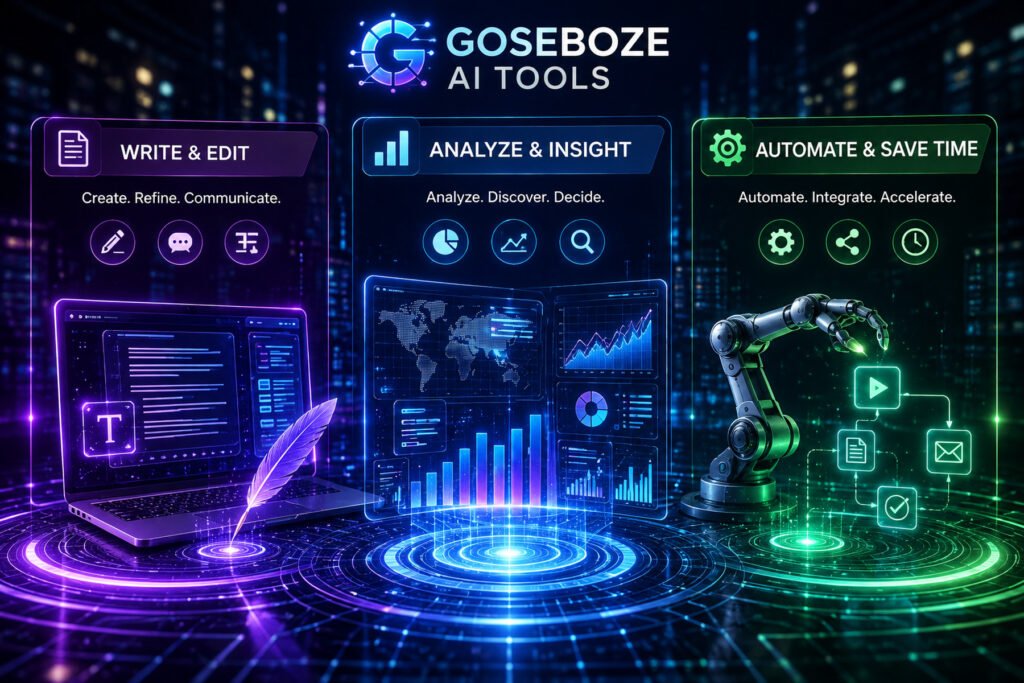
Nobody tells you this part upfront: the phrase “AI tool” has gotten so stretched out it barely means anything specific anymore. A tiny spreadsheet plugin and a sprawling automation system both get slapped with the same three letters now.
The goseboze AI tools worth keeping usually split into three rough camps. Ones that help you write or edit. Ones that chew through numbers and spot patterns you’d miss staring at a spreadsheet for an hour. And a quieter third group — automation that just runs while you’re off doing something else entirely.
Figuring out which camp you actually need first saves weeks of chasing shiny features that never mattered.
Picking Tools That Won’t Waste Time
Most people start with “what’s popular right now” instead of “what’s actually broken in my day.” Backwards order, honestly.
Ask what’s dragging. Research taking too long? Writing the same client reply for the eleventh time this month? The tool needs to fix that exact ache — not dazzle you with a feature list you’ll open once and forget.
If you’re weighing options for a leadership or coordination-heavy role, this product manager picks list breaks down what’s genuinely useful versus what just photographs well on a pricing page.
Saving four minutes a day isn’t worth a subscription. Saving four hours a week is a whole different conversation.
A Straight-Up Comparison Table
Numbers cut through marketing language faster than paragraphs do, so here’s how goseboze AI tools tend to stack up by category, stripped of the sales pitch.
| Tool Category | Typical Setup Time | Best For | Learning Curve |
| Writing assistants | Under 10 minutes | Drafting, editing, outlines | Low |
| Data visualization tools | 30–60 minutes | Reports, dashboards, trend spotting | Medium |
| Automation platforms | 1–3 hours | Repetitive multi-step tasks | Medium to high |
| Visibility and monitoring tools | 15–30 minutes | Brand tracking, competitor checks | Low to medium |
Nothing revolutionary here. But laying it out flat beats scrolling through fifty comparison-article tabs at midnight.
Where Automation Tools Fit In
Automation splits people into two camps — obsessive fans or people who won’t touch it — and honestly, I get both reactions.
Set up badly, it creates more mess than it saves. Triggers break silently. Duplicate emails fire off. Some workflow quietly dies three weeks in and nobody notices until a client asks why nothing happened. Set up well, though, it’s the closest thing to getting hours back without anyone realizing where they went.
Want to see how this plays out beyond theory? There’s a solid automation platform deep dive worth reading before committing to anything.
My rule: automate the boring repeatable grind first. Keep the judgment calls for yourself. AI still can’t reliably tell when a client email needs a softer tone.
Visibility And Data Tools Worth Checking

This is where things get genuinely interesting — and also where most “top 10” listicles start phoning it in.
Visibility tools now track where your brand or content shows up across search results and AI-generated answers, which is a strange new problem that simply didn’t exist a couple years back. Worth a look if you publish regularly — this brand visibility tool guide points toward ones that actually track something meaningful instead of vanity metrics.
On the data side, if raw spreadsheets make your eyes glaze over, a decent visualization tool turns that chaos into something you could explain to a client in five minutes flat. This visual data explorer view covers a few worth testing.
Both categories share one blind spot — they’re only useful if someone actually looks at what they produce. Sounds obvious. Gets skipped constantly anyway.
What The Market Data Shows
It’s not just anecdotal enthusiasm either — the spending trend backs up how fast this space is moving. Worldwide spending on AI platforms and models is projected to climb sharply through 2026, with demand tilting toward tools offering real usage tracking and cost transparency instead of a flashy onboarding screen, according to Gartner’s 2026 forecast on the AI platforms and models market. Gartner
That shift matters for anyone weighing goseboze AI tools right now. Vendors face more pressure to prove real value, not just wow someone in a two-minute demo. Good news for buyers — more tools are getting built to last rather than to impress once and vanish.
What To Watch For Before Committing

A few warning signs show up before you’ve even opened the tool, if you’re paying attention instead of getting swept up.
A pricing page that dodges specifics. No clear line on where your data actually lives. A demo that only ever shows the happy path, never what breaks when something goes sideways. None of these are automatic dealbreakers on their own, but they’re worth pausing over.
One evaluation approach that’s held up well suggests mapping specific goals before testing anything, then digging into how a vendor handles bias, data security, and decision transparency — laid out clearly in this expert evaluation checklist points piece from Forbes.
One thing I’d tack on from personal trial and error — if a free trial pressures you into deciding within 48 hours, that’s usually worth noticing. Tools built to last don’t need to rush you.
A Quick Look At 2025 Options
Even with the calendar having moved on, a chunk of last year’s tool releases are still holding up fine, quietly, without the marketing noise surrounding whatever’s newest.
Worth browsing if your toolkit hasn’t been touched in a while — this fresh new release lineup covers a batch that’s aged better than most.
Not everything trendy survives contact with actual work. A few of these did, and that says more than any launch-day headline ever could.
Mistakes Worth Skipping Entirely
Buying before naming the actual problem. Happens constantly — a slick feature demo gets people excited before anyone asks whether they even need it.
Ignoring how a tool talks to the rest of your stack. A brilliant standalone tool that doesn’t integrate just becomes a second inbox nobody checks.
Sticking with something out of pure sunk cost. If it hasn’t earned its keep after a fair trial run, let it go. No shame in that.
And the big one — treating every AI tool like it’s interchangeable with the next. It isn’t. A writing assistant and a full automation platform solve entirely different headaches, and blurring that line burns both time and budget.
Frequently Asked Questions
Are goseboze AI tools worth paying for, or should I stick with free versions?
Depends entirely on how much you’ll actually use them. Occasional light tasks usually sit fine on free tiers. Daily heavy workflows hit limits fast, and the paid tier often pays for itself within weeks.
How long before I see real value from a new AI tool?
Most show some benefit within the first week, but genuine, measurable time savings usually kick in after two or three weeks of consistent use, once habits actually settle.
Do I need technical skills to set up automation-based AI tools?
Not really anymore — most modern platforms lean heavily on no-code interfaces. Patience during setup helps more than any coding background ever would.
What’s the single biggest mistake people make choosing AI tools?
Picking based on hype instead of a clearly named problem. Chasing “what’s trending” instead of “what’s actually slow in my workflow” wastes subscriptions almost every time.
Can small businesses realistically benefit, or is this mostly built for larger teams?
Small teams often benefit more, honestly, since saved time translates directly into capacity they’d otherwise pay to hire for. Larger teams gain too, just spread thinner across more people.
How do I know if a tool is handling my data responsibly?
Look for a specific data policy, not vague marketing language. Trustworthy vendors spell out exactly where data goes, how long it’s retained, and whether it trains their models.
Should I test multiple tools at once or one at a time?
One at a time gives cleaner signal. Running several together makes it nearly impossible to tell which tool actually caused the improvement you’re noticing.
Is it normal for a tool that looked great in the demo to underperform daily?
Extremely normal, unfortunately. Demos are built to impress in ten minutes flat. Real workflows bring messy data, interruptions, and edge cases no demo ever bothers showing.
Conclusion
So where does all this land? Honestly, the goseboze AI tools that actually stick aren’t the flashiest ones in the room. They’re the ones that quietly do their job without needing constant babysitting. Boring answer, I know — but it’s the one that held up after months of testing, not the one that sounded good in a pitch deck.
The pattern that keeps repeating is this: tools solving one clearly defined problem tend to outperform “does everything” platforms by a wide margin. Focus beats breadth, at least in this space, at least for now. Maybe that shifts as the tech matures further, but right now specificity keeps winning.
Don’t let the sheer volume of options freeze the decision. Pick whichever single pain point is costing the most time this month. Test exactly one tool against it for two weeks straight. Keep it if it earns its place. Drop it without guilt if it doesn’t.
The market’s only getting louder from here — spending climbing, new vendors launching monthly, everyone claiming to be the one tool you need. That noise isn’t fading anytime soon, so the actual skill worth building isn’t “know every tool out there.” It’s “know how to size one up fast, honestly, without falling for the pitch.” That skill outlasts any single product on this list, including the ones recommended above.
Start small. Test honestly. And don’t get talked into a demo that looks too polished to be believable — that’s usually the first sign something’s being oversold.

An IT career coach with 7 years of experience helping beginners map out certification paths that actually lead to interviews, not just another resume line. He’s guided dozens of career-switchers through their first AWS or CompTIA exam and writes for itechnova.io, covering IT certifications, cybersecurity, and the software tools people actually need to know.