

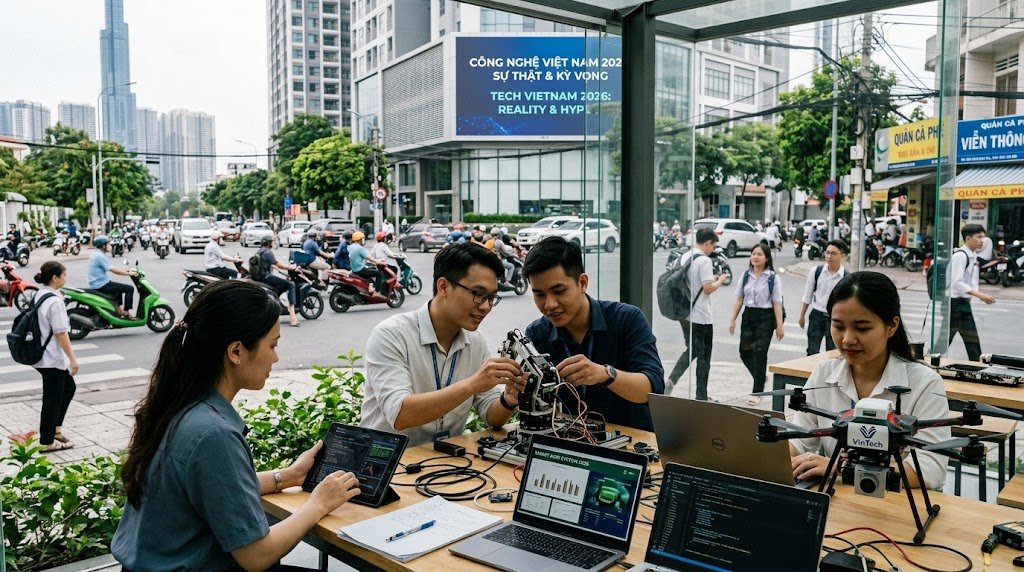
Vietnam ranks seventh in the world for IPv6 adoption. You won’t see that in much vietnam tech news, because the headlines go to chip fabs and AI laws instead, and fair enough, those are more exciting. But the plumbing is the reason the exciting parts are believable. After reading the ministry briefings, company filings and law texts behind the coverage, my estimate is that about two-thirds of it holds up. The remainder is ambition in a hard hat.
If you’ve watched a market like Poland’s tech scene for a while, this will look familiar. Plenty of engineers, a government in a hurry, and news that shows up in scraps. I’ve tried to tape the scraps of vietnam tech news together as of October 2026, and I’ve flagged the numbers that feel shaky.
What Is Happening in Vietnam Tech News Right Now?
Three things dominate. A new legal framework covers AI and digital assets, the first domestic chip fab is being built, and the government wants local software companies to earn serious money abroad. Funding is flowing to bigger companies, which leaves early-stage founders with a thinner year than the headlines suggest.
The best single snapshot of vietnam tech news this autumn came from the Science and Technology Ministry’s briefing on September 30. Digital technology industry revenue for the first nine months was estimated at about 5.387 quadrillion dong, up roughly 32.1% on last year, according to VietnamPlus. At the exchange rate the same briefing used for its monthly figure, I get something near $207 billion, but that conversion is mine, so take it loosely.
Smaller numbers from that briefing interested me more. IPv6 adoption is 67%, second in Southeast Asia. About 34.6 million people hold digital signature certificates, nearly half the population aged 15 to 65. The national data exchange platform has processed 4.86 billion transactions since 2020. Nobody tweets about this stuff, yet it’s the bedrock under every vietnam tech news story about AI.
One caution before going further: “digital technology industry” revenue usually includes electronics manufacturing along with software and telecom, and a lot of that manufacturing is done in foreign-owned plants. Fast growth in the total doesn’t mean Vietnamese firms are keeping the value. I’d keep that filter on for almost every vietnam tech news headline about growth, including some further down this page.
FPT, the Best Single Test

If I had to pick one company to understand vietnam tech news as a whole, it would be FPT. Digital in Asia puts its 2025 revenue at about $2.66 billion. Over the past two years it has been turning an outsourcing business into one that also rents out AI computing, starting with a $200 million AI factory plan with Nvidia announced in 2024. The factories now run GPU clusters in Vietnam and Japan.
First-half 2026 results were good, and they’re the kind of numbers vietnam tech news tends to repeat without context. AI and data analytics revenue passed 1.84 trillion dong, about $71 million, up 54%. Digital transformation revenue rose 23.8% to 9.61 trillion dong. Mirae Asset Securities Vietnam reckons the two AI factories earned over $12 million in the half-year, running at roughly 90% utilization. A broker summary adds net profit up 14.1%, backlog up 32.3%, and global IT services at 72% of revenue.
So far so cheerful. The Investor then published a careful analysis noting that growing AI revenue doesn’t show FPT has moved to pricing by outcome. The company hasn’t said what share of contracts are priced on business results, and it doesn’t break out AI profit. Pre-tax profit from overseas IT services rose 12.1% to a little over 3 trillion dong, slower than revenue. GPUs, power, data centers and training cost money well before they earn any.
Put $12 million in six months next to a $200 million announcement and you get a good utilization signal, not a payback story. FPT has said it wants AI-first work to reach about a third of revenue, which sounds plausible to me. What I can’t tell yet is whether that third will carry margin or just volume. I’d ask the same of any company that announces an “AI factory” in vietnam tech news this year.
Is Vietnam Building Its Own Chips?
Yes, though not at the top of the ladder, which is the part vietnam tech news about chips often skips. Viettel, the military-owned telecom group, broke ground on Vietnam’s first chip fab on January 17, 2026, at Hoa Lac Hi-Tech Park just outside Hanoi. The site is big, about 27 hectares, and the schedule runs to 2030: build first, then technology transfer, then steady operation, if all goes well.
A Báo Đầu tư piece from September calls it a 32nm project. That’s a mature node, mainstream more than ten years ago, so nobody serious expects Hoa Lac to compete with TSMC. The idea is specialized chips, the “small brains” for narrow jobs in industry, vehicles and defense, where domestic supply matters more than density. Even so, the same analysis says getting technology out of foreign corporations is difficult. Viettel needs a way to master the process, not just buy a production line.
Private money is joining in, which gives vietnam tech news a second chip storyline. Geleximco is working through investment procedures for a plant in Hung Yen, with construction expected from November 2026 and first commercial products aimed at early 2028. FPT has announced an advanced testing and packaging facility and, per TNGlobal, made its first commercial chip delivery into Japan. Design, test and packaging are where Vietnam already had a foothold. For adjacent reading on smaller device makers, the supply chain questions overlap.
The national semiconductor strategy, as the US-ASEAN Business Council summarizes it, sets a 2030 shopping list. One domestic fab. 100 design companies. Ten assembly and test facilities. 50,000 design engineers. Annual revenue of $25 billion, with 10 to 15% of the value added at home. After that comes $100 billion in turnover by 2050. My bet is that the fab turns out to be the symbolic goal and the 100 design companies the hard one. A fab is a building you can finance. Design companies need founders, customers and a lot of patience.
Laws That Now Apply
When vietnam tech news turns to regulation, two laws keep coming up. The first is the Digital Technology Industry law, passed on June 14, 2025 and live since January 1, 2026. It offers incentives for AI, chips and data centers, and it treats digital assets as property, which matters once we get to crypto.
Then there’s the AI Law, 134/2025/QH15. Lawmakers passed it on December 10, 2025 with 90.7% in favour, and it started to apply on March 1, 2026. Analysts call it the first standalone, binding AI law in Southeast Asia. It has eight chapters and 35 articles. High-risk systems have to register. Facial recognition without consent and malicious deepfakes are banned outright.
On top of the laws sit the policy papers, and most big targets you read in vietnam tech news come from them. Resolution 57 (2024) called AI a driver of science and digital transformation. Decision 1671, dated August 28, 2026, approved the new national AI strategy through 2030, with a vision to 2045. It wants 60% of businesses using AI, civil servants using it weekly, and 60% of administrative decisions backed by data and AI. In 2021 the goal was top four in ASEAN. Now it’s top three.
Writing a rule is easy. Checking it is hard, and vietnam tech news mostly covers the easy half. A risk-based regime needs people who can audit models, and they’re the same people every company is trying to hire. Next time a shiny new regulation is announced, ask who’s going to check compliance.
The $55 Billion Export Target
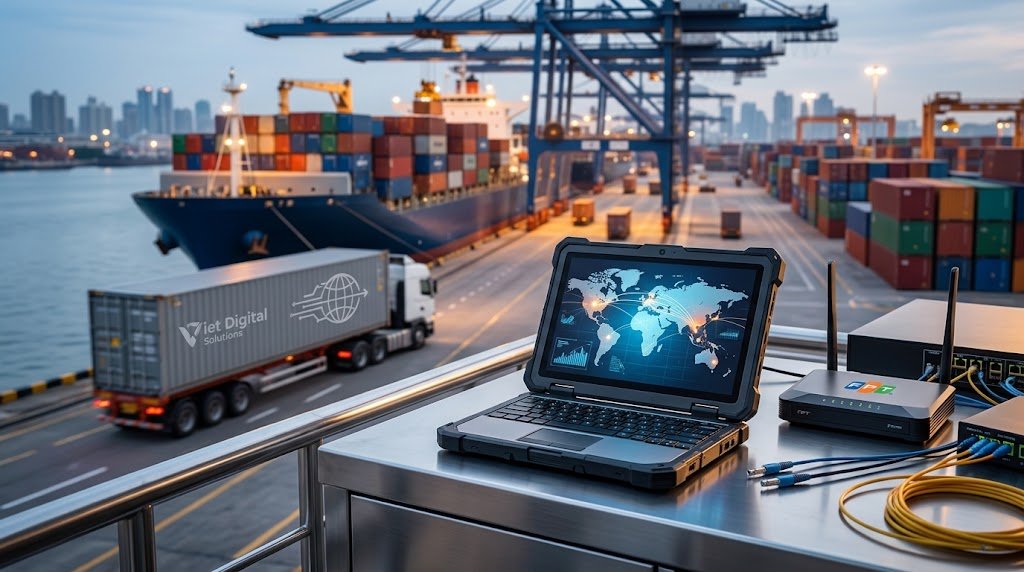
The export push is where vietnam tech news gets most ambitious. In June the government signed Decision 982, a program to help digital technology companies expand abroad through 2030, with a vision to 2045. Targets: at least 5,000 digital technology firms with overseas revenue, at least $55 billion in annual export turnover, and five companies each earning $1 billion or more abroad.
Viet Nam News also cites digital product exports of $20.3 billion, up 39.6%. I couldn’t confirm which period that covers, so I treat it as directional.
On deals, FPT signed six cooperation agreements at business forums in Bangkok and Singapore in late May, spanning AI transformation with partners in agriculture, banking, logistics, energy and manufacturing, according to Tuoi Tre. Payments are another front: State Bank data reported by VietnamPlus on October 1 shows more than 2.5 million domestic acceptance points but only about 154,000, just over 6%, taking the cross-border QR standard.
Now my back-of-envelope worry about the five-company target. If global IT services are 72% of FPT’s revenue, FPT’s overseas business is already well beyond $1 billion by rough arithmetic. The program’s real test is who the other four are, and the list gets short very fast.
Startup Money Is Uneven
Funding data here is a mess, so startup vietnam tech news is hard to quote with a straight face. Tracxn counts 1,424 funded Vietnamese companies as of September 2026 and about $22.2 billion raised in total. For 2026 through August it shows roughly $295 million across 15 equity rounds. One newsletter, citing the same tracker, had only $28.7 million across 8 rounds by May. Both can’t describe the same period. Trackers lag, so I wouldn’t lean on a single source.
DO Ventures’ Vietnam Innovation and Private Capital Report 2026 gives a cleaner picture: $4.5 billion across 149 deals, private equity at a record $4 billion, venture capital back at $509 million. VC deal count fell to 103 while capital rose 28%, meaning fewer, bigger cheques. Another report cited by Vietcetera found the ten biggest deals made up about 72% of value, with little funding between seed and Series A and slow exits.
Ho Chi Minh City has approved a venture fund that starts at 500 billion dong, about $19.7 million. The state puts in 200 billion and private investors 300 billion. The plan is to grow it to at least 5 trillion by 2035 and back 50 to 150 startups. Nationally, NATIF wants about 15 AI application projects in 2026, with grants up to $150,000, then around 50 projects a year from 2027.
At Da Nang’s SURF 2026 startup festival, speakers noted that international venture funds expect fast-growth startups to build products that can compete outside Vietnam. A promising home market, in other words, doesn’t satisfy a global investor on its own.
I see a reset, not a collapse, whatever the loudest vietnam tech news says. For a comparison of how another emerging market copes when late-stage rounds hog the money, look at Egypt’s startup scene. My advice to founders is plain: get revenue before the cheque, because the gap between seed and Series A is where a lot of companies stall.
Crypto’s Slow Road to Licensing
Crypto is where vietnam tech news ran ahead of reality. Resolution 05/2025/NQ-CP, issued on September 9, 2025, set up a five-year crypto pilot. Licence applications opened on January 20, 2026. In April the government talked about a second-quarter launch for the first licensed platform. As of the late-September reports I found, that hadn’t happened.
According to reports from late August and September, five applicants have passed an initial assessment and none has a final licence. The bar is high: at least 10 trillion dong in contributed charter capital (about $383 million) and a 49% cap on foreign ownership. Decree 284 took effect September 1 and sets fines of 180 to 200 million dong for offering crypto services or advertising an exchange without authorization.
The would-be operators make this corner of vietnam tech news fun to follow. MBBank signed with Dunamu, the Upbit operator. Techcombank set up its own exchange entity. VIX Securities partnered with FPT, and SSI Digital signed with Bithumb to explore a local exchange. Once the first licence lands, domestic investors face a six-month countdown to the licensed-platform requirement.
For global price context, our wider crypto market coverage is a good companion. None of this vietnam tech news is financial advice, and licensing status can change in any given week.
Data Centers, 5G and Dead Zones
AI needs compute and power, and that’s where vietnam tech news turns physical. CMC Corp won approval in July 2025 for a $250 million hyperscale data center in Ho Chi Minh City. A G42 and FPT consortium has floated a much bigger one, $2.1 billion, which would be the country’s largest AI campus if it ever proceeds (Digital in Asia). Viettel is reportedly training a Vietnamese-language model with 120 billion parameters. On power, a July VietnamPlus piece tied offshore wind plans to rising electricity demand, partly from data centers.
Telecom is its own chapter of vietnam tech news. Sources told Tahawul Tech last year that Huawei won contracts for parts of the 5G network, which would be a change from the old policy of keeping Chinese vendors out of critical infrastructure. In April 2026 Huawei also signed a strategic deal with SHB bank covering infrastructure, data platforms, cloud, automation and AI.
Then the gaps that vietnam tech news seldom covers. The ministry is working on mobile dead zones in 273 villages and weak or missing coverage at 209 state offices, schools and clinics, and is studying temporary satellite links combined with base stations. A country with 110.5 million mobile internet subscriptions can still have villages where calls don’t connect.
The government also issued a national cybersecurity architecture framework on October 1, setting basic requirements for sharing monitoring data and avoiding duplicate spending under the National Digital Architecture Framework. Dull document, real consequences for procurement.
Foreign Money and Partners

Foreign capital runs through vietnam tech news constantly. Chinese companies alone have about $36 billion registered across 6,386 active projects, per Tuoi Tre’s April 2026 report. New registrations in 2025 hit an estimated $3.64 billion, around 1.3 times the year before. The mix is tilting toward precision electronics. One sore point at the conference behind that report: cross-border payments.
Partnerships in vietnam tech news run in many directions. Singapore is helping expand semiconductor workforce training. Vietnam asked South Korea for help on nuclear power and AI, and Japan for postgraduate scholarships in strategic technologies at a ministerial meeting on October 2. Israel is in talks on cybersecurity and AI, and there’s a safe-AI agenda with China and ASEAN.
Ownership is shifting too. Digital in Asia notes Nvidia (through VinBrain) and Qualcomm (through MovianAI) now own units that used to sit inside Vingroup’s AI business. Good for the engineers, an open question for self-reliance goals.
I read this as a deliberate hedge: Chinese vendors in 5G, American chips in AI factories, Korean and Japanese training money. Mixed signals, by design.
Robots, Drones and the Innovation Scorecard
Not all vietnam tech news is about chips and chatbots. Vietnam’s innovation output ranking rose two places, from 37th to 35th, which hits the government’s 2026 target under Resolution 02/NQ-CP, according to VietnamPlus. For 2030 the goals get bigger. A top-40 finish in the Global Innovation Index. R&D spending of at least 2% of GDP, with non-state money above 60%. Publications growing about 10% a year. Patents growing 16 to 18% a year.
Hardware is part of the picture too. A VinRobotics robot, the VR-H3, joined the robot parade at ICRA 2026, and VietnamPlus has been running pieces on the UAV industry as a driver of what officials call a low-altitude economy. Regional projects are getting physical as well: Can Tho plans a hi-tech park worth over $192 million linking research, incubation and high-value production, and Ho Chi Minh City is developing a specialised digital technology park.
These stories get less attention than AI because there’s no single dramatic number. I’d still watch them. Drones and robots are where software skills, cheap manufacturing and a young engineering workforce overlap, and that overlap is Vietnam’s usual sweet spot. Whether the vietnam tech news of 2027 is about a homegrown robotics champion or another round of memoranda will tell you a lot about how this decade goes.
Dates Worth Bookmarking
Dates beat adjectives when tracking vietnam tech news across months. These are the ones I’d keep, as of October 2026.
| Date | Event | Why it matters |
| June 14, 2025 | Digital Technology Industry Law adopted | Incentives for AI, chips and data centers; digital assets treated as property |
| Sept 9, 2025 | Resolution 05 issued | Starts the five-year crypto pilot |
| Dec 10, 2025 | AI Law passed (90.7% approval) | First binding AI statute in Southeast Asia |
| Jan 1, 2026 | Digital Technology Industry Law in force | Incentives and definitions become usable |
| Jan 17, 2026 | Viettel fab groundbreaking, Hoa Lac | Start of the 2026 to 2030 build |
| Jan 20, 2026 | Crypto licence applications open | Five applicants cleared initial review by late summer |
| Mar 1, 2026 | AI Law in force | High-risk registration; deepfake and facial recognition limits |
| Aug 28, 2026 | Decision 1671 on national AI strategy | Targets run to 2030, vision to 2045 |
| Sept 1, 2026 | Decree 284 takes effect | Penalties for unlicensed crypto services |
| Nov 2026 | Geleximco chip plant construction expected; TECHFEST Vietnam in Hanoi | Private-sector chip push; startup showcase |
The November entries are plans, not facts. When a plan slips, the slip is usually the story.
Jobs, Skills and the Talent Gap
Every plan in vietnam tech news depends on people. The chip strategy wants 50,000 design engineers by 2030 and over 100,000 industry professionals by 2040. FPT wants 6,000 AI engineers by 2028. The AI strategy has all civil servants using AI weekly. A new AI law needs auditors too.
On the supply side of vietnam tech news, a memorandum signed October 1 sets up an AI Centre of Excellence in Ho Chi Minh City linking the state, universities and businesses. Singapore is helping with semiconductor training, and the science ministry is funding AI application tasks of up to about $192,000, with companies covering at least half in cash.
What will employers want? My guess, not a sourced fact: chip verification and design, machine learning operations, data engineering and security. If you’re considering a move, tech hiring trends are worth a skim next to local job boards, since global patterns in AI and security roles tend to reach Vietnamese postings a few months later.
Wages are the awkward part of vietnam tech news that nobody puts in a headline. Foreign acquirers and chip firms already hire from local pools, pulling senior pay up and squeezing startups. A company that can’t match offers tends to lose its best three people first, which is usually enough to stall a roadmap.
What Readers Keep Getting Wrong
A groundbreaking isn’t production, and mixing the two up is the most common error in vietnam tech news. Viettel’s ceremony was in January 2026; the plant’s run is 2026 to 2030. Reading a ceremony as an output milestone is the commonest slip, partly because the photos look finished.
Memoranda aren’t revenue either, though vietnam tech news often files them that way. FPT’s six agreements in Bangkok and Singapore signal intent, not contracts with dollar figures. A cooperation announcement with a foreign ministry means a meeting happened.
Periods matter in vietnam tech news more than people admit. Quarter, year to date, or cumulative since launch? When a number shows up without one, like the $20.3 billion export figure in the reporting I found, it goes in a separate mental drawer with an asterisk.
Revenue is not profit, and AI revenue is not margin; the FPT analysis makes that case well. Government targets are also plans rather than forecasts: top four in ASEAN in 2021, top three in 2026, before the first was tested. None of that makes vietnam tech news fake. It makes it unfinished, and unfinished stories reward patience more than cheering.
Ministry briefings deserve a note of their own. They exist to report progress, and they’re excellent for counting things, less so for judging them. Pair them with outlets that question company claims, and the picture gets much sharper.
Following Vietnam Tech News Without Burning Hours

You don’t need fifty tabs. VietnamPlus, run by the national news agency, carries the ministry’s monthly figures. Viet Nam News and Tuoi Tre News cover policy and deals in English, and The Investor questions company claims. For company numbers, go to investor relations pages and earnings reports; FPT publishes quarterly summaries.
A simple routine for vietnam tech news works. Read the ministry briefing on the last day of each month for figures and the legal to-do list. Read earnings reports for two or three companies each quarter. Keep a running note of dates, since the date is often the most useful thing in an article.
Set alerts on a few words: licence, decree, groundbreaking, AI factory, data center. A decree changes rules, a licence changes who can operate, a groundbreaking starts a clock, and the last two track capacity. Separate folders cut the noise fast.
FAQs
What is the biggest vietnam tech news story of 2026?
Probably the AI Law (in force since March 1) together with Viettel’s chip fab, which broke ground in January. One sets rules, the other builds capacity.
Does Vietnam have an AI law?
Yes. Law 134/2025/QH15 was passed on December 10, 2025 and took effect March 1, 2026. It is risk-based and requires registration for high-risk systems.
Is crypto legal in Vietnam now?
Digital assets are recognized as property and a five-year licensed pilot is underway. At time of writing, based on late-September 2026 reports, no exchange had a final licence.
Is Vietnam a good place to start a tech company?
Recent vietnam tech news shows strong engineering talent, state support and a large domestic market, but funding between seed and Series A is thin, so plan to reach revenue early.
Where can I follow vietnam tech news in English?
VietnamPlus, Viet Nam News, Tuoi Tre News and The Investor cover most of it, with company earnings reports and the ministry’s monthly briefing filling in the numbers.
Final Thoughts
After a year of vietnam tech news, the 2026 story is real enough to take seriously and unfinished enough to doubt. The legal groundwork is further along than most outsiders realize: a digital technology law in force since January, an AI law in force since March, a refreshed AI strategy approved in August, and a crypto pilot with real rules even if no licence has landed. Physical pieces are going up too, from the chip fab at Hoa Lac to FPT’s GPU clusters. Rules, concrete and silicon arriving in the same year is rarer than it sounds for a middle-income economy, and the ministry’s growth figures back it up.
Where I’d stay cautious is the distance between announcement and delivery, a gap that runs through nearly all vietnam tech news. A fab isn’t a chip industry. A city venture fund isn’t a pipeline of Series A companies. The most reliable pattern I found in vietnam tech news is that plans arrive on schedule in the press and a little late in practice, and the interesting analysis lives in that delay.
For founders, I’d say chase revenue and local partners before big cheques. Investors should watch the seed-to-A gap and the exit routes, since that’s where returns get decided. Professionals weighing a move have decent odds in chip design, machine learning operations and security over the next five years. Everyone else should treat each figure as incomplete until they know its period, its source and who is paying for it. That habit alone separates people who understand this market from people who repeat it. I’d also keep one eye on the boring indicators, such as IPv6 adoption, digital signatures and the number of villages without signal, because they move slowly and rarely lie.
If you want to keep tracking vietnam tech news without drowning, the plan is simple: bookmark the handful of sources above, keep a list of dates, and revisit the big storylines each quarter. Check the first crypto licence, the November milestones for the private chip plant and the next two FPT earnings reports. That small routine puts you ahead of most people repeating headlines. And if there’s a sector you’d like broken down further, whether chips, AI, funding or crypto, tell me and I’ll give it its own deep dive.

An IT career coach with 7 years of experience helping beginners map out certification paths that actually lead to interviews, not just another resume line. He’s guided dozens of career-switchers through their first AWS or CompTIA exam and writes for itechnova.io, covering IT certifications, cybersecurity, and the software tools people actually need to know.